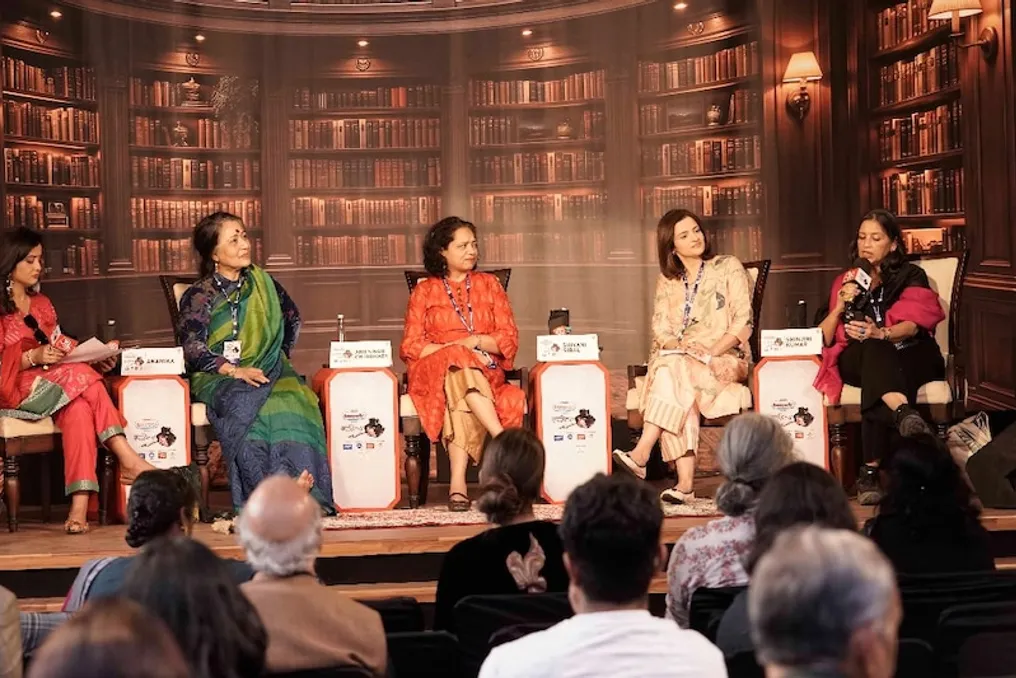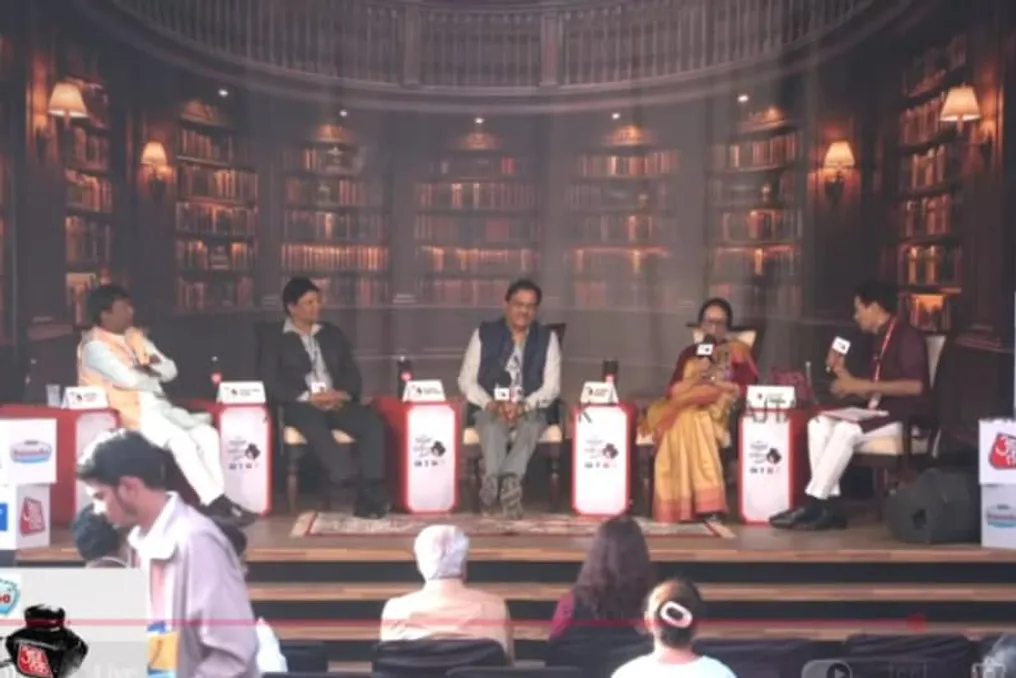
The role of women in Rabindranath Tagore's life and stories related to the Dalai Lama were discussed at the 'Sahitya Aajtak 2026' event
Read more
Aaj Tak
www.aajtak.in

The role of women in Rabindranath Tagore's life and stories related to the Dalai Lama were discussed at the 'Sahitya Aajtak 2026' event

As part of the 'Sahitya Aajtak 2026' event, a special session titled 'The Unfiltered Life: Confronting the Truth Through Biography' was organized. This session featured Dr. Jayshri Purwar, historian and writer Raj Gopal Singh Verma, Indian author and translator Ashutosh Garg, and Arvind Yadav.

At 'Sahitya Aajtak 2026', a special session was held dedicated to the contribution of various literary genres and authors. Authors shared information about their work, books, and literary journeys. Various topics were covered, ranging from translation between Hindi and Bengali to biographies of historical figures and mythological novels.

Author and translator Ashutosh Garg was asked about his book on Ashwatthama, as well as the difficulties of writing about mythological characters and presenting figures like Ashwatthama in a new light. Garg noted that working with mythological heroes brings a certain anxiety because society, especially Hindu society, is emotionally attached to these themes. Therefore, the author has to write with great caution, trying not to distort the original plot of the book.

Garg emphasized that the image of Ashwatthama in people's eyes is largely negative due to his participation in the war on the side of the Kauravas. However, in his opinion, no person can be called entirely good or bad; every good person has flaws, and every bad person has virtues. He wanted to examine the character of Ashwatthama precisely from this perspective to explore his hidden facets, i.e., positive and negative aspects. He believes that changing the view of a character can reveal their untapped sides.

Historian and writer Raj Gopal Singh Verma spoke about an obscure aspect of Subhas Chandra Bose's life that is often overshadowed by his bravery and patriotism. Said Ansari asked him how he portrayed Subhas Chandra Bose's romantic relationships and personal life in his book. Verma reported that Subhas Chandra Bose was married and had a daughter, but these details did not receive wide coverage during his lifetime, and information about his personal life remained limited even later.

He added that during his research, he managed to find numerous documents and love letters in the archives. With their help, he tried to understand Subhas Chandra Bose's private life, as well as events related to his wife and daughter. Verma mentioned that at the time of Subhas Chandra Bose's passing, his daughter Anita was only four months old. His research also included the life of his wife and the subsequent path of his daughter. Anita Bose is a professor of economics at a German university.

Dr. Jayshri Purwar discussed her book 'Rabindranata Ki Nayikaen' (The Heroines of Rabindranath), noting that many women played an important role in the life of Rabindranath Tagore. Among them were his mother, wife, daughter-in-law Kadambari Devi, niece Sarala Devi, Indira Devi, and Maitreyi Devi. She stated that these women inspired Rabindranath Tagore and influenced his life and creativity, as well as helped develop their talents. It was out of curiosity to understand this aspect that she wrote this book. Dr. Purwar also preferred to call him Tagore instead of Rabindranath, as his name is written as Tagore in Bengali.

Author and journalist Dr. Arvind Yadav mentioned his book 'Anashwar', which is dedicated to the biography of the 14th Dalai Lama.
Similar stories

Navatej Sarna speaks on the Jallianwala Bagh and Koh-i-Noor Uprisings, stating that empires do not apologize for their past
Read more
www.aajtak.in

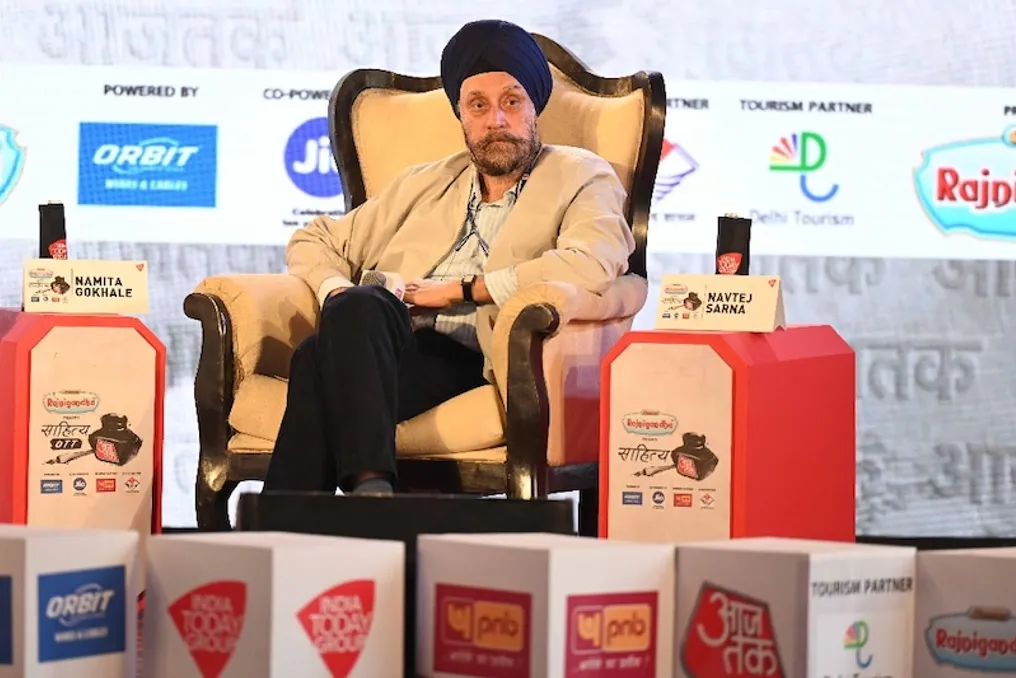
Navatej Sarna speaks on the Jallianwala Bagh and Koh-i-Noor Uprisings, stating that empires do not apologize for their past

During literary discussions held on the third day of the 'Sahitya Aajtak' event in 2026, several authors shared their thoughts on various topics. The session dedicated to the question, 'Why does the past attract writers?' garnered particular interest. Participants included former diplomat and writer Navatej Sarna, renowned writer Namita Gokhale, and former diplomat and writer Lakshmi Puri.

During the conversation, all three highlighted plots from their books and touched upon numerous non-obvious aspects of history, mythology, Indian culture, colonial legacy, and women's empowerment. Important issues were raised concerning the tragedy at Jallianwala Bagh, the return of the Koh-i-Noor, forgotten characters from the Mahabharata epic, the ecological crisis in the Himalayas, and the role of women in Indian traditions.

The authors emphasized that the past enriches not only their creativity but also provides perspective for understanding the present and improving the future.

Former diplomat and award-winning author of the 'Sahitya Akademi,' Navatej Sarna, presented his views on questions such as: 'Why has the British government still not offered an official apology for the Jallianwala Bagh tragedy? Why has the Koh-i-Noor not been returned to India?' He discussed British colonialism, lesser-known pages of history, and the responsibility of writers through the lens of his works in detail.

Refusal of the Koh-i-Noor Project

Navatej Sarna recounted that he was initially supposed to be the third author of a book about the Koh-i-Noor, written by William Delrimple and Anita Anand. He was slated to write the third book, and the contract had already been signed. However, during this period, he was appointed as the High Commissioner of India in Britain. This placed him in a moral dilemma: if he wrote such a book and traveled to Britain, it could complicate the task assigned to him by the Government of India. For this reason, he withdrew from the project himself.

Cannot Wait for Apologies

Addressing the Jallianwala Bagh tragedy and the return of the Koh-i-Noor, Navatej Sarna noted that the injustice committed during colonial rule cannot be denied. Nevertheless, he stated that one cannot simply wait for the Koh-i-Noor to return or for an apology for Jallianwala Bagh to be issued in order to move forward. He recalled that Britain expressed deep regret on the centenary of the Jallianwala Bagh tragedy. At that time, he wrote an article arguing that a mere expression of regret is insufficient. Sarna concluded that it is sad that empires do not apologize for their past. He added that India's dignity lies in the fact that regardless of whether the opponent apologizes for its mistake or not, India must move forward.

Justifications for Refusing the Return of the Koh-i-Noor

Navatej Sarna pointed out the numerous arguments put forth by Britain regarding the return of the Koh-i-Noor. The question arises as to whom it should be returned, since it belonged to Maharaja Ranjit Singh and was associated with Lahore. Pakistan and Afghanistan have also made claims regarding this. He noted that regardless of whether the Koh-i-Noor is returned, future generations can be told where, how, and under what circumstances it was acquired.

Translating His Father's Stories

Navatej Sarna also shared his experience translating his father's stories about the partition of India. His father wrote about a hundred stories on the partition, from which Sarna selected thirty. Sarna said, 'If you cried reading these stories, I cried translating them. I heard my father's voice.' He explained that his father personally experienced the tragedy of partition and lost his sister. The main goal of his work was to show that there are good and bad people in every religion, and that hope in humanity should not be lost even in the toughest times.

Historical Date of Flags

In his new book, which mentions the history of the national flag, Navatej Sarna clarified that the commonly held belief that the tricolor was hoisted over the Red Fort on August 15, 1947, is incorrect. According to him, the flag was hoisted over the Red Fort on August 16, 1947. The day before, on the evening of August 15, the flag was publicly hoisted at Prince Park near the India Gate. He urged people to respect the national flag and observe the related rules.

Poetry Discussion at the Sahitya Aajtak 2026 Event in Delhi
Read more
www.aajtak.in

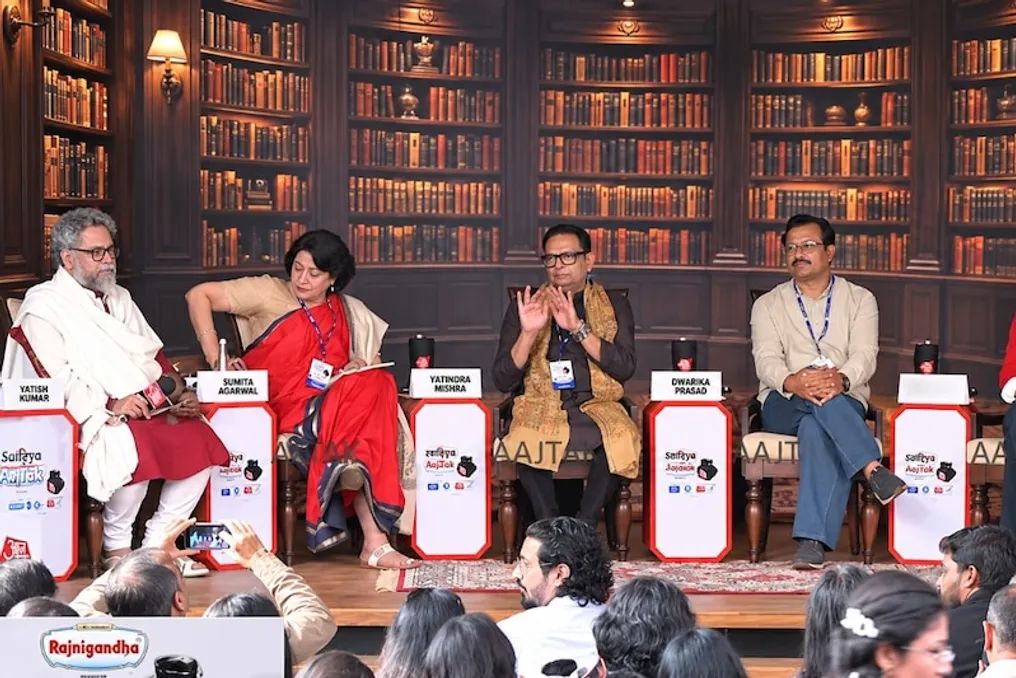
Poetry Discussion at the Sahitya Aajtak 2026 Event in Delhi

The third and final day of the Sahitya Aajtak 2026 event is taking place at the Major Dhyan Chand Stadium in Delhi. This three-day event gathers prominent figures from the worlds of literature, poetry, cinema, politics, music, and art. In the first two days, various sessions attracted public attention, and on the last day, diverse facets of poetry and literature were presented.

As part of the special session 'Today's Poetry, Current Poetry, Your Poetry' at Sahitya Aajtak 2026, renowned literary and poetic figures participated, including Dr. Sumita Mishra, Yatindra Mishra, Yatish Kumar, Dwarika Prasad Uniyal, and Anamika Anu. During the discussion, the process of creating verses, the creativity of the new generation, and the connection between poetry and the poet's personal experience were discussed.

Anamika Anu shared her journey in creating verses, recounting that her journey began in Bihar and continues in Kerala. She traveled from lemon groves to coconut plantations, and the transition from Maithili to Malayalam enriched her. It was among these diverse cultural ideas that her poetry was born.

Dwarika Prasad Uniyal spoke about the writing of the younger generation and methods of self-expression. He noted that the approach of the youth differs from previous generations. In his opinion, the youth read and write, but their manner of writing is more candid. He added that sometimes this youth can be 'politically incorrect,' and instead of suppressing their expression, they need to be guided in the right direction. He believes this is a 'real generation, not reels,' and emphasized the importance of directing their self-expression correctly. Uniyal also mentioned social media, noting that it has provided the youth with a large platform to express various viewpoints, and he is convinced that poetry remains a part of youth life.

Yatish Kumar discussed the interconnection between literature and humanity, stating that approaching literature makes a person better, and a better person becomes a better leader. He explained the difference between poetry and prose: poetry penetrates inward, whereas prose follows you. In his view, these are completely different things, and poetry is like grass growing on the soil of experience.

Yatindra Mishra revealed the power and influence of poetry, saying that poetry is like coal. He clarified that one cannot control whether this coal will turn into ash or a torch. Speaking about his literary journey, he mentioned starting literature at the age of 18 and interacting with his mentor and famous poet Kunwar Narayan. He recounted telling Kunwar Narayan about his desire to change the world with his thoughts, to which he replied that 'the country will not change through Ramayana-Mahabharata, but through your poetry.' According to Yatindra Mishra, Kunwar Narayan taught him to change himself and see this change through his poetry.

Dr. Sumita Mishra, an Indian Civil Services officer from the 1990 batch, writer, and poet who worked in senior administrative positions in the Haryana government, discussed the link between her work and poetry. She shared that many bitter experiences gained during her work became part of her poetry. She noted that some things she cannot say at work, she can express through poetry. She presented her experience through two lines of poetry and said that where there are limitations, poetry serves as her support for self-expression.

Throughout the session, poetry was viewed not merely as a genre of literature, but as something connected to experience, self-expression, and social change. The speakers demonstrated through their experiences how poetry penetrates a person, is born from personal experience, and how its form changes over time.

Sahitya Aajtak 2026 continues to showcase many facets of poetry and cinema. On the previous day, poets gathered audiences with their works at poetry evenings and mushairas. Poems on themes of humor, emotions, and daily life were performed on stage and highly appreciated by the audience. The three-day Sahitya Aajtak 2026 event takes place in Delhi at the Major Dhyan Chand National Stadium from November 27 to 29, providing a platform for the exchange of experiences and ideas with major figures from the worlds of literature, music, art, film, and thought.

Discussion at 'Sahitya Aajtak': Instead of War, Women Should Become Warriors of Dialogue
Read more
www.aajtak.in

Discussion at 'Sahitya Aajtak': Instead of War, Women Should Become Warriors of Dialogue

During the second day of the 'Sahitya Aajtak' event in 2026, interesting discussions took place regarding literature, cinema, female discourse, and freedom of expression. In a special session titled 'Beyond the Pages: Fiction, Yatharth aur Imagination,' writer and poet, Dr. Anamika, recipient of the Academy of Literature award, writer Shinjani Kumar, and screenwriter Anu Singh Chaudhary participated.

These three writers shared their thoughts on topics such as realism and imagination in literature, female entrepreneurship, patriarchy, and the boundaries of language. A debate was also discussed concerning the portrayal of Sita's mother in the film 'Ramayana' and the use of the address 'tum' (you) to Lord Rama.

Responding to the question about portraying Sita's mother as a warrior in the film 'Ramayana,' Dr. Anamika noted that there is also a form of psychological warfare. Women wage a battle for their subconscious through language, which is the most effective tool in this psychological war.

She emphasized: 'We should not become like men; men should become like us. Therefore, communication is necessary. Resorting to violence is not a solution.' Anamika cited an example from her novel where her Sita manages a school in the forest, teaching tribal children not to plan revenge. Even Shurpanka and Shambuk are taught in this fictional school. In her view, the new Sita should be taught to resolve problems through dialogue, not war, which is possible thanks to the power of education and language.

Regarding the dispute about Sita's mother addressing Lord Rama with 'tum' in the film, Anamika stated that she had not watched the film. Nevertheless, she believes that outsiders should not interfere in the relationship between two people. She argued: 'Who are we to spy on how two men and women talk? Whether they say 'tu' or 'tum' to each other is not a subject for public debate. It is a game, and we cannot censor it.'

Citing examples from religious and Sufi literature, she added that even devotees address God with 'tu'. In the private world of love, no dictates can exist.

Screenwriter Anu Singh Chaudhary spoke about the boundaries of language in creativity and freedom of expression. She raised the question of why, when men use certain language towards women, it is not considered violent, but when women use the same language, it is declared violent. She questioned: where does the boundary of language begin and end, and who determines it?

Anu Singh Chaudhary shared that as a screenwriter, she tries to remain honest to her characters and the story. Often, sincerity and boldness in writing texts are lost when trying to please everyone.

Writer Shinjani Kumar mentioned her childhood experience and time spent in Munger, Bihar. She recounted that in the linguistic environment in which she grew up, profanity was part of daily speech. When she started writing poems in Hindi, the language of that environment appeared in her poetry. She mentioned the tradition of singing songs with profanities at weddings in Bihar, calling it the voice of collective resistance of women.

Anamika countered that women do not need to imitate men to insult. Through the power of metaphor and allegory, one's thought can be expressed convincingly through satire and humor.

Shinjani Kumar shared her research experience for her book 'Busy Women.' She visited 30 small towns across the country and surveyed 300 women. During this trip, she discovered a surprising fact: in places where patriarchy is stronger, women are more open in expressing their opinions.

She gave the example of an entrepreneur from Patna who, after her husband's death, decided not to stay at home but to start a business servicing elevators. This woman has been working in the field of elevator installation and maintenance for 20 years and now runs its production.

Shinjani Kumar also questioned the financial support provided by governments to promote female entrepreneurship. She noted that governments compete by offering women 10,000, 20,000, or 40,000 rupees, but money alone is not enough to create a successful entrepreneur. She stated that if money could make anyone an entrepreneur, all the children of wealthy people would become successful businessmen. Favorable social and cultural conditions are also necessary for business success.

She insisted on the need to link traditional arts and skills with economic activity, noting that if an artist cannot support a family with their art, they will abandon it for another job, leading to the disappearance of many traditional arts in the country.

Dr. Anamika continued the theme in her book 'Door Desh Ke Parinde' that relationships between a man and a woman are not always physical.

Popular