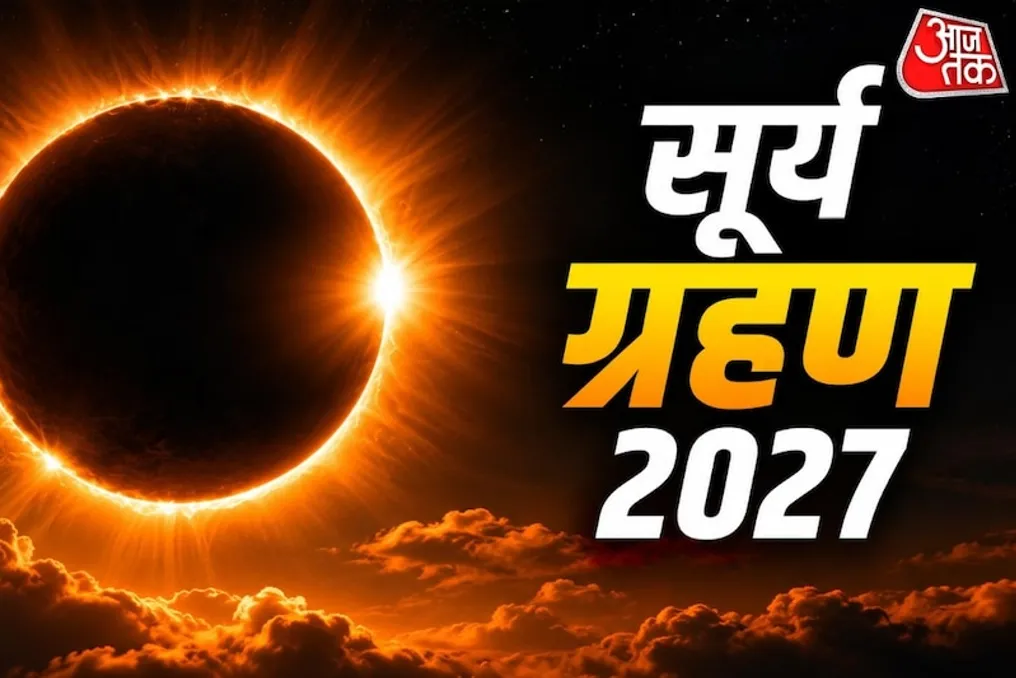
Information on the first solar eclipse of 2027: date, visibility in India, and the Sutak period
Read more
Aaj Tak
www.aajtak.in

Information on the first solar eclipse of 2027: date, visibility in India, and the Sutak period

The year 2027 is considered special from an astronomical perspective as various celestial events, including solar and lunar eclipses, are expected in the sky. From religious and astrological viewpoints, eclipses are considered significant because their influence extends not only to the 12 zodiac signs but also to the entire world.

The first solar eclipse in 2027 is scheduled for February. A distinctive feature of this event is that it will be a ring solar eclipse. This means that a luminous ring will form around the Sun.

When will the first solar eclipse of 2027 occur?

The first solar eclipse of 2027 will take place on February 6th, a Saturday. It will be a ring eclipse where the Moon is positioned between the Sun and the Earth but is unable to completely cover the Sun. As a result, the side of the Sun remains illuminated, creating the impression of a bright fiery ring in the sky. In science, this phenomenon is known as the 'Ring of Fire.'

Will the solar eclipse be visible in India?

The solar eclipse occurring in February will not be visible in India. The reason is that it will be nighttime in India at that time, and the Sun will not be visible. Consequently, residents of no part of the country will be able to observe this eclipse.

Will the Sutak period be observed in India during the solar eclipse?

The Sutak period accompanying the solar eclipse holds great religious significance. According to beliefs, the Sutak period begins 12 hours before the start of the solar eclipse. During this time, temples are closed, and auspicious rituals are prohibited, although it is considered proper to recite the name of God and chant mantras.

However, since the first solar eclipse of 2027 will not be visible in India, the Sutak period will also not be applicable in the country.

In which countries will the first solar eclipse be visible?

The solar eclipse on February 6, 2027, will be observable in certain regions of South America, Antarctica, and Africa. Additionally, it can be seen in some areas of the Atlantic Ocean.

How many solar eclipses will occur in 2027?

Two solar eclipses are expected in 2027. The first, on February 6, 2027, will be a ring eclipse and will not be visible in India. The second solar eclipse will take place on August 2, 2027, and it will be a total solar eclipse, the partial observation of which may be possible in some parts of India.

Similar stories

Five Eclipses in 2027: Information on Dates and Sutak Periods in India
Read more
www.aajtak.in

Five Eclipses in 2027: Information on Dates and Sutak Periods in India

The year 2027 promises to be astronomically significant as it will feature only five eclipses: two solar and three lunar. Particular attention is drawn to the total solar eclipse that will occur in August.

If you are interested in these celestial phenomena, you should know when they will take place in the new year and which ones will be visible in India.

The first eclipse will take place on February 6, 2027, and will be a ring solar eclipse. During this event, the Moon will pass in front of the Sun but will not be able to completely cover it, resulting in a glowing ring around the Sun known as the corona. However, this eclipse will not be visible in India.

The second eclipse in February is scheduled for February 21, 2027, and will be a partial lunar eclipse. In this event, the Moon will pass through the Earth's outer shadow, slightly reducing its brightness. Unlike a total lunar eclipse, the Moon will not turn red or dark.

The third eclipse of the year will occur on July 18, 2027, and will also be a partial lunar eclipse. During this period, a light shadow from the Earth will fall on the Moon, causing a slight change in its luminosity. Such eclipses are usually difficult to notice.

The total solar eclipse in August, which will happen on August 2, 2027, is one of the most significant astronomical events of the year. During this time, the Moon will completely cover the Sun, and darkness will prevail temporarily during the day in regions where it is visible. This eclipse will be observed in many countries, including Spain, Morocco, Algeria, Tunisia, Libya, Egypt, and Saudi Arabia; in India, it will be partially visible.

The fifth and final eclipse of the year will take place on August 17. This will be a partial lunar eclipse, where the Earth's outer shadow touches the Moon, which may lead to a slight decrease in its brightness.

Rules of the Sutak Period During Eclipses

According to religious beliefs, the Sutak period begins 12 hours before a solar eclipse and 9 hours before a lunar eclipse. During this time, specific rules regarding prayers, rituals, and food intake must be observed. Nevertheless, according to traditional views, the Sutak period is considered valid only if the eclipse is visible in that location. Therefore, to determine its applicability in India, one must consult local Panchang calendars.

Precautions When Observing a Solar Eclipse

Caution must be exercised when viewing a solar eclipse directly, as it can harm the eyes. To view it safely, certified solar filter glasses should be used; viewing the Sun with regular sunglasses is unsafe. A lunar eclipse, however, can be observed with the naked eye without special protective devices.

Bhadra will begin on the evening of Devutani Ekadashi 2026; auspicious time for worship is limited
Read more
www.aajtak.in

Bhadra will begin on the evening of Devutani Ekadashi 2026; auspicious time for worship is limited

According to the Hindu Panchang, on the day of Devutani Ekadashi, which falls on November 20th, the influence of Bhadra will last from the evening until 7 AM and until 6:31 AM on the following day, November 21st. Since the Moon is in the sign of Pisces on this day, the influence of Bhadra is felt on Earth. Bhadra manifests on Earth when the Moon is in the signs of Cancer, Leo, Aquarius, and Pisces.

Devutani Ekadashi is being observed today. There is a belief that on this day, Lord Vishnu awakens from yoga-nidra, after which auspicious and sacred deeds begin. Usually, people perform the ritual of awakening the deity in the evening, but today finding a suitable time for this will be extremely difficult due to the presence of Bhadra.

According to the Panchang, the Ekadashi date will be valid from November 20th at 7:15 AM until November 21st at 6:31 AM. Based on the time of sunrise, Devutani Ekadashi is considered valid on Friday, November 20th.

The Hindu Panchang indicates that on the day of Devutani Ekadashi, November 20th, Bhadra will be active from 7 PM until 6:31 AM the next day, November 21st. Since the Moon is located in the sign of Pisces on this day, the influence of Bhadra extends to the Earth's surface. Bhadra activates on Earth only when the Moon is in the signs of Cancer, Leo, Aquarius, and Pisces.

Three auspicious time intervals are provided on the day of Devutani Ekadashi. The first is Abhijit Muhurta, the second is Vijay Muhurta, and the third is Goduli Muhurta in the evening. Abhijit and Vijay Muhurta are suitable for performing religious rituals and worship. At the same time, Goduli Muhurta is recommended for awakening the Lord, during which Vishnu should be awakened and proper worship rituals performed.

Abhijit Muhurta time: from 11:45 AM to 12:28 PM. Vijay Muhurta time: from 1:53 PM to 2:35 PM. Goduli Muhurta time: from 5:26 PM to 5:52 PM.

In the tradition of Sanatana Dharma, Devutani Ekadashi is revered as the festival of Lord Vishnu's awakening. According to beliefs, Vishnu enters yoga-nidra with Ashadha Shukla Ekadashi. This period of rest is called Chaturmas, during which weddings and other auspicious ceremonies are suspended. With the arrival of Kartika Shukla Ekadashi, when Lord Vishnu awakens, Chaturmas ends. After this, events such as weddings, Griha Pravesh pujas, Mundan, and other festive events resume, making Devutani Ekadashi extremely important from a religious and spiritual point of view.

On the day of Devutani Ekadashi, special worship of Lord Vishnu and Goddess Lakshmi is customary. Devotees should start the day with a morning bath and thorough cleaning of the place of worship. Then, the idol or image of Lord Vishnu and Goddess Lakshmi should be purified and decorated with new clothes and flowers. Lord Vishnu is bathed with a garland, tilak is applied, and flowers are offered. Using yellow flowers is considered auspicious. Next, seasonal fruits and other offerings, including tulsi leaves, must be presented to the deity. During the worship, a lamp should be lit, a gong should be rung, and hymns should be sung, praying for the awakening of Lord Vishnu. Concluding the ritual, one should pray for the well-being, peace, and happiness of the entire family.

Popular