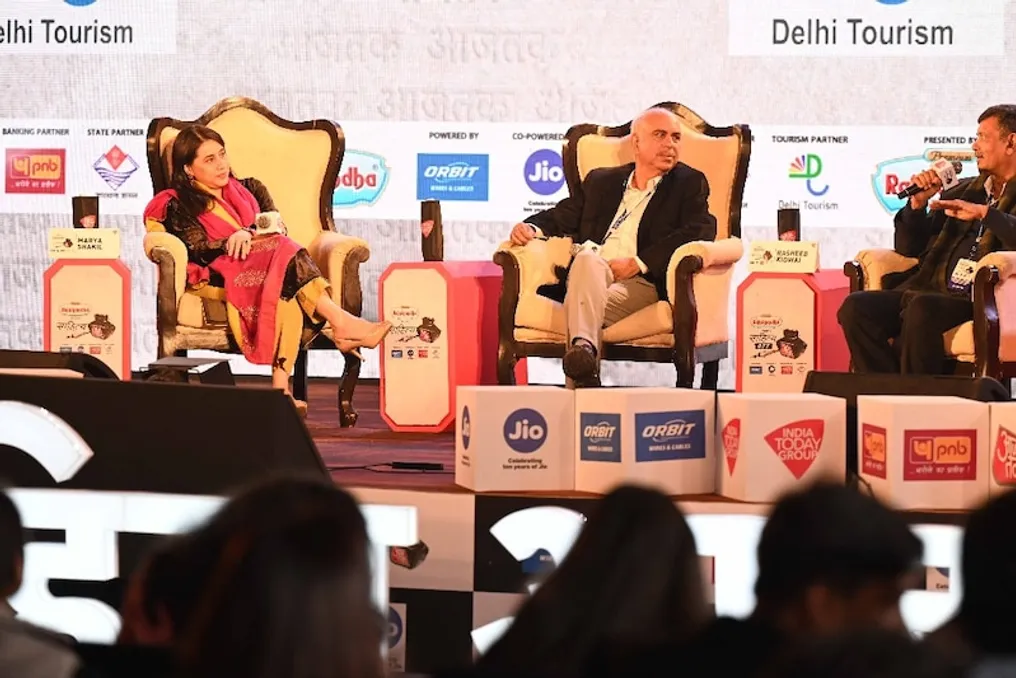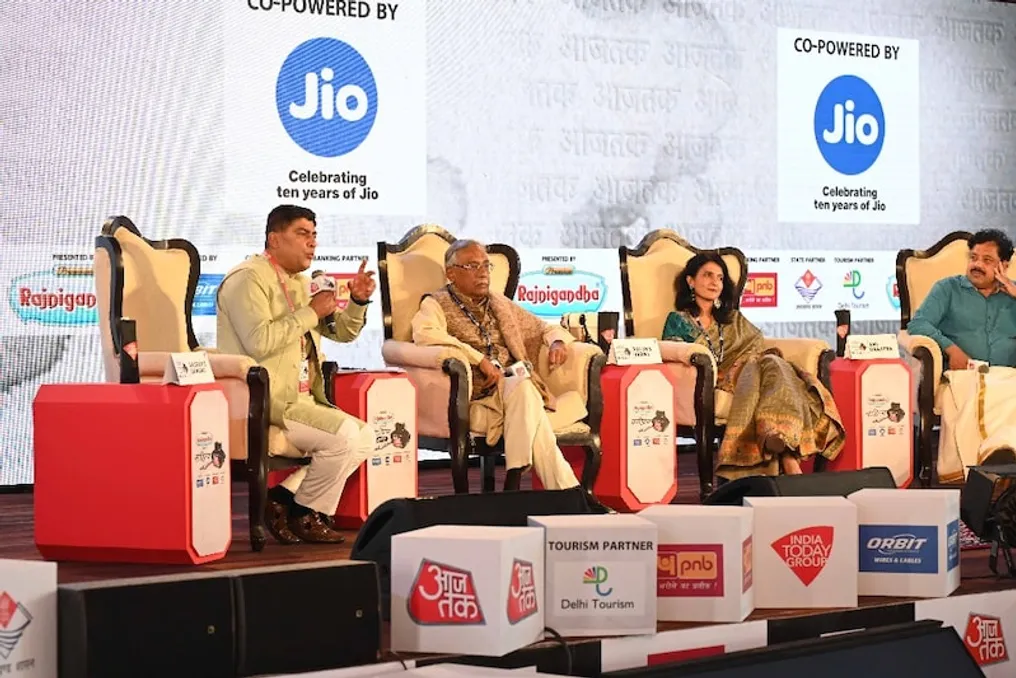
An interesting discussion titled 'Exploring Indian Consciousness: History, Narrative, and Us' took place on the 'Sahitya Aajtak' platform. Former diplomat and writer Pawan K. Verma, writer Ami Ganatra, and author Anand Neelakantan participated in the special session 'History, Narrative, and Us: Exploring Indian Consciousness.' They discussed issues of Indian civilization, cultural unity, ancient texts, and scientific approaches, sharing their views on these topics.
Pawan Verma suggested that British colonial thought assumed India would not exist without them, believing it was divided into many parts that were later unified into a nation. However, in his view, the strength of its culture has connected India for millennia. He cited Adi Shankaracharya, who founded temples in Shringeri in the south, Dwarka in the west, Puri in the east, and Jyotirmath in the north in the 8th century, thereby unifying India despite the presence of different empires, states, and languages.
Writer Ami Ganatra noted that in India, there are hardly any places where people's names do not include the names Rama or Krishna. She gave the example of Periyar in South India, whose name Ramasamy contains the name Rama. She emphasized that Rama unites not only Indian culture but also the cultures of Southeast Asia; even the kings of Thailand use the name Rama, and the old capital Ayutthaya is inspired by Ayodhya.
Author Anand Neelakantan questioned the trend of searching for modern scientific inventions in ancient Indian texts. He stated that one of the main features of Indian civilization is its logical thinking, but attempts to find an atomic bomb in the Mahabharata lead to the loss of this very trait. He questioned on what basis one can speak of an atomic bomb in an era when people fought wars on horse-drawn chariots. He also criticized the attempt to link the episode of Ganesha with plastic surgery.
Anand Neelakantan added that India's contribution to world culture is much more significant, and its importance should not be diminished by searching for fictional sciences in great philosophical works.
Pawan Verma agreed with Anand Neelakantan on this matter. He noted that colonialism breeds a feeling of inferiority regarding one's own culture and history. He believes that excessive glorification of one's past is a reaction to this. He stated: 'There was no atomic bomb; the explosion was an explosion of original thought. Original thought was the atomic bomb of India.'
Verma also stressed that India has made significant contributions to fields such as philosophy, music, art, architecture, ecology, political science, and metallurgy, and this contribution needs to be re-evaluated now.
Ami Ganatra shared a personal experience: while working in a German company in Hong Kong, a three-day leadership training was organized. During this training, she told her British instructor that his training method reminded her of the teachings of Lord Krishna to Arjuna. The instructor replied that he had studied the Mahabharata, Vedanta, and Bhagavad Gita in Rishikesh for four years and developed the leadership course based on these studies, for which he charged thousands of euros.
Ami asked why people have forgotten to learn from their sacred texts while being taught by them abroad.
During the discussion, various opinions arose regarding the political and cultural unity of India. Anand Neelakantan argued that the Ramayana and Mahabharata unite India culturally, but the document that supports its political unity is the Constitution of India.
Meanwhile, Pawan Verma considered the concept of the modern nation-state relatively new. He argued that the absence of political unity does not mean the absence of cultural and civilizational unity in India. Ami Ganatra cited the concept of the universal ruler in the Ramayana and the expeditions of Yudhishthira for Rajasuya Yajna in the Mahabharata, showing that the concept of political unity was present in ancient texts.
Pawan Verma also expressed concern about the growing distance of the new generation from Indian languages. He explained that language is not just a means of communication but also a path to connection with culture, folk tales, and the native land. He urged the new generation to maturely integrate into their culture, avoiding both feelings of inferiority and excessive glorification of their past. The most important thing is acquiring knowledge about one's culture.