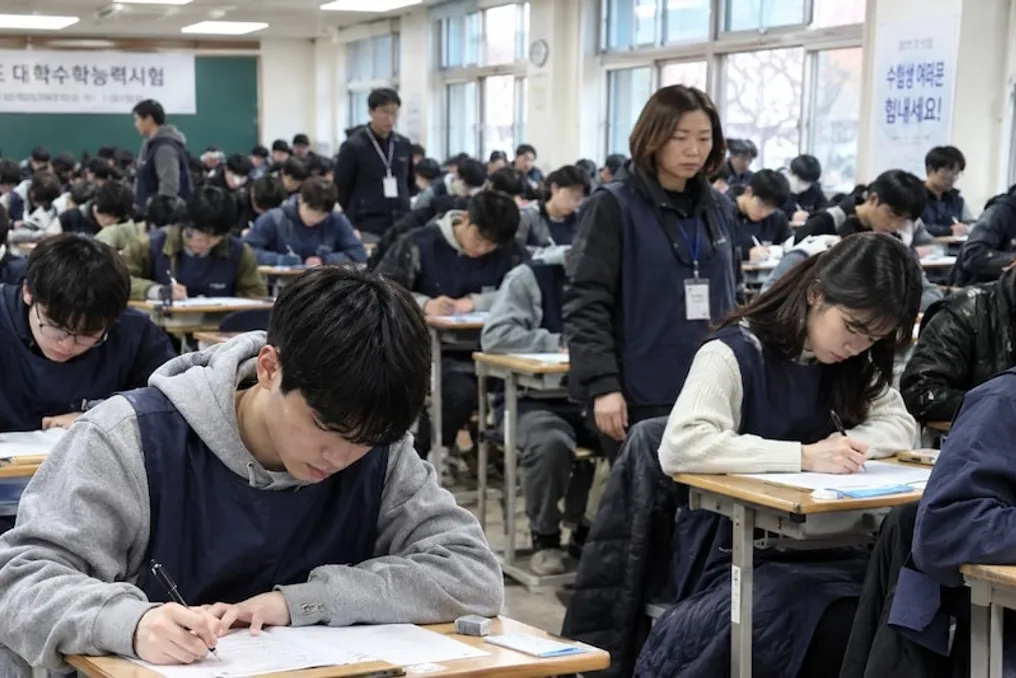
South Korean universities implement strict anti-cheating measures using AI, including aprons and glasses stickers
Read more
Aaj Tak
www.aajtak.in

South Korean universities implement strict anti-cheating measures using AI, including aprons and glasses stickers

Universities in South Korea have adopted unique rules to combat the increasing use of electronic devices and artificial intelligence (AI) for cheating. According to a report by the South Korean news agency Yonhap (YNA) on the Korea Now platform, at one university in Seoul, students take exams while wearing aprons to prevent the use of miniature cameras hidden in clothing or buttons. In other instances, stickers are applied to glasses, and requirements are set for hair to be tied back to expose the ears.

These unusual measures were introduced due to the rise in cheating incidents involving electronic gadgets and AI. Specifically, during one university essay exam, candidates were issued aprons. This unconventional practice was observed at a university in the capital of South Korea, where examinees were required to wear aprons.

According to the Korea Now digital platform from YNA, the increase in cheating cases using electronic devices and AI has caused serious concern within South Korea's education system, prompting universities to begin implementing very strict and unusual security measures.

The apron at a university in Seoul is part of an enhanced security system. Its purpose is to prevent students from using miniature cameras that they might conceal in their clothing or shirt buttons. Students who refuse to wear the apron undergo a thorough metal detector check after the exam.

Other prestigious universities in South Korea have also taken several stringent steps to limit cheating. Soongkukkwang University has completely banned students from bringing pens and pencils from home; they are only allowed to use writing instruments provided by the university itself.

At Sukmyung Women's University, additional requirements have been established: earplugs are prohibited, and female students are required to tie their hair back so that their ears are clearly visible. Furthermore, special stickers are placed on students' glasses after inspection to prevent the possibility of replacing them with smart glasses during the exam.

A major political and administrative scandal arose in connection with alleged AI-assisted cheating during this year's National College Entrance Exam. The South Korean Minister of Education, Choe Kyo-jin, resigned, taking moral responsibility for the controversy. The Ministry of Education reviewed the security protocols at 46 universities conducting their own entrance exams.

President Lee Jae-myung stated his determination to fight cheaters and those involved in cheating cases. He emphasized that culprits would be found and severely punished by the end, and informants (witnesses) about cheating would receive a reward of at least 100 million won (South Korean currency) per case.

Similar stories

South Korean Education Minister Resigns Over AI Exam Measures
Read more
noticiasaominuto.com

South Korean Education Minister Resigns Over AI Exam Measures

South Korea's Minister of Education, Choi Kyo-jin, announced his resignation due to contradictions arising from last-minute measures approved to prevent the use of artificial intelligence (AI) in university entrance exams.

Choi submitted his resignation statement after the exam concluded last Thursday. He announced this in a ministry statement distributed by the South Korean news agency Yonhap.

The official explained that various measures were approved immediately before the examination during preparation, which caused 'inconvenience' for students. He stated that as the responsible minister, he could not avoid criticism for failing to prepare them in advance.

Several days before the exam, South Korean authorities announced a series of measures to combat AI cheating. These measures included banning electronic devices in classrooms, checking candidates' glasses, and covering all clothing buttons with stickers.

Authorities even resorted to sending emergency alerts to students' mobile phones to check if they had phones on them during the exam. Despite this, at least 111 violations related to electronic devices were discovered.

According to the Ministry of Education, 54 violations were identified through emergency alerts, while another 52 were found during various checks, and in five cases, the use of devices during the exam was confirmed, including AI glasses and miniature cameras.

The increased scrutiny followed an admission by the top scorer in the tax accounting exam on Sunday, who confessed to using a miniature camera to send AI questions and view answers on a mobile phone, causing a wave of concern across the country.

South Korean President Lee Jae-myung called for 'exemplary sanctions' for students who commit violations in national exams in light of the growing use of AI for exam cheating on Friday.

98 exam participants detained in South Korea for attempting to use AI for cheating
Read more
www.aajtak.in

98 exam participants detained in South Korea for attempting to use AI for cheating

In the age of artificial intelligence, methods of cheating on exams are rapidly transforming. The problem is no longer just about hiding notes or mobile phones in the testing center; new difficulties are being created by the use of gadgets such as smart glasses, miniature cameras, and wireless headphones, which threatens the transparency of exams.

To counter this threat, South Korea has implemented extremely strict security measures for its crucial university entrance examination. Participants' glasses were inspected, stickers were placed on clothing buttons, and emergency alerts were sent to mobile phones across the country three times. Despite all these measures, 98 applicants were caught violating the rules.

This incident occurred on November 19 during the 2027 CSAT (College Scholastic Ability Test) in South Korea, locally known as 'Suneung'. A total of 551,864 candidates applied for this significant national entrance examination.

The administration took several unusual steps to prevent cheating. Center staff checked candidates' glasses to detect hidden cameras in the frames. Stickers were attached to clothing buttons, reducing the possibility of concealing small cameras. Smartphones, smartwatches, smart glasses, Bluetooth headsets, and other electronic devices were completely prohibited in the classrooms.

During the exam, three emergency alerts were broadcast across the country via mobile phones. These alerts emit a loud sound that can be heard even if the phone's sound is turned off. The goal was to identify applicants who had not turned in their phones before the start of the exam. According to reports, after the alerts sounded, mobile phones were found on 49 applicants, and measures were taken regarding cases involving smart devices.

According to the South Korean Ministry of Education, five suspicious cases related to the use of smart gadgets were identified during the exam. One case involved smart glasses, and one candidate was found with a miniature camera and wireless headphones. In another case, there was a report of an attempt to photograph exam questions using a smartphone, and two candidates were observed using smartphones in the restroom.

The Ministry reported that a total of 98 candidates were detained for rule violations. An expert committee will determine the final measures depending on the severity of each case, ensuring all procedures are completed before the results are announced on December 11.

Recent scandals have been the main reason for increased vigilance. Han Won-seok, a certified tax accountant in South Korea, allegedly confessed to using miniature cameras, smartphones, and generative AI for cheating. Following this confession from a candidate who answered 159 out of 160 questions correctly in the first stage, a heated discussion arose about the reliability of the examination system, and a police investigation began.

Officials are also concerned that smart glasses or miniature cameras could become a means of quickly obtaining answers by scanning questions and using AI.

The government intends to take a firm stance on such matters, planning to ban participation in exams for up to ten years for those caught cheating. Furthermore, a proposal has been put forward to offer a reward of up to 100 million Korean won (approximately 75 thousand US dollars) to anyone who provides reliable information about cheating using advanced gadgets. However, the ten-year ban is currently being considered as a proposed measure, and the final decision will be made within the review process.

Since the CSAT is considered decisive for students' future and careers in South Korea, many aspects of life in the country change on this day. To protect against noise during the English listening section, flights are temporarily suspended in Seoul, additional subway services are launched, and the stock market opens later. This exam, held in 1,312 centers nationwide, involved approximately 75,000 inspectors and 8,400 additional staff. This incident in South Korea demonstrates that in the age of AI, exam security must adapt not only to traditional methods but also to new forms of technology and surveillance.

South Korean admits using artificial intelligence and camera to cheat on professional exam
Read more
tecnoblog.net

South Korean admits using artificial intelligence and camera to cheat on professional exam

A 34-year-old South Korean citizen, identified as Han Won-seok, nearly achieved the maximum score in one of South Korea's most relevant professional exams, missing only one of 160 questions and scoring 397.5 out of a total of 400 points.

His exceptional performance, which placed him first among those who passed, raised suspicions of fraud from other competitors and professionals in the tax sector. The exam in question is a highly competitive contest for obtaining a certified tax accountant license.

Initially, Won-seok denied the accusations, but under pressure, he admitted to committing fraud. This confession was released in a video posted on his lawyer Lee Don-ho's YouTube channel.

In the video, Han Won-seok explained that he used a mini-camera to photograph the questions, which were automatically transmitted to his smartphone. He configured the phone to forward these images to a generative AI tool, which then produced the answers. The solutions were then accessed via a secondary screen connected to the mobile device. Although there were initial suspicions that he was using headphones to receive the AI's answers, this was not confirmed.

The method worked successfully to the point that he replicated it in the second phase of the exam, held three months later. On this occasion, he scored 663 out of 800, again maintaining first place.

The cheating could have been prevented if participants had been prohibited from bringing cell phones into the testing venue; however, they were only instructed to turn off and store the devices. In both stages, there were two supervisors present in the room, but neither noticed any suspicious behavior from Han Won-seok.

In addition to confessing to the fraud on video, Han Won-seok surrendered to the Seoul Metropolitan Police, who are continuing the investigation. There is no clarity yet regarding the sanctions that will be imposed on the individual, but it is likely that he will lose his certification and be barred from taking another exam for five years.

Since the case has entered the criminal sphere, there is a possibility of Han Won-seok being sentenced to prison, although investigations are proceeding with him free. Regardless of the outcome, this incident should prompt South Korean authorities to review procedures and regulations for public examinations, given that cases of fraud involving artificial intelligence are not new in the country, with four recent examples of AI glasses use in school assessments.

Popular