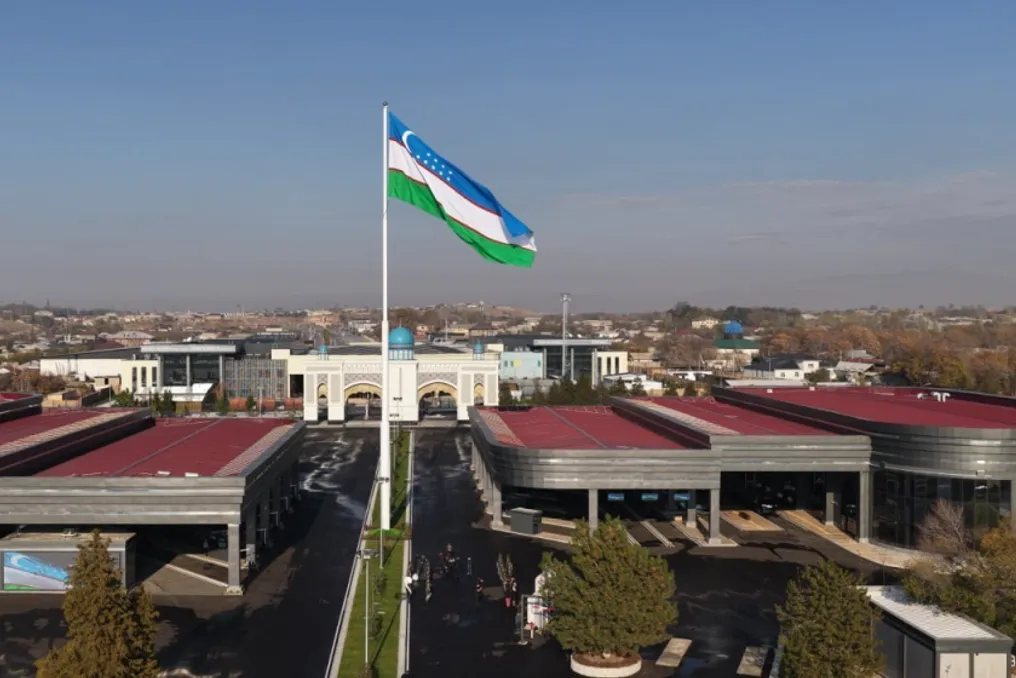
The border customs checkpoint 'Gishtkuprik' on the border between Uzbekistan and Kazakhstan has been officially opened after nearly two years of large-scale reconstruction. This point, previously known as 'Chernyaevka' (or 'Zhibek Zholy' from the Kazakh side), began operating for border crossing on November 25th. The opening ceremony was attended by officials from both countries, along with performances by Uzbek and Kazakh musical ensembles at 4:00 PM.
The 'Gishtkuprik' post was established on November 1, 1991, and remains one of the key checkpoints for citizens, vehicles, and buses. Due to increased trade turnover and strengthened ties between Uzbekistan and Kazakhstan, expansion of this point was necessary. According to the Customs Committee, in 2023, 9.8 million citizens and 244 thousand vehicles passed through it, while in 2024, these figures rose to 11.5 million citizens and 291 thousand vehicles, corresponding to an increase of 17% and 19% respectively.
The modernization of the post began in November 2022 by decree of the President of Uzbekistan, and the final stage of reconstruction was completed in February 2025, although it was initially expected to take only four months. In the same year, another checkpoint on the border with Kazakhstan—'Navoi' ('Kaplanbek')—was modernized.
The grand opening ceremony for the 'Gishtkuprik' and 'Zhibek Zholy' posts was attended by the Deputy Prime Minister of Uzbekistan, Minister of Economy and Finance Jamshid Kuchkarov, the Minister of Finance of Kazakhstan Madi Takiev, as well as heads of the customs services of both countries and other officials. After a symbolic ribbon-cutting, representatives of both nations familiarized themselves with the capabilities of the new posts, and the musical ensembles demonstrated cultural unity.
How Has 'Gishtkuprik' Changed After Reconstruction
According to the Customs Committee, the reconstruction led to an increase in the total area of the post from six to nine hectares. All infrastructure for the movement of both citizens and vehicles has been completely updated. The number of pedestrian lanes has been doubled (from four to eight), and the lanes for inspecting passenger cars have increased more than fourfold—from four to eighteen. Additionally, the number of parking spaces has increased tenfold, reaching 200 places from the previous 20.
The daily throughput capacity of the post has significantly increased: for citizens, it rose from 31 thousand to 100 thousand people (more than three times); for passenger cars, from 750 to 3000 (four times); and for buses, from 70 to 400 (nearly six times).
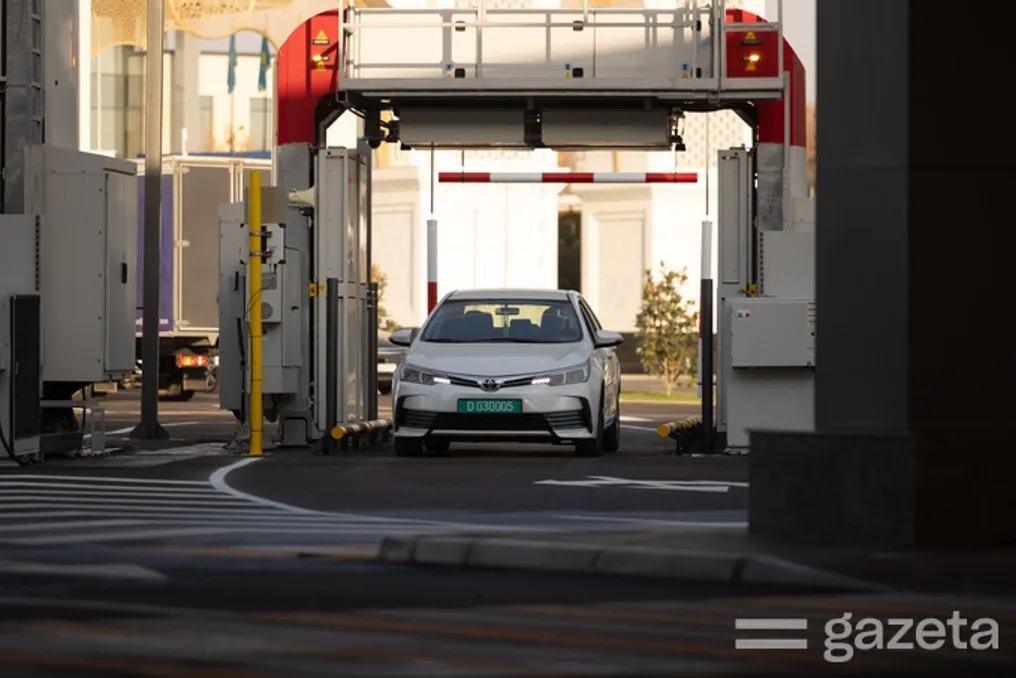
The facility is equipped with three inspection and control complexes, ten X-ray machines, two Body Scanners, six portal radiation monitors, 188 surveillance cameras, and five video servers. Tourists also have access to tax refunds on purchased goods (Tax Free). Pedestrians enter the post building from the right side, and hand luggage passes through X-ray scanners. Adults can use the automated E-Gate system for passport control, where the scanner checks the passport, and a camera records the face before the gate opens.
Citizens traveling with children or requiring additional checks are directed to the border guard booth. For those wishing to pass the border in fast track mode, a paid Fast Track system has been introduced, similar to that used in airports, with dedicated staff assigned. It is expected that users of Fast Track in Uzbekistan will be able to use the same mode in Kazakhstan.
The Smart Customs Border system has been implemented to speed up the passage of passenger cars and buses. Vehicles pass through two X-ray machines of different heights, and disembarking passengers is not required. Farhod Olimjonov, head of one of the Customs Committee departments, reported that the average time to pass the post for one person has been reduced from an estimated 30 minutes to 5–10 minutes.
Upon entry, a passenger car is first analyzed by cameras, and a risk management system using databases from the Ministry of Internal Affairs, the Tax Committee, and the Ministry of Transport determines whether the vehicle should proceed through the 'green' or 'red' corridor for in-depth inspection. A similar system is applied to buses: the Customs Committee and the Ministry of Transport have introduced SmartBus, which pre-transmits passenger data to the post obtained during ticket purchase.
Farhod Olimjonov emphasized that Kazakhstan possesses all the necessary conditions and means, as both posts were reconstructed according to a unified project, guaranteeing equal throughput capacity. Parking lots are provided in case of exceeding throughput capacity, and all arriving vehicles will be registered in an electronic queue, whose data will be analyzed by the risk management system.
A representative of the Customs Committee also specified that the opening of 'Gishtkuprik' will allow truck traffic to resume through the 'Navoi' post, reducing the load on the 'Yallama' and 'Syrdarya' posts. Farhod Olimjonov reminded that the current limit for duty-free import of personal goods is up to 300 US dollars, and for commercial cargo, it is recommended to use the 'Navoi' post, an agreement on which has been reached with Kazakhstan.
Opinions of the First Citizens Who Crossed the Border
The doors of the border customs posts on both sides opened at 4:00 PM, and the first visitors, both pedestrians and drivers, were waiting to cross the border. A correspondent from 'Gazeta' interviewed the first citizens who used the new regime after the reconstruction.
Kenzhabay Kuilibayev from Kazakhstan shared his joy, noting that thanks to new technologies, the border crossing process, which previously took two to three hours, has become significantly easier, which is especially important for visiting relatives in Tashkent.
Ibrohim Odilov from Uzbekistan, traveling from Shymkent, noted that passing the post took only two to three minutes, unlike the previous two-to-three-hour journeys, and stressed that there is now no requirement for bribes from the Kazakh side.
Elbek Dustimbetov from Uzbekistan, who frequently visits relatives in Kazakhstan, compared his old experience, when it took an hour and a half to pass through the 'Kaplanbek' ('Navoi') post, with the current time of two to three minutes. He noted that it will now be easier for residents of Almaty and Saryagash to visit relatives more often.
Abdumumin Nishonov from Uzbekistan recounted how the border crossing used to take half a day, creating serious difficulties, especially for children and the sick, sometimes preventing them from attending important family events. He highly praised the new, more convenient appearance of the post.
Khasan and Husan from Kazakhstan, celebrating their birthday, thanked Mirziyoyev for the beauty of the post. However, they expressed a wish for the possibility of more freely transporting gifts from Kazakhstan, as the current limit of 5–10 kg seems insufficient for a large number of relatives.
Rustam Jalilberdiyev from Kazakhstan, who travels for personal matters, noted a sharp reduction in border crossing time from the previous 4, 6, or 8 hours to less than 10 minutes, comparing it to a five-hour wait at 'Kaplanbek'.
Rayimkul Tajimetov from Kazakhstan, who regularly visits Uzbekistan, noted that the time to pass the post decreased from 40 minutes to an hour to five minutes, and expressed confidence in the further acceleration of the process as the technologies are fine-tuned.