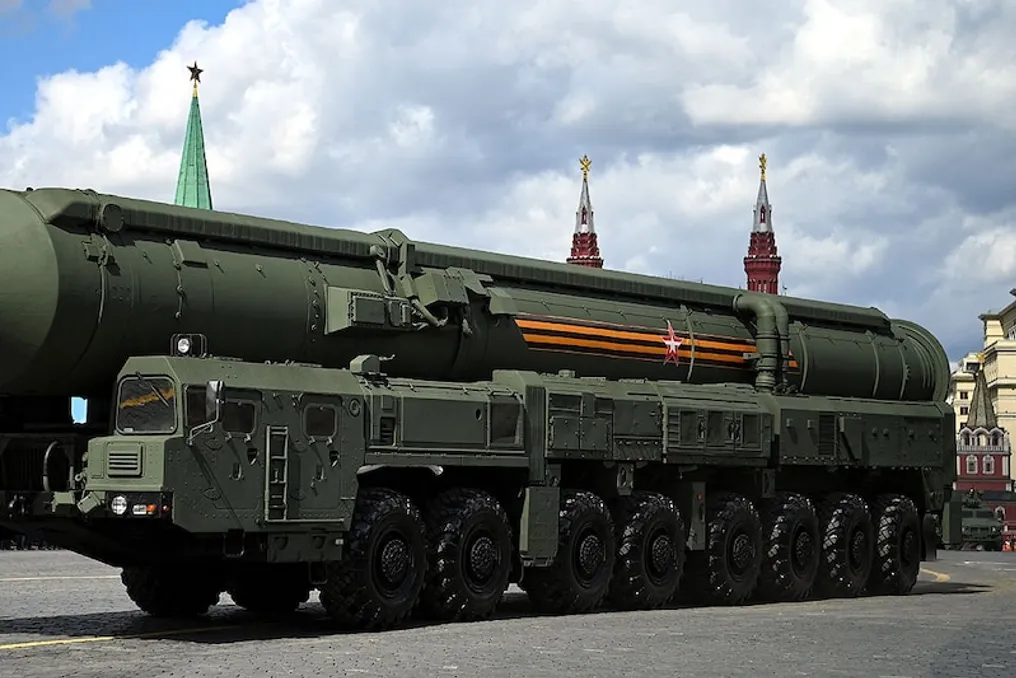
Column of Russian nuclear missiles observed in Siberia; Yars capabilities and strategy discussed
Read more
Aaj Tak
www.aajtak.in

Column of Russian nuclear missiles observed in Siberia; Yars capabilities and strategy discussed

A column of RS-24 Yars ballistic missiles with nuclear potential was spotted in the Siberian region of Russia, sparking active discussions in military circles. Video footage shows the missiles traveling along a rural road accompanied by heavy military equipment. This convoy was observed near the village of Bobrovka, not far from the city of Barnaul, in the Altai Krai.

It is premature to consider this activity as some special military message from Russia in the context of the war with Ukraine. Such maneuvers may be part of planned exercises and patrols of the Russian Strategic Missile Forces.

The RS-24 Yars is an intercontinental ballistic missile with nuclear potential that can be transported on specialized ground military transport. Its estimated range is from 10,500 to 12,000 kilometers, allowing it to reach targets located far from Russia.

The main feature of the Yars is its ability to carry multiple nuclear warheads. This technology is known as MIRV (Multiple Independently Targetable Re-entry Vehicles), which allows many warheads to be directed at various targets from a single missile.

The Yars missile is deployed on a mobile launch platform, freeing it from being tied to any fixed base. This allows it to move along roads to various locations and be launched from there if necessary. This is what ensures its strategic significance.

It is extremely difficult for any country to completely destroy such enemy weapons because determining their actual location is not easy. Compared to stationary objects, mobile missiles are easier to conceal and change their deployment locations. For this reason, Russia highly values these types of weapons to ensure its nuclear deterrence.

Barnaul, located in Siberia, in the Altai Krai, is the location of the 35th Missile Division of Russia, which possesses Yars missile systems. Therefore, it is very likely that the convoy observed near the village of Bobrovka is related to this military unit.

The international community closely monitors military actions involving nuclear weapons amid tensions between Russia and Western countries. Russia has previously conducted exercises using Yars missiles. For example, similar training took place in the Volgograd region in February 2025, where mobile launch platforms moved through forests and established patrol routes. These exercises included practicing missile concealment, ensuring their safety, and protecting them from possible observation or sabotage attempts by the enemy.

Thus, the movement of the convoy near Barnaul is not sufficient proof that it is a signal of Russia's nuclear potential or preparation for immediate action against Ukraine. Military analysis requires confirmation of multiple aspects, such as the number of missiles, the state of their deployment, the activity of the launch platforms, and official military signals, to conclude on preparation for a nuclear strike.

A key element of Russia's nuclear strategy is ensuring the capability for retaliatory action even after the first strike by the enemy, known as nuclear deterrence. Mobile Yars missiles strengthen this strategy because their location can change, and their destruction is relatively difficult. Thus, although the convoy near Barnaul may be part of routine military activity, it demonstrates the important role of mobile missiles in Russia's strategic nuclear system.

Similar stories

Russia may be able to prepare a nuclear bomb for space launch as early as 2026
Read more
olhardigital.com.br

Russia may be able to prepare a nuclear bomb for space launch as early as 2026

According to an investigation published on Monday (23) by the newspaper Süddeutsche Zeitung and German broadcasters NDR and WDR, Russia could potentially prepare a nuclear bomb launch into space as early as this year.

Sources in Western intelligence services claim that the warhead will be transported by the Sputnik-S satellite. However, there is currently no public evidence of such an imminent launch.

The alarming report underlying these concerns was issued in early November. According to the German broadcaster ARD, secret services indicated the possibility of a launch within the next sixty days. This information was passed to NATO, and military experts from the Bundeswehr (German armed forces) warned the German government, including Defense Minister Boris Pistorius. It is assumed that the satellite is located in Moscow.

The German Ministry of Defence stated that it monitors the space activities of other countries but did not directly comment on these claims. The Russian Embassy in Berlin called the information 'propaganda' and stated that it was unaware of these events.

As early as October, the U.S. Defense Intelligence Agency (DIA) warned about the development of a Russian satellite system for transporting nuclear weapons. This issue was also covered in a report by Olhar Digital regarding suspicions related to a Russian project.

According to U.S. military intelligence, after the weapon is deployed, it is unlikely that effective countermeasures can be taken. Detonation could lead to debris formation and an electromagnetic pulse capable of disrupting satellites, electronic systems, GPS, the internet, communications, weather forecasting, and financial operations.

Steven Whiting, head of U.S. Space Command, estimated that about one-third of low-orbit satellites would fail in the first hours or days, with the rest experiencing failures in subsequent months.

NATO relies on satellites for surveillance and communication. Nevertheless, the Russian fleet could operate in the Baltic Sea without this support thanks to millimeter mapping conducted under the guise of research vessels.

If the project is implemented, it would violate the 1967 Outer Space Treaty, which prohibits the placement of nuclear weapons and other weapons of mass destruction in orbit. In December 2024, the UN General Assembly voted to maintain this agreement, but Russia voted against it.

The Kosmos-2553 satellite, launched in 2022 shortly before the invasion of Ukraine, is under surveillance by intelligence services. Moscow asserts that the satellite has a scientific purpose, but Western authorities suspect it is being used to test the impact of radiation on space systems and satellites.

These suspicions regarding the equipment are part of a broader scenario of space militarization. In 2021, Russia destroyed its own satellite using a missile, and the debris posed a risk to astronauts on the International Space Station (ISS). In 2025, the U.S. acknowledged having orbital systems with potential offensive capabilities. Since the start of the war in Ukraine, the French company Aldoria has also registered nearly 30 suspicious close approaches between Russian and European satellites.

Nevertheless, the risk of a nuclear explosion in orbit is not purely theoretical. In 1962, during the Starfish Prime test, the U.S. detonated a nuclear bomb at an altitude of 400 kilometers over the Pacific Ocean. The electromagnetic pulse caused failures in streetlights in Hawaii and communication systems, and destroyed several satellites, including the first British and first American civilian ones.

Popular