More than ten years ago, when Mireille Malbos first arrived in Dakhla, she found a city that was largely in an unfinished state of development. She noted that she observed enormous progress and values the place for its tranquility, exceptional quality of life, and beautiful nature, including the sea, lagoon, and dolphins.
Malbos, a French entrepreneur and guesthouse owner, personally witnessed the transformation of Dakhla into one of the main tourist destinations in Western Sahara. Located on the southern cape of the territory stretching into the Atlantic Ocean, the city attracts an increasing number of foreign guests—from windsurfing enthusiasts to tourists seeking solitude and closeness to nature.
However, for many Sahrawis, this idyllic picture greatly diverges from their reality. Yahdi Essabi, a Sahrawi journalist and human rights activist, first encountered Dakhla not as a resort, but behind the bars of a prison cell. In 2021, Moroccan authorities arrested Essabi on charges of filming military sites in the region.
He recalls inhumane and degrading treatment in prison, including deprivation of food, water, and sleep, psychological violence, insults directed at his Sahrawi identity, and refusal of medical care. Essabi also mentions pressure and threats from prison staff, who forbade him from speaking about what was happening inside. Due to ongoing repression by Moroccan authorities against supporters of Sahrawi independence, Essabi was forced to leave Western Sahara for his own safety.
These sharply contrasting experiences reflect the coexisting contradictory realities of Western Sahara—a territory shaped by more than fifty years of conflict. Western Sahara is a territory not part of the UN, whose decolonization process remains unresolved. The region has been under Moroccan control since 1975, while the Polisario Front, the nationalist movement of the Sahrawi people, continues to strive for self-determination.
The issue of Western Sahara has once again attracted international attention after the UN Security Council did not renew the mandate of MINURSO, the mission monitoring the ceasefire between Morocco and Polisario, raising fears of renewed hostilities. This move came amid growing international support for Rabat's proposal of autonomy for the territory, which was rejected by the independence movement. To gain this support, Morocco seeks to demonstrate governance over the territory through a series of large-scale projects, presenting them as models of sustainable development. However, Sahrawi rights defenders question both the impact of this strategy and who ultimately benefits from it.
“Dubai of North Africa”
Dakhla has become one of the most prominent examples of this strategy. Over the last decade, the city has undergone radical changes, facilitated by billions of dollars in public and private investment. The plan envisions transforming Dakhla into a major ecotourism center, which some Moroccan officials have dubbed the “Dubai of North Africa.”
Nevertheless, this strategy, dependent on a wide range of foreign investors, including companies from Europe, the US, China, the UAE, and Israel, raises questions about compliance with international law and the consequences for Sahrawi rights. Rashid Sghir, a Sahrawi from Dakhla, notes: “There are places where Sahrawis cannot move freely. This is especially true for areas where natural resources and tourism activities are located.”
Andrea Maria Pelliconi, a lecturer in human rights and global justice law at the University of Southampton, told MEE: “Foreign investments are not automatically illegal, but they become so when they contribute to entrenching an illegal situation or undermining the right to self-determination, especially without the consent of the Sahrawi people.”
New resorts, residential areas, port infrastructure, and desalination plants are transforming the urban landscape and economy of the territory. However, this process often leads to the displacement or marginalization of Sahrawi communities and restricted access to land and resources. According to Rashid Sghir, a native of Dakhla, the indigenous Sahrawi population, which now constitutes a minority after decades of demographic change, is increasingly marginalized in terms of rights and economic opportunities.
Sghir told MEE: “We do not have full freedom of movement in our own territory. Restrictions apply not only within the city but also in surrounding areas.” He added: “There are places where Sahrawis cannot move freely. This is especially true for areas where natural resources and tourism activities are located.” He also emphasized: “The system does not just control the movement and activities of people; there is also constant psychological pressure.”
The 2024 report by UN Secretary-General António Guterres noted the economic marginalization of the Sahrawi population. It stated that “reports described investments as often prioritizing interests that do not meet the needs of the local Sahrawi population, exacerbating economic inequality and hindering fair development for all Sahrawis,” and also noted that natural resources are being exploited without significant consultation or participation from affected communities.
Concrete in the Desert
Today, Dakhla represents one massive construction site. Along the main road leading from the city center to the cape, towards bay-view tourist resorts, the desert landscape is dotted with buildings under construction and an expanding network of roads. Analysis of satellite images by the Placemarks project, which studies environmental changes in Africa, shows that urban expansion began in 2016 and accelerated sharply since 2023.
In one of the city's peripheral zones, for example, around 130 hectares—equivalent to more than 180 football fields—plots have already been divided. Approximately 100 hectares of this land could be built upon. Currently, buildings occupy only two hectares, but with full development, the building area could increase by more than thirty times.
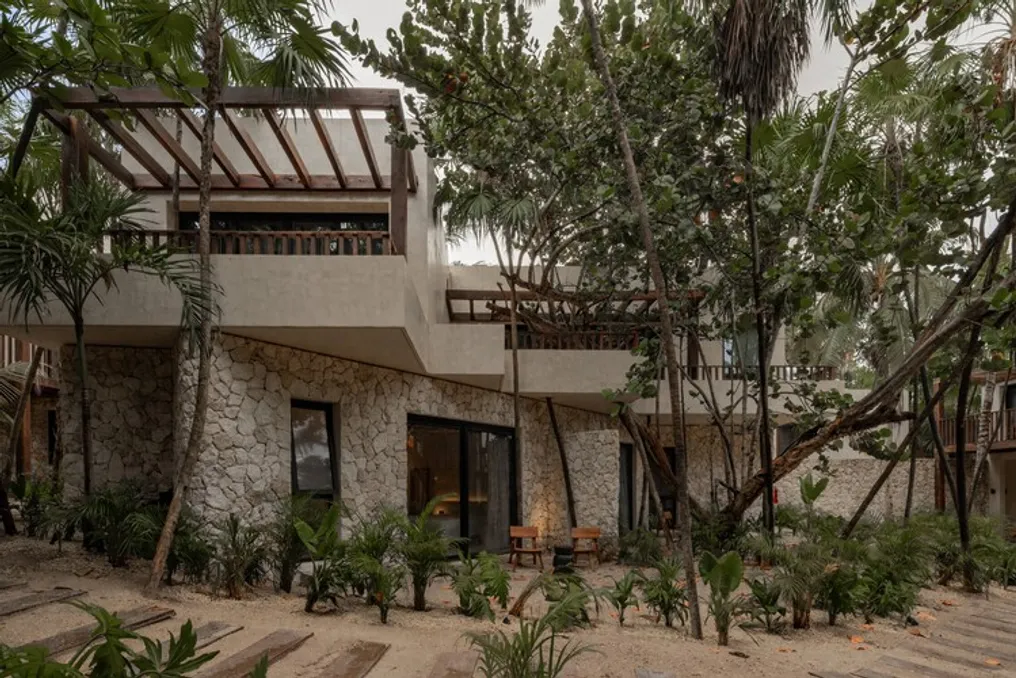
Developers actively promote Dakhla to foreign investors through elite residential projects aimed at affluent buyers. The Blue Bay Residency billboard reads: “Immerse yourself in unparalleled luxury at our coastal villas, where crystal-clear water stretches to the horizon. This stunning residence offers spacious, elegant rooms, meticulously designed to provide breathtaking views of the surrounding landscape.”
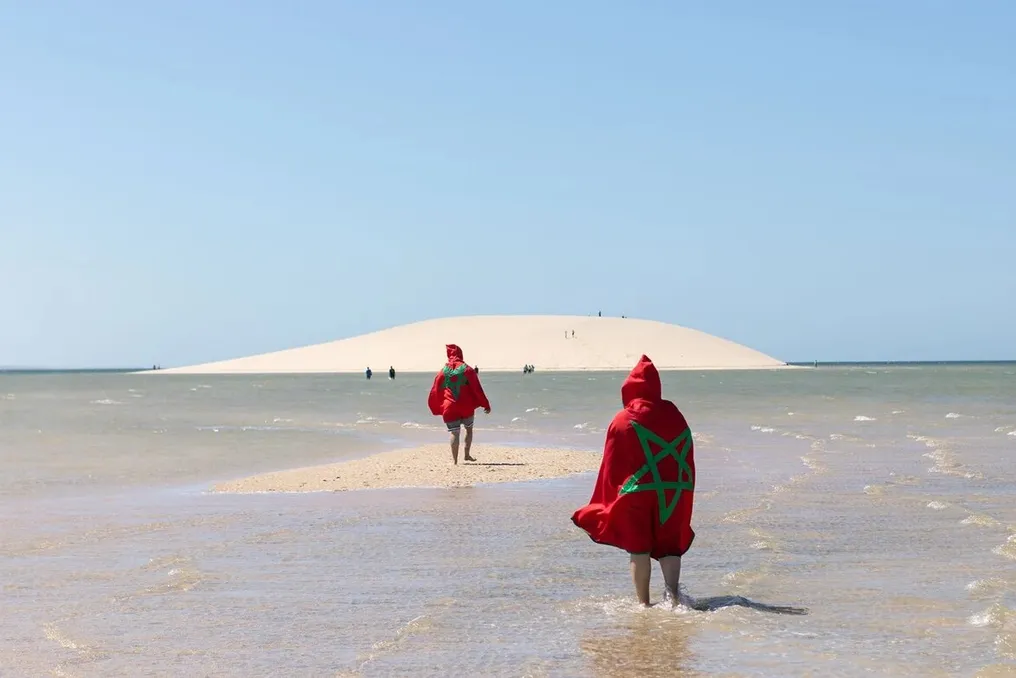
Along the bay, amidst sand dunes, numerous resorts offering all-inclusive packages have appeared in recent years, including windsurfing lessons, yoga sessions, and evenings with Moroccan cuisine and music, turning the coast into a tourist center primarily focused on foreign visitors.
However, the rapid pace of development raises concerns about its impact on the environment, including land degradation and increasing pressure on scarce water resources. Although Dakhla is advertised as a model of sustainable development based on ecotourism, renewable energy, and environmental restoration, the Moroccan document underpinning this strategy also warns that uncontrolled growth in tourism and infrastructure expansion could damage the fragile desert and coastal ecosystems of the region.
The document points out: “Today, population growth is suffocating the city, causing alarming levels of pollution, especially in the lagoon—which is a unique ecological and tourist attraction—as well as in other sensitive areas such as Sargha and White Dune.” One project near White Dune illustrates these concerns. A few meters from the White Dune eco-resort is the unfinished framework of what was supposed to be another eco-tourism complex covering about 3.5 hectares. Earthworks and terracing began in 2018 and continued until 2022, drastically changing the landscape, but the project was never completed due to financial disputes between investors. Today, instead of the planned tourist complex, the landscape above Dakhla's lagoon is crisscrossed with vast concrete surfaces.
Consolidation of Occupation
Between 2016 and 2025, the number of overnight stays in hotels increased from approximately 98,000 to 468,000, partly due to the introduction of new low-cost air routes connecting Dakhla with several European cities. International airlines such as Ryanair and Transavia, as well as accommodation and travel platforms including Airbnb, Booking.com, and Tripadvisor, are already positioning Dakhla as an integral part of Morocco, further blurring the disputed status of the territory.
Critics argue that Morocco's tourism plans in the region primarily serve a political agenda, shaping perceptions of the kingdom's presence in Western Sahara. A 2026 report supported by the Greens/EFA group of the European Parliament asserts that Rabat uses tourism development in Dakhla to strengthen its claims to the territory, presenting it as a sustainable tourist destination rather than occupied land.
Andrea Maria Pelliconi, a human rights lecturer, stated: “Tourism can help normalize Morocco's presence, presenting places like Dakhla as undeniably Moroccan.”
The report states: “Tourism under occupation does not require convincing visitors that Morocco has legitimate sovereignty over the territory. It can work much more easily: by creating an experience where this question almost never arises.”
This transformation is actively implemented through state policy, including allocating land belonging to private state property to investors at prices the report calls 'symbolic,' while depriving the indigenous Sahrawi population of control over their own resources. According to Pelliconi, “tourism can help normalize Morocco's presence, presenting places like Dakhla as undeniably Moroccan.”
He also noted to MEE: “Airlines, tour operators, online platforms, and international tourists can contribute to this process, often without intending to take a political stance. Many visitors may not even realize that Western Sahara is a territory not part of the UN, whose status remains unresolved.”
Thus, beneath the veneer of prosperity, tranquility, and natural beauty promoted by Moroccan authorities and experienced by many foreign guests, the transformation of Dakhla has become inseparable from broader issues of dispossession, representation, and self-determination for many Sahrawis. Sghir concluded: “It is painful for us to see other people come to our territory, enjoy its resources and landscapes, while the Sahrawi population remains marginalized.”