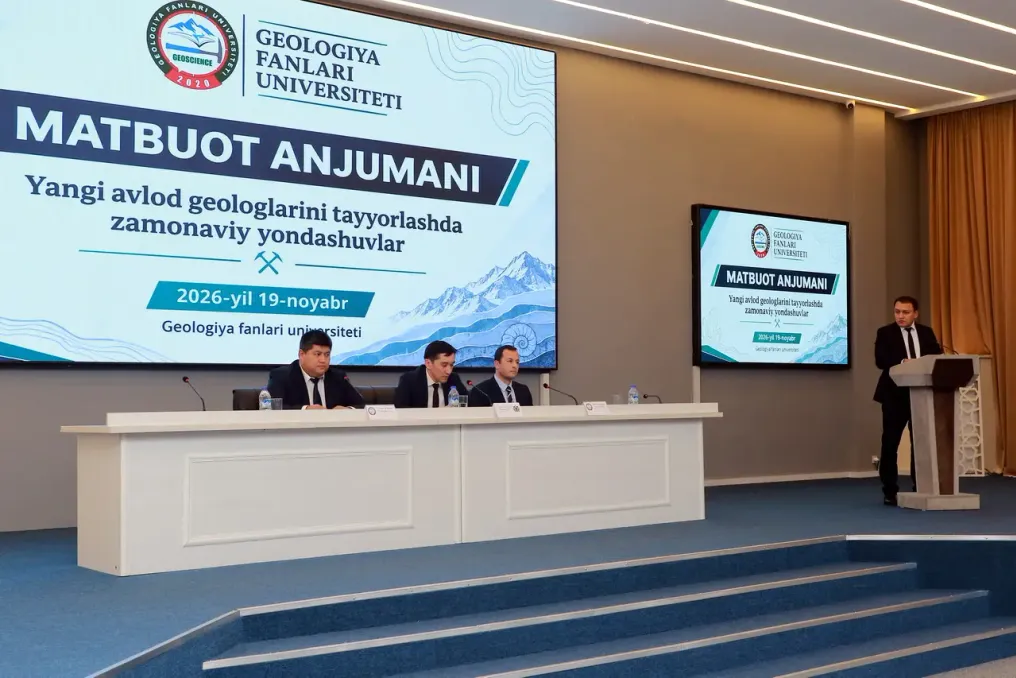
The Uzbek University of Geological Sciences, which currently enrolls a total of 2372 students, is expanding practical training and scientific research in the fields of artificial intelligence, three-dimensional modeling, and critical minerals. This was announced at a press conference organized by the Ministry of Mining and Geology and the university itself.
The event, titled 'Modern Approaches to Training the New Generation of Geologists,' took place at the Media Content Training Center under the Administration of the President of Uzbekistan. Participants included Mirgiyos Gafforov, Head of the Department of Innovation, Science, and Education of the ministry; Bahrom Urinov, First Vice-Rector for Youth, Spiritual, and Educational Affairs of the university; and Obidjon Kodirov, Vice-Rector for Research and Innovation. Journalists and bloggers were also present.
Currently, 2372 students are studying at the university. Of these, 1022 are full-time, 883 are part-time, 248 are evening students, and 68 are distance learners. Additionally, 101 students are enrolled in master's programs, and 50 are in joint educational programs. The student body includes 39 foreign nationals.
In addition to geology, ecology, and economics, the university focuses on critical minerals, management, and artificial intelligence technologies. Key priorities include combining theoretical education with practical training, implementing digital technologies, and adapting curricula to meet industrial needs.
As part of field practices in Oxakot, 250 first-year students receive basic knowledge in general geology and geodesy. Another 140 second-year students study structural geology, drilling, and geophysics. Industrial internships are conducted in cooperation with the Navoi and Almalyk Mining and Metallurgical Complexes, Uzbekneftegaz, Uzbekgeolograzvedka, Uzbekhydrogeology, and Kitap Geopark.
According to the dual education plan for the 2026–2027 academic year, the university plans to involve 181 out of 355 second and third-year students participating in industry-related programs, which accounts for 51%. It is expected that all 74 fourth-year students will participate in the program. The university noted that this program helps students apply their knowledge in real industrial conditions, improve skills, and prepare for the labor market.
The university conducts research jointly with scientific institutes within its structure. The work covers mineral resources, advancements in geological exploration, geophysics, geochemistry, and digital geological modeling. The university aims to expand the application of artificial intelligence, 3D modeling, digitization of geological data, and modern software. Other areas of work include cooperation with foreign universities and research centers, joint projects, and support for young scientists.
The university offers various student clubs, such as sports, Zakovat, KVN, GFU Media, Qizlarjon, startup, oratory, IT, environmental, and volunteer clubs. Intellectual competitions, educational meetings, book-related events, and social projects are also organized. The university stated that it regularly monitors living and learning conditions for students, addresses their requests, and works to resolve emerging issues.
Among the university's future tasks are improving the quality of education, expanding dual education, developing laboratories and digital technologies, strengthening international cooperation, and training highly qualified specialists to meet the needs of companies. At the end of the press conference, journalists asked questions about the quality of education, student employment opportunities, research, and the training of young specialists, to which representatives of the university and the ministry responded.