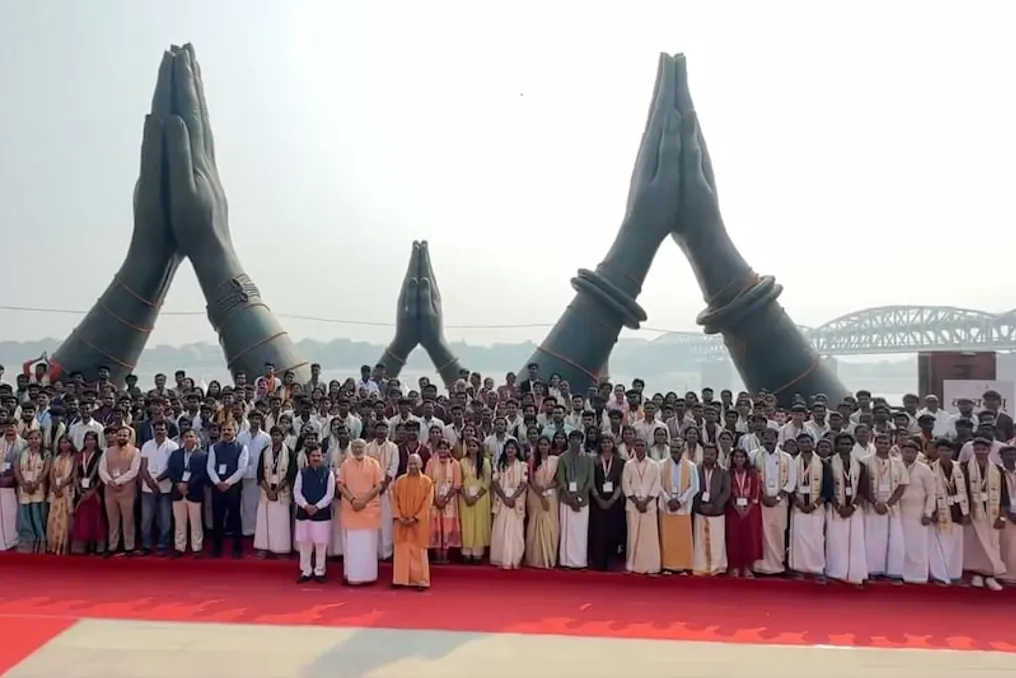
5th edition of Kashi Tamil Sangamam begins in Varanasi; Thirukkural published in 50 languages
Read more
Aaj Tak
www.aajtak.in

5th edition of Kashi Tamil Sangamam begins in Varanasi; Thirukkural published in 50 languages

The fifth event of Kashi Tamil Sangamam commenced in Varanasi on Saturday. CP Radhakrishnan, Vice President, inaugurated the program in the presence of Chief Minister Yogi Adityanath and Education Minister Prahlad Joshi. As part of this event, a collection of the great Tamil literary work 'Thirukkural' translated into 50 languages was released, including ten foreign languages.

This year's theme for Sangamam is 'Thirukkural Paiilvam,' which means 'Let us practice Thirukkural.' The goal of the event is to convey the teachings and moral principles of Thiruvalluvar, especially to students and youth. The program will run from November 28 to December 12.

At the ceremony on Saturday, Prime Minister Narendra Modi expressed joy over the start of Kashi Tamil Sangamam 5.0 via social media X. He welcomed people who traveled from Tamil Nadu and other regions to Kashi. Modi noted that this year's theme, 'Thirukkural Paiilvam,' holds special significance. He emphasized that the work Thirukkural, created by the great poet and philosopher Thiruvalluvar, contains invaluable lessons about various aspects of human life.

The Prime Minister also highly appreciated the initiative to release the translation of Thirukkural in 50 languages, including ten international ones. He expressed hope that this will help make Thiruvalluvar's ideas more popular among the youth. Modi added that over the years, Kashi Tamil Sangamam has transformed into a major platform for cultural and intellectual exchange, contributing to the strengthening of the spirit of 'One India, Great India.'

Vice President CP Radhakrishnan highlighted the centuries-old cultural, civilizational, and spiritual ties between Kashi and Tamil Nadu. He stressed that Kashi holds a special place in the hearts of Kashi Tamils, and the pilgrimage to Baba Vishwanath is a significant spiritual aspiration for them. He viewed Kashi Tamil Sangamam not merely as a cultural event but as a movement aimed at strengthening national unity and reviving the shared heritage of the country. This initiative, he said, promotes Prime Minister Narendra Modi's concept of 'One India, Great India.'

Radhakrishnan called Thirukkural a comprehensive guide to life, noting that its lessons on equality, humanism, and virtue transcend linguistic, regional, and state boundaries. He urged participants not only to read Thirukkural but also to apply its teachings in daily life. The Vice President also mentioned that achieving 50 language translations of Thirukkural is a great achievement for the Tamil language and literature, as the first edition had 13 languages, the second had 16, and now the fifth has 50. Emphasizing linguistic harmony, he called for respecting not only one's native language but also other languages, warning that love for one's own language should not turn into hostility towards others.

Chief Minister Yogi Adityanath stated that Kashi Tamil Sangamam has become a festival of India's eternal traditions. He believes that the teachings of Saint Thiruvalluvar are relevant to all human civilization, and the foundations of Indian tradition consist of religion, prosperity, and pleasure. Yogi noted that Kashi and Tamil Nadu represent two ancient branches of Indian culture and civilization. When the knowledge tradition of the Ganges meets the Tamil tradition in Kashi, the cultural consciousness of India is strengthened. He mentioned the old ties between Kashi and Tamil Nadu, citing 'Tenkasi' in Tamil Nadu as an example of this connection, and also pointed out the preservation of traces of Tamil culture in the areas of Kedarnath Ghat and Hanuman Ghat in Kashi. The Minister also spoke about the development of infrastructure, knowledge, spirituality, and heritage in Kashi, emphasizing the need to unite people and regions to strengthen the nation.

Vice President CP Radhakrishnan also touched upon the river linking project, expressing hope that one day the waters of the Ganges will reach the Kaveri. He concluded that the ideals associated with India's cultural heritage and humanism can show the way to the entire world. Distinguished guests such as the central minister of education Prahlad Joshi were present at the event. Participants included students, teachers, writers, journalists, farmers, artisans, women, and industry representatives from Tamil Nadu. The main objective of this event is to strengthen cultural, linguistic, spiritual, and educational ties between Kashi and Tamil Nadu, with a special focus on passing on the common heritage and knowledge to the new generation.
Similar stories

Unique aspects of culture presented through poetry and painting at the literature festival in Delhi
Read more
www.aajtak.in

Unique aspects of culture presented through poetry and painting at the literature festival in Delhi

A major literary festival, 'Sahitya Aajtak' 2026, is taking place at the Major Dyan Chand Stadium in the capital city of Delhi. This forum organizes numerous special sessions aimed at uniting the country through waves of art and literature.

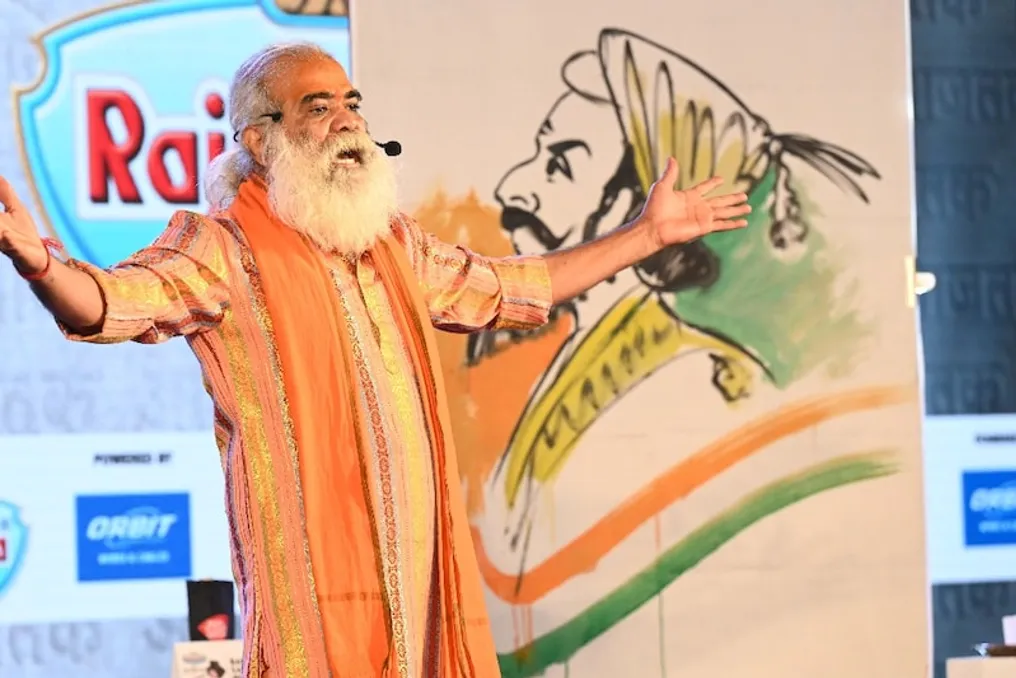
As part of the events, a special session titled 'Poetry, Canvas, and Narrative: Unique Colors of Culture' was held, featuring the renowned poet, artist, and storyteller Baba Satyanarayan Maurya. During this event, Baba Satyanarayan showcased both his poetry and his talent for painting.

He meticulously translated the feelings of words into paintings and created an image of Chhatrapati Maharaj Shivaji on canvas live on stage. Listening to his simple, patriotic verses and witnessing his talent, the audience felt immersed in the colors of the nation.

On the 'Sahitya Aajtak' platform, Baba Satyanarayan Maurya, a celebrated artist, poet, writer, and musician, spoke about Vedic religion, Indian culture, and traditions. The founder of the Institute of Devotion to India, Maurya stated that if people do not stand up for their society today, who will stand up for the country in the future. He also emphasized the importance of asking questions and maintaining curiosity, urging people to question wherever injustice is observed.

Kumar Vishwas presented his Ramkatha at the 'Sahitya Aajtak' event
Read more
www.aajtak.in

Kumar Vishwas presented his Ramkatha at the 'Sahitya Aajtak' event

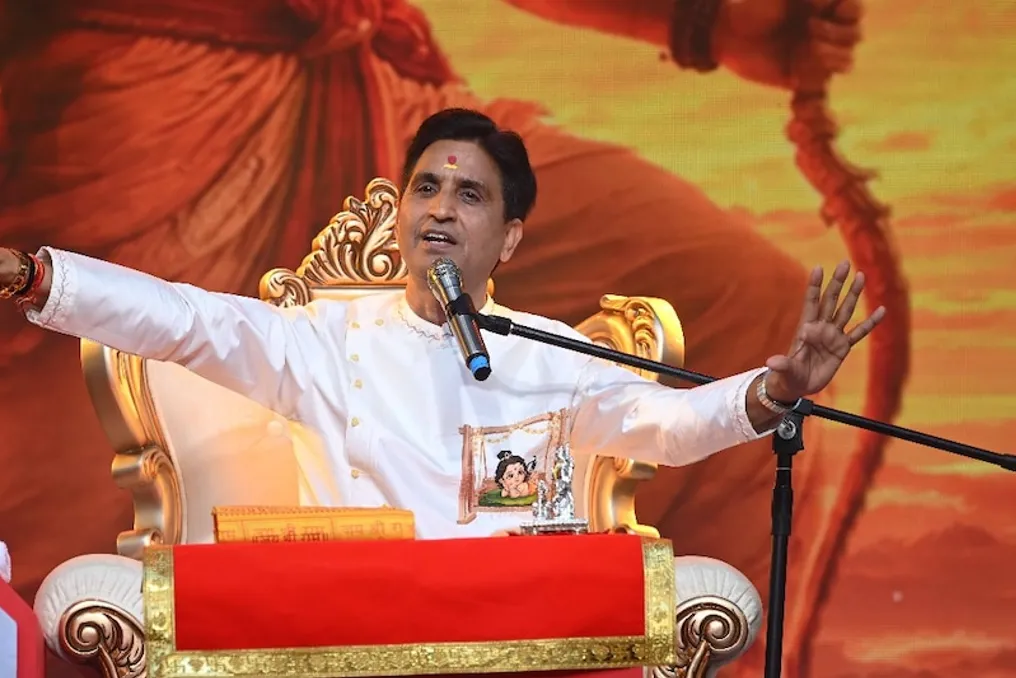
The 'Sahitya Aajtak' 2026 event began on November 27 in slightly cold weather, marking the start of a grand literary gathering. The commencement of this event was marked by a flow of Ramkatha that impressed the audience with its emotional impact. In his special presentation titled 'Apne-apne Ram,' Kumar Vishwas noted that the story of Shri Rama demonstrates the fine line between achieving success and attaining true meaning in life. This thought of the popular poet-thinker, who deeply understands the Ram history, was met with a thunderous ovation from the audience.

Kumar Vishwas discussed Ramkatha, the origin of literature, and the contribution of Maharishi Valmiki. He emphasized that literature is about involving everyone and expressing everyone's feelings. He called Ramkatha the greatest example of literature. During his speech, he also vividly explained the difference between God Rama and Krishna.

Vishwas stated that the Ramayana is the first poem and the first literature in the world; before it, there were only Vedic mantras, but no poetry. He recounted the story of the first verse uttered from the lips of Maharishi Valmiki. One morning, Valmiki emerged from the Tamsa river after bathing when he saw a pair of birds immersed in love. At that moment, the hunter shot an arrow at one of the birds. After the bird's death and hearing its mournful cry, a verse sounded from Maharishi Valmiki's mouth. This verse was written in the Anashtupa meter. Valmiki wondered how such rhythm and rhyme appeared in his words. He shared this story with Maharishi Narada. Narada told him that this was poetry, a divine gift, and the consciousness of art.

When Valmiki asked what to do with this talent, Devarshi Narada advised him to describe a person who would guide humanity in the future. For this, he suggested describing Rama, the son of King Dasharatha, born into the Ikshaku clan. Narada said that thanks to Maharishi Valmiki, feelings found language, and poetry appeared on the lips of the world. He also noted that Maharishi Valmiki was not an ordinary Rishi; even Lord Rama bowed his head before him and touched his feet. Kumar Vishwas mentioned the role of Maharishi Valmiki in the lives of Mother Sita and Lava-Kusha.

He uttered the words: 'It is Valmiki whose touch transforms a sorrowful verse. It is Valmiki whose creation brings Rama to the world.' Kumar Vishwas added that both Krishna and Rama are important in life. When asked about the difference between Rama and Krishna, he answers with one phrase: 'Rama is a dream, and Krishna is the self.' The audience reacted approvingly to this statement.

Explaining the significance of Ramkatha, he asserted that the Ramayana cannot be viewed merely as the biography of God Rama. Ramkatha is an elixir that strengthens the human soul. Kumar Vishwas insisted: 'If any foreigner calls Shrimad Valmiki's Ramayana a biography of Rama, tell him that Ramkatha is not a biography, but an elixir. If medicine is the immunity of the body, then Ramkatha is the immunity of the soul.'

Kumar Vishwas noted that there are over 300 Ramkathas worldwide, which various poets and writers depicted in their own ways. The great poet Maharishi Valmiki wrote Rama first. He was followed by authors such as Goswami Tulsidas, Kaviraja Kamban, Bhavabhuti, Kalidasa, Maharishi Vyasa, and Bhasa. He concluded that 'the dream that humanity has seen until now—the most meaningful, the most complete, and the most sublime—is the dream of Rama.'

To explain a person's relationship with God, Kumar Vishwas used the example of health. He explained that a doctor can name the symptoms of an illness and prescribe medicine, but health has no distinct signs. A healthy body is health itself. Using this analogy, he said that Rama cannot be perceived merely as a means of escaping troubles. Rama is not a cure, but health. Kumar Vishwas stressed that a person should not get used to remembering God only in difficult times; remembrance of God should be constant in life. The most important thing is the feeling of gratitude towards God.

During the event, he also shared an anecdote from his speech. A young woman asked him why she should pray if morning prayers take half an hour, and why she should bow her head before her mother (God). Through this incident, Kumar Vishwas clarified the importance of faith and gratitude towards God.

Popular