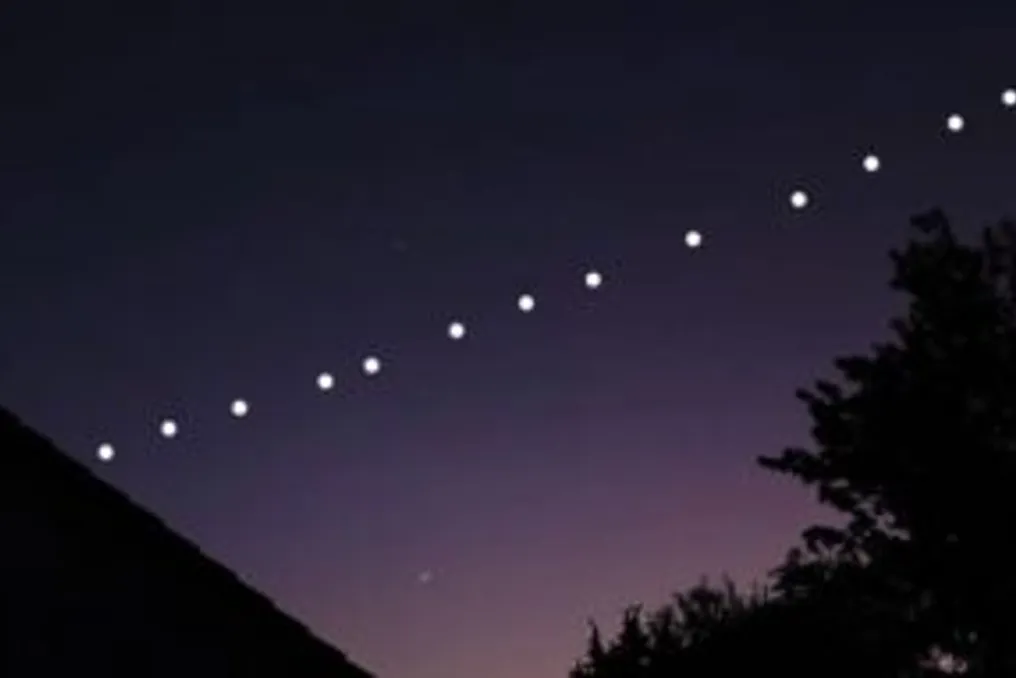
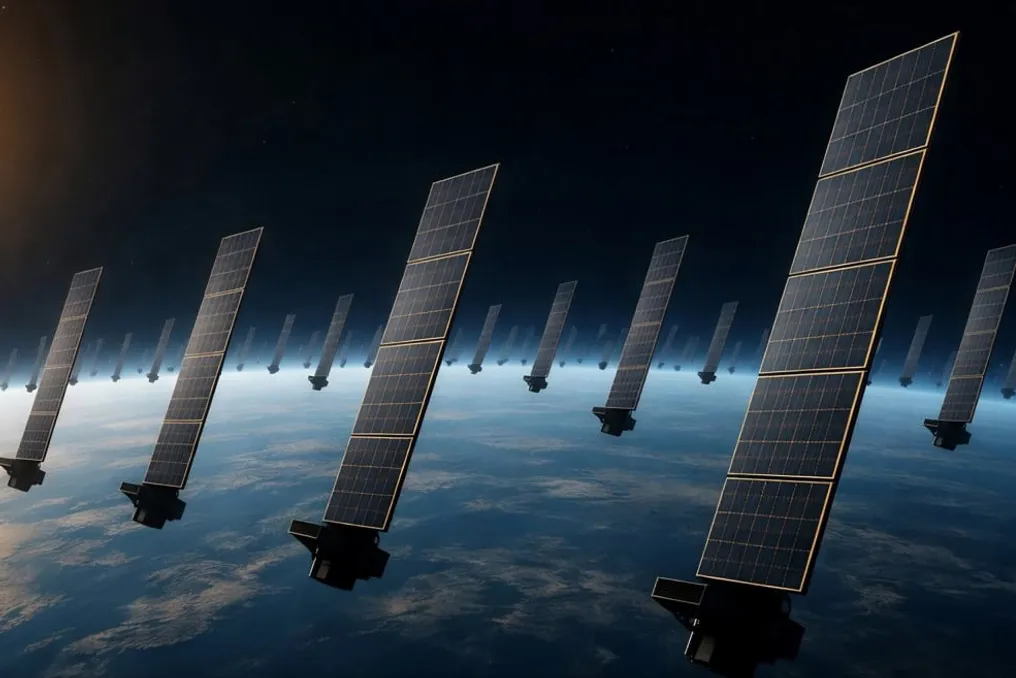
The company Accu conducted a study that raised concerns about a growing phenomenon: in many parts of the planet, the number of artificial satellites crossing the sky has become greater than the number of visible naked-eye stars. The cause of this is the increase in low-Earth orbit satellites designed for internet services, particularly Starlink devices.
The study was based on data collected between October 12 and 18 of this year. This data was obtained from the satellite monitoring system provided by the United States Space Force on the CelesTrak website.
During the period under review, Accu researchers analyzed the trajectories of 15,833 artificial satellites operating in low orbit—that is, at an altitude of up to 2000 km.
The study found that, on average, 710 satellites passed over a British city with an average latitude at night, assuming a completely unobstructed horizon. About 105 of these satellites could be seen with the naked eye because they reflected sunlight, shining as brightly or even brighter than stars.
It is important to note that artificial satellites do not emit light themselves; they become visible at night, during sunset or sunrise due to the reflection of sunlight. However, their visibility is not constant and depends on factors such as the satellite's position relative to the Sun, the shadow cast by the Earth, weather conditions ('clear sky'), and the observer's location.
A representative from Accu explained to Space that in a typical UK city, about 300 satellites catch sunlight in the first hour after darkness falls. This number drops to less than 20 around midnight and rises again to approximately 300 before dawn.
Although the study focused on the territory of Great Britain, the researchers claim that the intense movement of satellites is already noticeable in a significant part of Europe, the United States, and in regions of the northern and southern latitudes between 40 and 50 degrees.
It was noted that Brazil is in a privileged position because much of its territory is located near the equator, where satellite traffic tends to be less intense.
There are several reasons for concern. Firstly, the problem creates a light pollution effect that not only deprives the night sky of its 'naturalness' but can also interfere with astronomical observations. For example, the light trail of an artificial satellite can disrupt the telescope's field of view, negatively affecting data analysis or collection.
Furthermore, there is a concern that the large number of satellites reflecting sunlight may cause a sky brightness enhancement effect, making it difficult to observe very distant astronomical objects.