
Thousands of people report menstrual changes after exposure to tear gas in French protests
Read more
Noticias ao Minuto
noticiasaominuto.com

Thousands of people report menstrual changes after exposure to tear gas in French protests

A collective of French activists and parliamentarians has called on authorities to suspend the use of tear gas to disperse demonstrations. According to The Associated Press (AP), reports include menstrual changes and other reproductive health issues.

This request arose after numerous individuals reported intense cramps, bleeding, and changes in their menstrual cycles after being exposed to tear gas during protests held last month in France. The women's rights advocacy group, Lacrymos de Sang, compiled approximately nine thousand complaints, 94% of which mentioned gynecological symptoms.

During the October 17 mobilization, when marches took place in about 110 cities, French police used approximately 22 thousand tear gas grenades. The Minister of the Interior, Laurent Nuñez, has already rejected such requests, arguing that the use of this gas is essential for crowd control, as it serves as an alternative to more dangerous weaponry.

Reports from victims affected by tear gas

The French newspaper Le Monde documented several cases of women impacted by the use of tear gas. One victim, named Emilie, reported being hit in the face while walking her dog, which resulted in vomiting and significant bleeding, culminating in the loss of her baby after seven months of pregnancy.

Other witnesses shared similar experiences: Maëva, 20 years old, described menstruation ten times more painful than usual, while Camille mentioned feeling sharp pain and heavy bleeding immediately after her menstrual period.

The AP pointed out that among the individuals exposed during the protests were peaceful demonstrators, including the elderly, children, and pregnant women, as well as residents near the protest sites.

Mélina Galland, a 24-year-old independent photographer who covered the October 17 protests in Paris, felt unusual abdominal pain upon arriving home, described as intense pain she had never experienced during that phase of her menstrual cycle.

Camille Baroux, another 25-year-old photographer, began noticing menstrual pain and irregularities after covering protests in 2020 and 2021. She noticed her cycles became more regular, but recently resumed irregularities over the past two months while covering recent protests.

What is known about the use of tear gas

Currently, there is no scientific proof linking exposure to the gas with the symptoms reported by women. However, it is known that the tear gas grenades used by the French police contain CS, an irritating chemical substance that affects the eyes, skin, and respiratory tract.

The AP clarifies that CS is a crystalline powder that disperses in the air in fine particles, whose effects vary depending on the amount used and the duration of people's exposure.

According to The Guardian, most toxicological investigations on CS have been conducted on male animals. There are only two studies focused on menstrual changes after exposure to the chemical agent, but neither has managed to establish a cause-and-effect relationship.

Gynecologist and obstetrician Maha Eid, who works at the Port-Royal maternity ward in Paris, reported treating women with debilitating menstrual pain and worsening endometriosis symptoms in the days following the demonstrations. According to the doctor, the chemical substance can, depending on the intensity and duration of exposure, activate receptors in the uterine lining, potentially causing uterine contractions and posing a risk during early pregnancy. The specialist emphasized, however, the need for more research to establish definitive conclusions.
Similar stories

Study points to possible benefit of medications like Ozempic on male fertility
Read more
olhardigital.com.br

Study points to possible benefit of medications like Ozempic on male fertility

Medications known for treating type 2 diabetes and promoting weight loss, such as Ozempic, may be linked to improvements in male fertility. An investigation published in the scientific journal Biomedicines revealed positive changes in sperm quality and testosterone levels in men who used drugs from the GLP-1 receptor agonist class.

The research monitored 108 men who presented with obesity and/or type 2 diabetes over one year. The participants received semaglutide, the active component of Ozempic, or liraglutide, sold under the brand name Victoza.

At the end of the follow-up, scientists noted a significant increase in sperm count, in addition to improvements in indicators related to the morphology and motility of these reproductive cells. Additionally, average testosterone levels rose by about 30% during this period.

Despite these encouraging findings, specialists emphasize that it is not yet possible to categorically state that such medications directly increase a man's chances of conception. Another relevant piece of data observed was the average 30% increase in testosterone levels, concomitant with a decrease in estradiol levels, a hormone linked to estrogen.

A possible cause for these changes lies in the individuals' weight loss. Previous studies indicate that visceral fat, concentrated in the abdominal region and around organs, can exert a great influence on testosterone decline. However, the results obtained do not allow establishing a direct link between weight loss and improvement in sperm concentration, since variations in body mass index (BMI) did not necessarily follow changes in sperm count, even after considering factors such as age and diabetes diagnosis.

Researchers also speculate that the medications might act directly on the testes, which are the organs responsible for producing testosterone and sperm. Experiments in obese mice suggest that these drugs could protect the testes against damage, and studies have already identified functional GLP-1 receptors in human sperm. One proposed theory is that the treatments modify processes such as inflammation and oxidative stress in the testes, creating an environment more conducive to the generation of reproductive cells.

The study has significant limitations. One of them is the absence of a control group, which makes it difficult to determine if the observed changes were caused exclusively by the medications. Furthermore, the researchers did not have data on the participants' fertility history, preventing definitive conclusions about increased chances of pregnancy.

This is not the first investigation on the topic. In 2025, a small clinical trial conducted in Slovenia evaluated 13 men with obesity, type 2 diabetes, and low testosterone who used semaglutide. In this group, the proportion of normally shaped sperm doubled, and testosterone levels also increased; however, this experiment also lacked a placebo control group.

The researchers themselves warn that robust clinical evidence is still needed to recommend GLP-1 class medications as primary treatment for male fertility problems. Larger, controlled clinical trials with appropriate monitoring will be essential to confirm the findings and understand the mechanisms involved.

Swelling of legs and ankles may be caused by fluid retention, not obesity, explains doctor
Read more
www.aajtak.in

Swelling of legs and ankles may be caused by fluid retention, not obesity, explains doctor

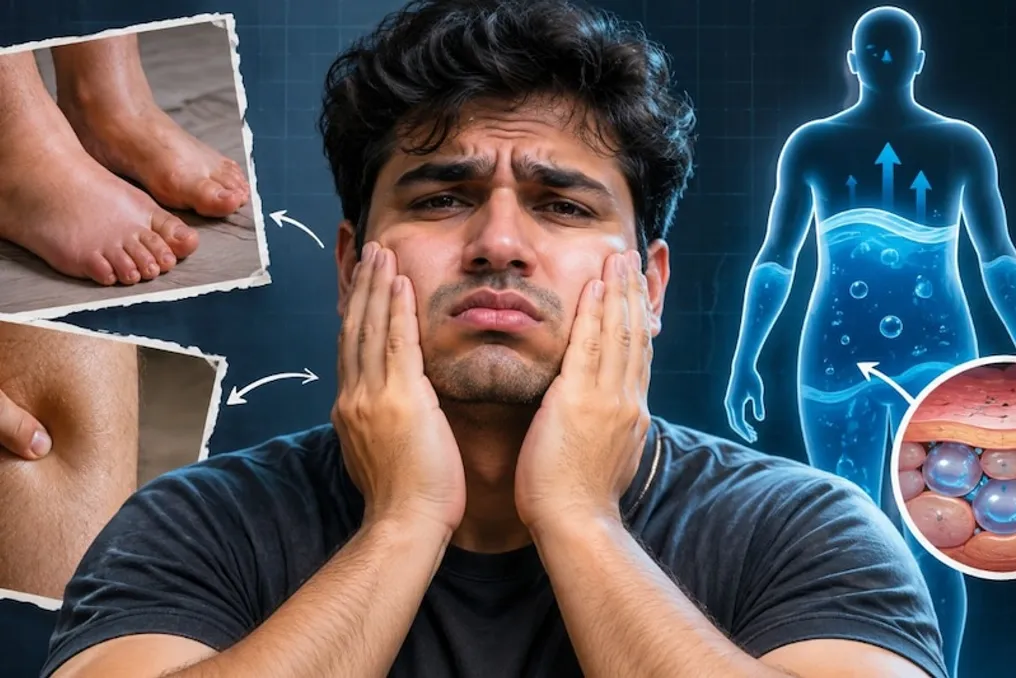
If you notice weight gain, feel heaviness in your body, and your arms, legs, or face look swollen, this could be a sign of fluid retention in the body, not obesity. However, many people are unaware of this difference, so it is important to understand the distinctions by consulting a doctor.

According to Ayurveda specialist Dr. Chanchal Sharma, fluid retention means the accumulation of liquid substances within parts of the body. This condition involves an excess of water accumulating in body tissues, causing swelling in specific areas such as the legs and ankles. This symptom is a sign of fluid retention, not obesity. The main difference between regular obesity and fluid retention is that the latter presents with actual swelling that does not spread throughout the entire body.

Dr. Chanchal notes that this problem is more common among women, especially due to hormonal changes, such as before menstruation or during pregnancy. Furthermore, causes can include excessive salt intake, insufficient water consumption, prolonged sitting in one position, as well as diseases of the heart, kidneys, or liver.

Fluid retention can lead to a number of problems, including feelings of heaviness in the body, joint stiffness, rapid weight gain, and a general swollen state of the body.

To avoid this condition, it is recommended to reduce salt intake, consume enough water, perform light physical exercises daily, and avoid prolonged sitting in one position. If the swelling persists, it is necessary to consult a doctor, as this may indicate a serious illness. The problem of fluid accumulation in the body can be prevented by maintaining a healthy lifestyle and diet.

Possible reasons for testicular shrinkage: A review of five conditions
Read more
super.abril.com.br

Possible reasons for testicular shrinkage: A review of five conditions

Testicles generally maintain a relatively stable size throughout adulthood, so finding a decrease in size should not automatically be attributed to aging. This change, known as testicular atrophy, can be caused by various factors—from the consequences of hormone use to damage caused by infections, trauma to the area, and problems with local blood circulation.

Sydney Glina, a urologist at the Einstein Hospital in Israel, explains that testicular size is primarily determined by the volume of seminiferous tubules—the structures where sperm are produced. When part of this tissue is damaged, the organ can lose volume and impair its function. Five situations leading to testicular atrophy are then examined.

The Influence of Hormonal Preparations

Taking testosterone, whether for hormone replacement therapy or muscle building, as well as anabolic steroids, can lead to testicular shrinkage. To understand this link, it is necessary to understand how the brain regulates hormone production.

The hypothalamus stimulates the pituitary gland, which releases LH and FSH hormones. LH stimulates testosterone production in the testes, while FSH participates in the process of sperm formation. When a man receives hormones from outside the body via injections or gels, the brain interprets this as having sufficient circulating testosterone levels and reduces the secretion of these stimulators. With reduced LH and FSH, testicular activity decreases, sperm production may decrease or even cease, and the organ size may shrink.

Alexandre Holle, an endocrinologist, director of the Brazilian Association for the Study of Obesity and Metabolic Syndrome (Abeso), and deputy coordinator of the Department of Women's Endocrinology, Andrology, and Transgenderism of the Brazilian Society of Endocrinology and Metabolism (SBEM), notes: 'Although blood testosterone levels may be elevated during the use of these substances, the testicles are functionally inhibited and may decrease in volume.'

Recovery from this condition depends on the dose of substances used, the duration of exposure, the user's age, and previous health status. After stopping hormone intake, hormonal function may recover, but not always quickly or completely. Holle adds: 'Sperm production may take longer to recover than testosterone.'

Varicocele and Infections

Varicocele is an enlargement of veins around the testicles, similar to varicose veins in the legs. This condition tends to raise the local temperature and alter the conditions necessary for sperm production, which can negatively affect fertility. Over time, these changes can damage testicular tissue and cause a reduction in the volume of one or both testicles. However, this does not happen to all men with varicocele. Glina states: 'If varicocele is operated on immediately after diagnosis, sometimes size recovery is possible.'

Infections can also cause irreversible damage. These include orchitis—inflammation of the testicle itself, usually caused by viruses—and epididymitis, which affects the testicle and epididymis—a structure located behind it responsible for sperm transport and maturation. In the latter case, the cause is most often a bacterial infection.

These conditions can cause swelling and pain. After the acute phase, testicular tissue damage can lead to volume loss and impaired sperm production ability. Mumps is one of the most well-known viral infections affecting the testicles and causing orchitis. Other viral infections, such as measles and rubella, can also be associated with inflammation. With significant tissue damage, atrophy can be irreversible.

Testicular Torsion and Hormonal Imbalances

Another serious condition is testicular torsion, in which the spermatic cord twists and disrupts blood supply to the organ. The urologist from Einstein comments: 'Without prompt treatment, lack of blood and oxygen can lead to tissue death, causing a decrease in the number of seminiferous tubules and subsequent atrophy.'

Torsion is more common in children and adolescents but can occur in adults. Pain usually occurs suddenly and may be accompanied by swelling, nausea, or vomiting. This is an urgent medical condition requiring immediate care. The longer the blood flow is disrupted, the higher the risk of testicular loss. According to the Brazilian Society of Urologists, optimal surgical intervention should occur within 6 hours to preserve the organ.

In addition to external hormone intake, diseases affecting testicular function, the hypothalamus, or the pituitary gland can disrupt testicular activity and, depending on the cause and duration of development, reduce their volume. In primary hypogonadism, the problem lies within the testicles themselves, which do not respond properly to hormonal stimuli for testosterone and sperm production. In secondary hypogonadism, the failure occurs in the hypothalamus or pituitary gland—areas of the brain responsible for controlling hormone production.

Testosterone deficiency can cause decreased libido, reduced spontaneous or morning erections, loss of muscle mass, increase in body fat, and infertility. Fatigue and mood changes may also occur, although they can have many other causes.

Aging can gradually lower testosterone levels, but this does not mean every man will develop hypogonadism. The endocrinologist emphasizes: 'Significant testicular volume reduction should not simply be considered a normal consequence of age.'

It is important to remember that testicles do not have to be exactly the same size; minor differences between sides are common. A warning sign is noticeable shrinkage, sudden growth, a hardened area, or a change in the organ's consistency.

Diagnosis begins with collecting the patient's history and physical examination. Doppler ultrasound helps measure volume, examine testicular structure, and assess blood circulation. If hormonal imbalances or fertility concerns are suspected, the doctor may order tests for total testosterone, LH, FSH, and a semen analysis. Testosterone should be measured in the morning, and if the result is low, the dosage must be confirmed with a repeat test. Additional examinations depend on symptoms and initial results.

Treatment varies depending on the cause. In some cases, partial restoration of testicular volume and function is possible; in others, the damage is permanent. Therefore, it is important to notice any change in testicular size or consistency and consult a doctor. In case of sudden pain, seeking help must be immediate due to the risk of testicular torsion.

Popular