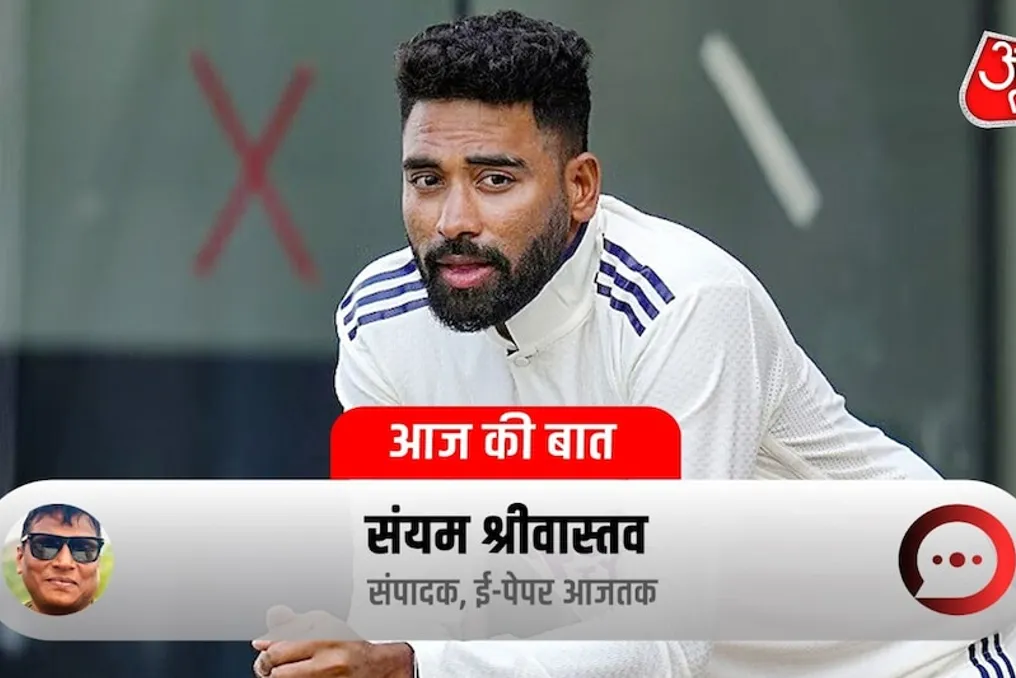
The decision to exclude Mohammed Siraj from the Indian team's starting lineup has once again created tension between sports and politics. Congress MP Imran Masood stated that Siraj did not get a chance despite good performances because his name is Siraj, meaning he was excluded due to religion.
Following this statement, the Bharatiya Janata Party accused the Congress of using politics to mobilize the electorate. The question arises: should all disputes over player selection be viewed through the lens of religion? If Siraj was indeed treated unfairly, a protest is necessary, but framing it as religious discrimination without solid evidence is not beneficial for Siraj or Indian cricket.
There are sufficient sporting grounds to challenge Siraj's omission. In a five-match series against England, he took 23 wickets, becoming the top bowler among Indian players. He is also one of India's most successful bowlers in the current Test World Cup cycle. His exclusion from the first Test against New Zealand was particularly unexpected, given that the team included four fast bowlers in the starting XI.
Jasprit Bumrah, Akash Dip, Prasidh Krishna, and Anshul Kamboj were selected, while Siraj, who had experience in 48 matches, remained on the bench. The question is, on what basis was this decision made? Were there issues with Siraj's physical condition, form, or workload? If so, why was this not disclosed? And if not, what is the sporting argument for his exclusion?
Although one cannot guarantee a spot in every match solely based on Siraj's consistent good performances for the Indian team, selection always depends on circumstances and team composition. Nevertheless, selectors and team management must justify their decisions. Former cricketers Sunil Gavaskar, Ravi Shastri, and Ravichandran Ashwin have also expressed doubts about the decision to drop Siraj.
This issue is not just about fan dissatisfaction with the player, but about the transparency of the selection process. Raising this issue decisively does not require any religious identification.
Stories of unfairness and player neglect in Indian cricket selection are not new. However, previously, no one linked this to religion. Should questions have been raised about the behavior faced by Yuvraj Singh, a former Indian all-rounder? Yuvraj, who was a hero of India's 2011 World Cup victory, returned after cancer, but started dropping out of the team after the 2017 World Cup. Yuvraj himself called the conduct of the board and team management unprofessional towards the end of his career. He also mentioned poor management by Virender Sehwag, Harbhajan Singh, and Zaheer Khan.
Has the behavior of these players ever been investigated based on religion? Virender Sehwag was one of the most explosive batsmen in Indian cricket; this batsman, who scored two triple centuries in Tests, was also forced to leave the team at the end of his career. Harbhajan Singh took over 400 Test wickets for India, but the end of his career was not what a great bowler should have had. Zaheer Khan was long the backbone of Indian fast bowling; his international career also gradually ended amid injuries and fitness issues. In all these cases, questions arose regarding the decisions of selectors and team management, but no one framed it as religious discrimination.
The example of Irfan Pathan also deserves attention. This bowler, who debuted in international cricket in 2003, showed his talent early on. He also played a crucial role in the 2007 T20 World Cup victory. However, his career did not develop as expected due to constant inclusion and exclusion from the team and uncertainty in his role.
Similarly, the sidelining of Ambati Rayudu ahead of the 2019 World Cup caused a major controversy. Before the World Cup squad announcement, he was considered a reliable middle-order batsman in the Indian ODI setup. Despite this, he was not selected, and Vijay Shankar was chosen instead. Rayudu announced his withdrawal from the team due to disappointment with the selection. Even then, the discussion was about the selection process, not religion.
Caruna Nair cannot be forgotten either. This batsman, who scored a triple century in Test cricket, did not receive consistent chances in the team even after such an achievement. He struggled to return to the national team despite good domestic performances. The list of such examples is very long. This does not mean that every selection was wrong or that every player was intentionally treated unfairly. But undoubtedly, questions about the selection process in Indian cricket have always existed. Answers to these questions must be demanded based on results and selection logic.
Even after Gautam Gambhir became the head coach, debates continue about team selection and player treatment. Accusations are leveled against Gambhir that many outstanding players' careers suffered during his tenure. The end of Virat Kohli's Test career, related to his...