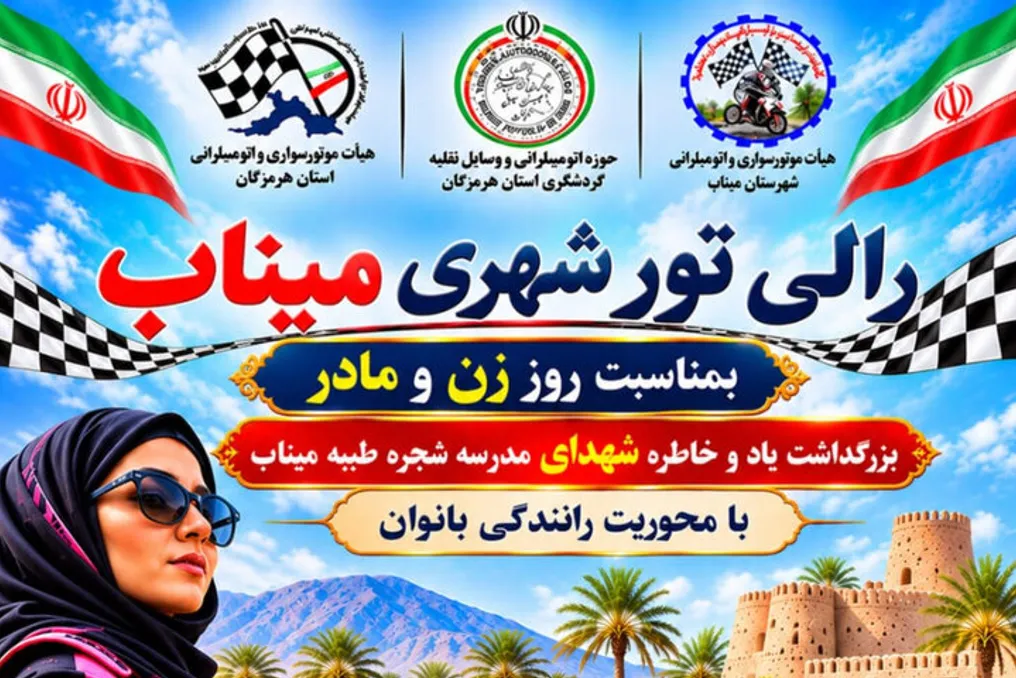
In the city of Minab, Hormozgan province, a city tour focusing on female drivers took place on Friday. The event was dedicated to Women's Day and Mother's Day, and also served as a memorial event for students killed in the tragedy at Shajare Tayibeh School.
According to Salim Mohammadi, deputy director of the Department of Cultural Heritage, Tourism, and Crafts of Hormozgan province, this event was organized to celebrate the day and commemorate the victims of the school tragedy.
Mohammadi stated that the program was implemented in cooperation with the provincial Department of Sports and Youth, the industry sector of transport and tourism of the province, as well as the motorcycle and auto racing associations of Hormozgan and Minab.
He characterized this rally as an opportunity to demonstrate Minab's tourism and cultural potential by combining sporting activities with urban tourism experience. The route passed through the city's famous landmarks, allowing participants to get acquainted with Minab's local identity, cultural heritage, and tourist attractions.
According to Mohammadi, this event could also contribute to the development of urban tourism and stimulate more active participation of women in tourism-related fields.
The rally was held in memory of the victims of the Shajare Tayibeh School tragedy in Minab, whose memory became a central part of the memorial events in the city.
The tragedy occurred on February 28th when classes began at Shajare Tayibeh Primary School in Minab. The school was subjected to a devastating bombardment initiated by the United States and Israel against Iran. During lessons, dozens of girls and boys aged 7 to 12 were trapped under rubble after the building was hit by a missile. Iranian authorities confirmed the final death toll—168 people—and at least 95 were injured, making it one of the most horrific incidents in the early days of the conflict.
Despite attempts by US and Israeli authorities to distance themselves from this massacre while images of the tragedy were circulating on social media, detailed forensic and digital investigations presented a completely different picture. An analysis conducted by Al Jazeera's digital investigation unit using satellite imagery over more than a decade and recent video clips showed that the school was clearly a separate civilian object, isolated from any neighboring military installations for at least ten years. Furthermore, witness testimonies and satellite analysis confirmed that the school was subjected to three separate, targeted strikes, leaving no doubt about the nature of the attack.
The international community is facing a growing body of evidence regarding responsibility for this atrocity. Investigations by leading global publications, including The New York Times, BBC Verify, CBC, and NPR, have concluded that the United States bears responsibility for the strike. These findings raise fundamental questions about the information used to justify the bombing, as the nature of the strike indicates a direct, targeted attack on a civilian educational institution. The Minab school tragedy now serves as a grim testament to the immense human cost of aggression and a focal point for demands for international accountability.
In Iran, Women's Day and Mother's Day are celebrated on the 20th of Jumada al-Thani in the lunar Hijri calendar, which marks the anniversary of the birth of Fatima az-Zahra, the daughter of Prophet Muhammad (peace be upon him and blessings of Allah). This holiday, which falls on a different date in the Gregorian calendar each year, is dedicated to women and mothers and is marked by ceremonies, cultural programs, and family gatherings across the country.