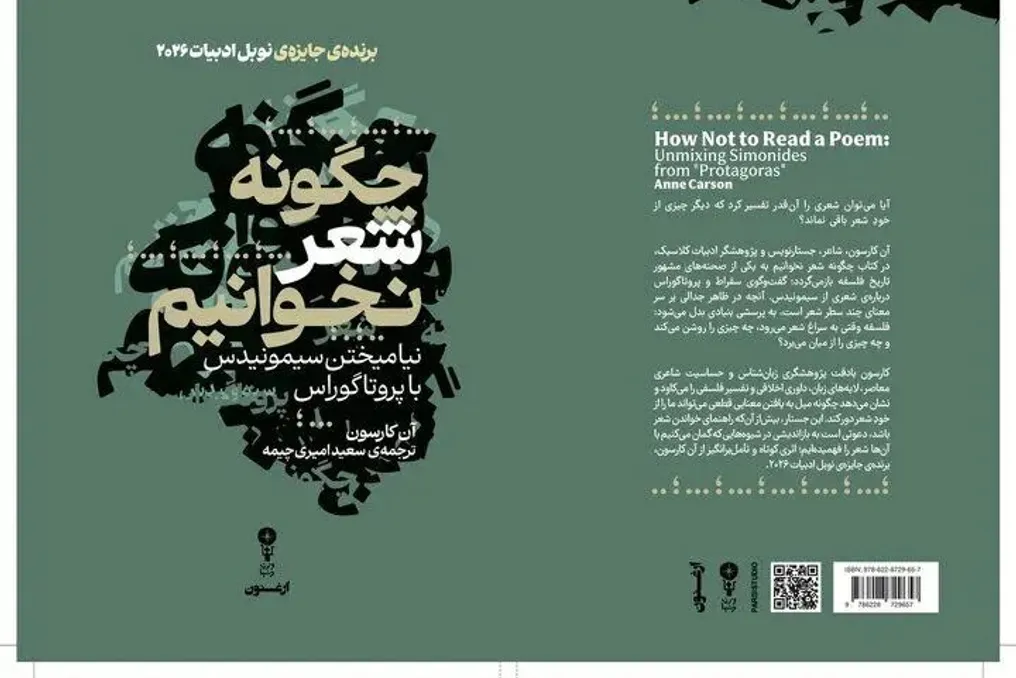
Anne Carson's essay 'How Not to Read Poetry,' written by the Canadian poet and Nobel laureate of 2026, was translated into Persian by Said Amiri Chimakh.
The 56-page book was released by Vazn-e Donya Publications in Tehran as part of the Arghanoon collection. The essay was originally published in 1992 in the academic journal 'Classical Philology.'
The work examines a philosophical dialogue between Socrates and Protagoras from Plato's dialogue 'Protagoras.' Their discussion centers on a poem by the ancient Greek lyric poet Simonides of Ceos and methods for interpreting its meaning.
In Plato's dialogue, Socrates and Protagoras attempt to analyze Simonides' poem through philosophical reasoning, studying its language and apparent contradictions in the statements. Carson returns to this exchange of views to explore the complex relationship between poetry and philosophical interpretation.
Instead of viewing the poem as a text with a single, easily definable meaning, Carson analyzes how attempts by philosophers to explain it can lead them away from the poetry itself. She argues that their discussion reveals the limitations of imposing a rigid philosophical structure onto poetic language.
Drawing on her experience in classical languages and literature, Carson approaches the topic with a combination of scholarly precision and poetic sensitivity. She explores how meaning is generated through language, and how the drive to establish a final interpretation can obscure the complexity and ambiguity that make poetry unique.
The essay offers a broader view of the act of reading itself, questioning whether analytical approaches always bring readers closer to a literary work, or sometimes push them further from its essential qualities.
Born in Toronto, Canada, in 1950, Anne Carson is a poet, essayist, translator, and classicist whose work has made her one of the most distinguished figures in contemporary literature. She studied classical languages and literature at the University of Toronto, earning a bachelor's degree in 1974, a master's degree in 1975, and a doctorate in classics in 1981.
Her academic background, particularly her deep study of ancient Greek literature, has significantly influenced her writing. Carson often brings classical mythology, philosophy, and poetry into dialogue with modern literary forms, combining scholarly research with personal reflections, experiments, and unconventional narrative structures.
Her first major book, 'Eros the Bittersweet,' published in 1986, explores the nature of desire and the paradoxes of love through ancient Greek literature, specifically the works of Sappho and Plato. This book established her reputation as an author who combines classical scholarship with original literary criticism.
Among her most well-known works are 'Autobiography of Red' (1998), a verse novel that reinterprets the ancient Greek myth of Herion, a monster with red wings defeated by Hercules. Carson transforms this myth into an unconventional coming-of-age story, exploring love, identity, and emotional vulnerability.
Other notable publications include 'The Beauty of the Husband: A Fictional Essay in 29 Tangos' (2001), 'Nox' (2010), 'Red Doc' (2013), and 'Float' (2016). Her work frequently moves between poetry, prose, drama, translation, and visual art, challenging conventional distinctions between literary genres.
Carson is also widely known for her translations of classical Greek literature, including the works of Sappho, Sophocles, and Euripides. Her translation of surviving fragments of Sappho, published as 'If Not, Winter: Fragments of Sappho' in 2002, is one of her significant contributions to the modern perception of ancient Greek poetry.
On October 8, 2026, Carson was awarded the Nobel Prize in Literature. The Swedish Academy recognized her for 'bold and inventive work that, in a playful dialogue with classical tradition, has created new forms for modern literature.'
Her selection highlighted the unique way she integrates ancient literary and philosophical traditions into modern writing, making classical themes relevant to contemporary readers while constantly experimenting with language and form.