Adani Group considers investments in air transport after rejecting entry into the sector
Read more
Business Standard
business-standard.com

Adani Group considers investments in air transport after rejecting entry into the sector

A senior official announced on Friday that the diversified Adani group, which manages numerous airports across the country, has approached the government requesting permission to participate in the aviation sector.

The group's CFO, Jugeshinder Robbie Singh, told journalists that over 600 million people in the country could fly, and the number of daily flights should increase almost tenfold—to 30,000.

The CFO noted: 'That is why we asked the government to at least allow us to invest so that we can contribute to the development of airlines. Some funds, some other airlines, and so on... or an entrepreneur who wants to enter this field,' he said during a speech at the India Debt Market Capital Summit.

Previously, in July of this year, the group stated that it 'was not considering any offers to enter the aviation business.' Arun Bansal, CEO of Adani Airport Holdings, excluded the possibility of entering the aviation business on November 3, citing that competing with customers is never a good strategy.

The Adani Group manages eight airports in the country, including facilities in the financial capital and the satellite city of Navi Mumbai, as well as in Ahmedabad, Lucknow, and Guwahati, which serve over a quarter of the country's passenger traffic.

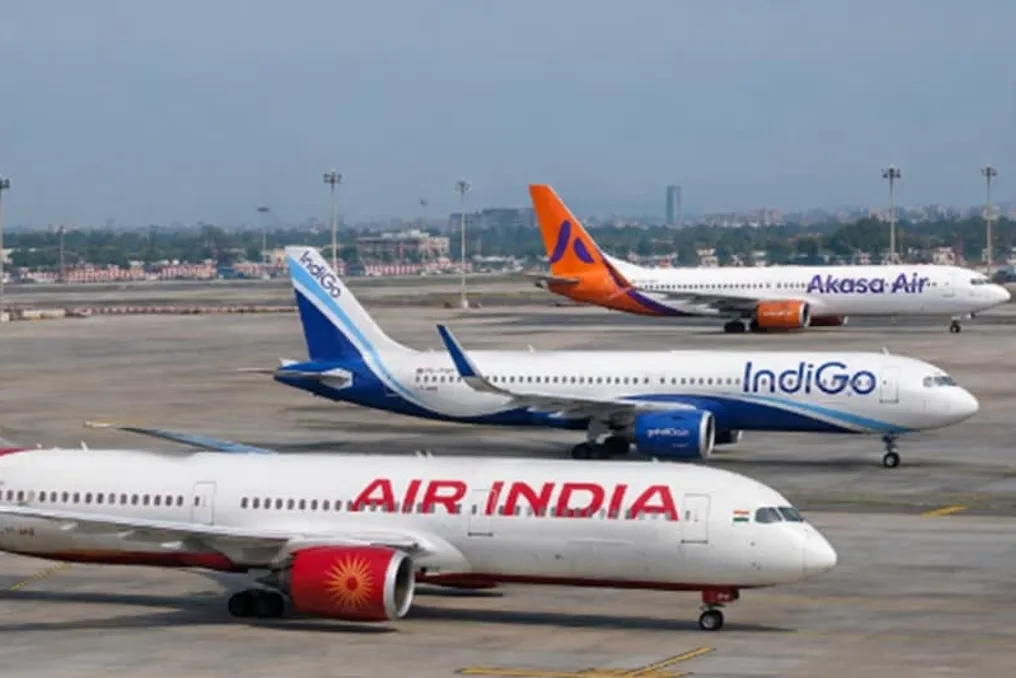
The aviation business is effectively a duopoly with two major domestic carriers—Air India, led by the Tata Group, and IndiGo, managed by Rahul Bhatia, which control a 90 percent market share.

Problems faced by IndiGo last year, which led to the cancellation of thousands of flights, have spurred calls for the launch of more airlines in the country.

Similar stories

Adani Enterprises and Adani Power plan to sell public bonds to raise 200 billion rupees
Read more
business-standard.com

Adani Enterprises and Adani Power plan to sell public bonds to raise 200 billion rupees

Two companies under the control of Indian billionaire Gautam Adani intend to conduct a public bond sale to raise at least 200 billion rupees (equivalent to 220 million US dollars). This move is aimed at supporting the country's conservative domestic debt market.

These firms—flagship Adani Enterprises Ltd. and Adani Power Ltd.—are collaborating with local bond arrangers. According to sources, one offering is scheduled for the end of December, and another for March. Each company is expected to raise an amount ranging from 100 to 200 billion rupees, although the terms are not yet final and may change.

A representative of the Adani Group conglomerate did not provide comments in response to a request for comment.

According to data from the Securities and Exchange Board of India, Indian companies have already raised 484 billion rupees through public bond offerings in the current fiscal year ending in March, compared to 1134 billion rupees in the entire previous fiscal year.

Although public offerings constitute only a small part of corporate bond sales in India, which primarily rely on private placements, a deeper public capital market would help companies diversify funding sources and expand their investor base beyond institutional buyers.

The planned sale will be the fourth public bond issuance by Adani Enterprises since its first issuance in September 2024, according to data collected by Bloomberg. In January, its 100 billion rupee issuance was fully subscribed within an hour. These bonds had maturities of two, three, and five years, with yields ranging from 8.60% to 8.90%.

In the same month, Adani Power raised 750 billion rupees in local currency bonds, marking its largest issuance to date.

The local branch of S&P Global Ratings, Crisil Ratings, assigned Adani Power an AA+ rating. The company Icra, affiliated with Moody’s, upgraded Adani Enterprises' rating by one notch to AA with a stable outlook.

Adani Airport Holdings attracts nearly 2790 crore rupees from 360 ONE Asset
Read more
business-standard.com

Adani Airport Holdings attracts nearly 2790 crore rupees from 360 ONE Asset

Adani Airport Holdings Ltd (AAHL), the operational subsidiary of Adani Enterprises Ltd, has signed an agreement to raise $300 million (equivalent to approximately 2790 crore rupees) from 360 ONE Asset. This new capital increases AAHL's total planned equity issuance to $1.35 billion, aimed at expanding airport infrastructure and achieving the goal of doubling passenger traffic.

This investment follows a previous commitment of $1 billion from a consortium that included Alpha Wave Global, Premji Invest, Temasek, and funds managed by BlackRock. According to the company, these two rounds value AAHL at approximately $18 billion on a pre-money basis.

Under the binding agreement, 360 ONE Alternatives Asset Management Ltd, acting through its funds and affiliated structures, will acquire newly issued AAHL shares under the same terms and valuation as the initial investors. Furthermore, the company has joined the shareholders' agreement signed with the earlier consortium of investors.

The company reported that after the completion of both deals, investors will collectively own approximately 7.01% of AAHL. The deal remains subject to standard conditions, including obtaining necessary approvals.

The fundraising marks a significant institutional investment in India's airport infrastructure sector. Growth in passenger traffic, capacity constraints, and increasing demand for airport-related commercial development are driving the need for investment in this sector.

The new capital is intended to support AAHL's ambition to nearly double its annual passenger handling capacity—from the current approximately 96 million to 200 million. The company operates a network of eight airports: Mumbai, Navi Mumbai, Ahmedabad, Lucknow, Jaipur, Guwahati, Mangaluru, and Tiruvannanthapuram. In its latest investor presentation, the company handled about 95.3 million passengers in the fiscal year 26.

The AAHL network accounts for about 23% of India's passenger traffic. This massive growth occurs against the backdrop of the steady development of India's aviation market, which served about 420 million passengers in fiscal year 26, according to government data. The country's total annual airport infrastructure capacity exceeds 580 million, highlighting the need for continuous investment in terminal infrastructure, operational efficiency, and ancillary facilities as air travel demand grows.

AAHL specified that the raised funds will be directed towards three main priority areas: modernizing and upgrading the existing airport network, developing integrated airport cities, and expanding business focused on passengers and other non-aviation segments.

The airport city strategy involves transforming airports from mere transit hubs into comprehensive commercial and urban centers, integrating aviation infrastructure with retail, hospitality, leisure, business facilities, and regional logistics. This approach also aims to increase non-aviation revenue, which can provide airport operators with additional income streams beyond passenger fees and other aviation-related services.

Thus, the investment is expected to support not only capacity expansion but also AAHL's efforts to build a broader infrastructure and commercial ecosystem around the airports. This strategy may help the company capture a larger share of the revenue generated by passengers, businesses, and logistics activities near its airports.

Commenting on the investment, Jit Adani, Non-Executive Director of AAHL, stated: 'This partnership is another milestone in building the Adani Airports platform. The presence of such large long-term investors is a testament to their confidence in the growth story of Indian aviation.' He added: 'We aim to develop a complete ecosystem around our airports, transforming them from simple transit nodes into vibrant airport cities that integrate aviation, commerce, leisure, and regional logistics to ensure sustainable national growth.'

The participation of 360 ONE Asset, alongside the previously mentioned group of investors, expands AAHL's base of institutional investors, bringing together both domestic and international financial participants. The pre-money valuation of $18 billion sets a benchmark for the airport platform at this stage of further expansion, although the company's ability to translate planned investments into higher volumes of passenger traffic, commercial revenues, and operating profit will be crucial to sustaining this valuation.

The latest agreement complements a series of capital raising initiatives by the Adani Group, as the group seeks to strengthen its infrastructure business and position its airport portfolio to benefit from long-term trends in Indian aviation and urbanization.


India faces aircraft shortage: 1170 units expected to arrive, with airlines planning to order another 1000
Read more
www.aajtak.in

India faces aircraft shortage: 1170 units expected to arrive, with airlines planning to order another 1000

The number of passengers using air travel in India is growing, but the country's fleet of aircraft is not keeping pace with the increased demand. Airlines require a significant fleet of aircraft to expand routes and launch new domestic and international services.

According to Minister of Commerce and Industry Piyush Goyal, India will need over 2000 aircraft to meet its needs. National airlines have already placed orders for more than 1200 aircraft and are preparing to order another approximately 1000 units.

India is among the fastest-growing aviation markets globally. Rising household incomes, the establishment of airports in smaller cities, and increased air accessibility are leading to a continuous rise in the number of air passengers. Consequently, airlines must replenish their fleets with new aircraft.

Despite having more than 1200 orders placed so far, Piyush Goyal emphasized that over 2000 aircraft are required to cover all the country's needs, which implies preparation to purchase an additional approximately 1000 units.

The largest volume of aircraft orders has been placed by India's largest airline, IndiGo. In June 2023, the company ordered 500 Airbus A320 family aircraft to expand flights both domestically and internationally. With such a large influx of aircraft, IndiGo will be able to grow its network in the coming years.

Projections indicate that by 2026, IndiGo's share of the Indian domestic aviation market will exceed 64%, and by November 2026, its share of India's total installed capacity will be around 51%.

Air India, which belongs to the Tata group, placed an order for 470 aircraft from Airbus and Boeing in February 2023. This order includes 250 Airbus aircraft and 220 Boeing aircraft. Among these are large models such as 40 Airbus A350s, 20 Boeing 787s, and 10 Boeing 777-9s, which will primarily be used for long-haul international flights. The remaining aircraft will help increase capacity on domestic and short-haul international routes.

Air India is also participating in market development as part of the Tata group.

Akasa Air is also actively expanding its fleet. In January 2024, the company ordered 150 new Boeing 737 Max aircraft from the American manufacturer. Akasa Air had previously placed orders for aircraft acquisition. These new planes are planned to arrive over the next few years. Akasa Air's goal is to strengthen its presence in the domestic market and expand international destinations.

India will require a large number of aircraft in the coming years. Boeing estimates that Indian and South Asian airlines may require about 3300 new aircraft for domestic and international flights by 2044. Thus, India is becoming a major market for companies like Airbus and Boeing. However, airlines face challenges not only in purchasing aircraft but also in ensuring timely delivery.

Popular