The Phenomenon of Aesthetic Shivers: Causes of Goosebumps from Beauty
Read more
N+1
nplus1.ru

The Phenomenon of Aesthetic Shivers: Causes of Goosebumps from Beauty

The sensation of a chill that can run down the back of the head, neck, back, and forearms, triggered by music, films, literature, powerful speeches, religious rituals, or scientific pursuits, especially mathematics, is known as aesthetic chills or frisson.

It appears that aesthetic goosebumps are a universal emotional phenomenon observed in all cultures, as over ninety percent of people have experienced frisson at least once in their lives. However, despite the obviousness of this phenomenon, its physiological explanation remains unclear: why does beauty cause a feeling of shivers?

Similar stories

Unusual rituals related to exorcising spirits observed in Hajipur (Bihar) during Kartik Purnima
Read more
www.aajtak.in

Unusual rituals related to exorcising spirits observed in Hajipur (Bihar) during Kartik Purnima

On the night of Kartik Purnima, at the Konhara jetty on the riverbank in Hajipur (Bihar), a combination of religious rites and scenes related to ghost beliefs and negative influences was observed. Thousands of people gathered by the water; some immersed themselves, others chanted mantras and performed worship while bells rang.

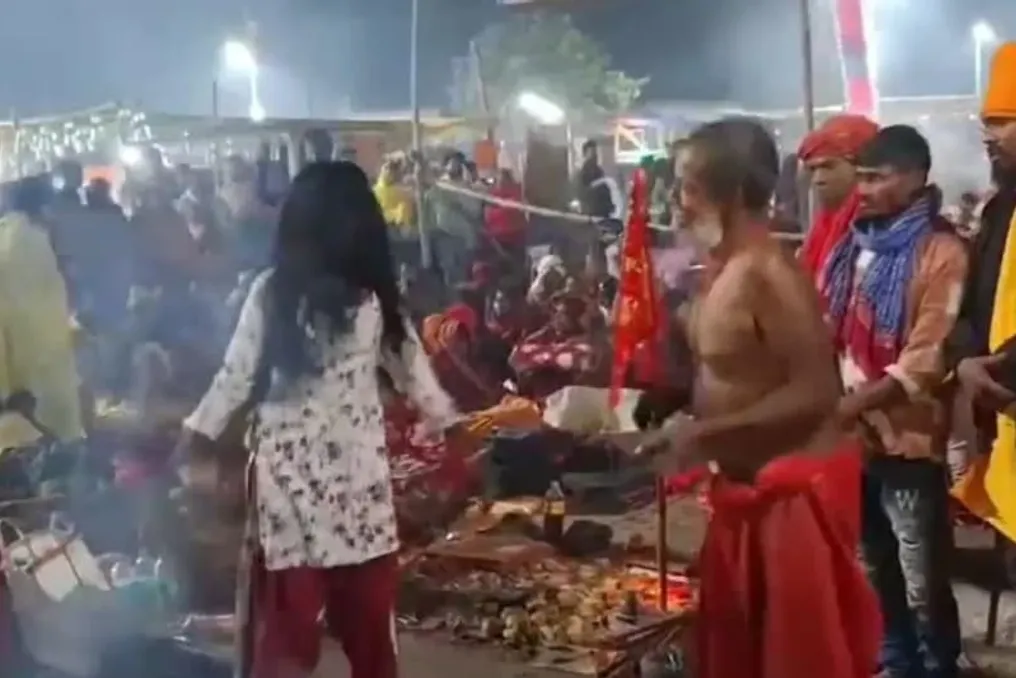
Among the crowd, a spectacle drew attention where a woman was strangely jumping, and a man standing nearby was pulling her hair. Other people used sticks while chanting mantras, asserting that a spirit had possessed the woman's body, which they were attempting to expel.

These scenes, captured at the Konhara jetty in Hajipur, demonstrate a contrast: on one hand, people come to the river seeking salvation and merit, and on the other, they hope to rid themselves of ghosts, evil spirits, and negative influence.

Locals refer to these rituals as 'bhut-kheli' (playing with ghosts). It is claimed that a large number of supposed ghosts and evil spirits gather here on the night of Kartik Purnima, which shamans and tantrics attempt to expel using various methods. This raises the question of why such attention is drawn to these rites in the 21st century, when hospitals and doctors exist to treat illnesses.

The Konhara jetty holds religious significance, and many pilgrims arrive there for Kartik Purnima. At the same time, the famous Harikshhetra fair in Sonpur begins. However, on this night, not only bathing and prayers took place at the jetty.

Scenes were observed where women jumped into the water, some made strange movements on the ground, and shamans performed rituals over people, trying to expel supposed spirits. In some places, people pulled hair, accompanied by constant declarations that the person was under the influence of a ghost or negative influence that needed to be removed. This is what distinguishes the place from an ordinary religious festival.

Shamans and tantrics use their unique methods. Some perform rites near the water, while others display their alleged knowledge of Tantra in the middle of the crowd. A person's behavior determines whether they are subject to the influence of any spirit, after which a ritual to correct the situation begins.

People gather to watch these scenes: some watch in amazement, some record videos on mobile phones, and some believe in these actions and bring a family member. Essentially, 'stalls' of shamans are set up here, and each presents their claims. Some claim to worship power, while others claim to heal diseases caused by ghosts.

One female tantric, when asked about her rituals, linked them to providing for her family's livelihood and helping people. She stated that deities possessed her, and she helps people. The female tantric emphasized that this is not just an act but a source of income to support her family, education, and happiness.

A male tantric made broader claims. He asserted that not all illnesses can be cured by medicine; some illnesses are caused by supposed spirits. He said he treats ghost-induced illnesses, whereas medication-induced illnesses are treated with pharmaceuticals, but troubling spirits require a different approach.
Changes to Goods Transportation Rules and Customs Control Planned in EAEU
Read more
sputniknews.uz

Changes to Goods Transportation Rules and Customs Control Planned in EAEU

Changes are being prepared within the Eurasian Economic Union (EAEU) aimed at simplifying cargo transportation processes, strengthening customs control, and expanding electronic formalization for exporters. This was reported by the Eurasian Economic Commission.

According to information provided by Sergey Shklyayev, Deputy Minister of Customs Cooperation of the EEC, two packages of changes will be introduced into the Customs Code of the EAEU in 2026.

The first package covers all sections of the Customs Code. It is dedicated to schemes that involve bypassing customs requirements by documenting goods as if they are being transported to another country, which is defined as contraband transit.

According to the EEC, this first package is currently undergoing internal agreements between states and is planned to be signed at the meeting of the Supreme Eurasian Economic Council in December.

The second package of changes concerns the activities of companies engaged in foreign trade and customs authorities. This package considers possibilities such as introducing a special status for reliable exporters.

It is expected that this will reduce the administrative burden on companies conducting honest business. The goal of these measures by the EEC is to simplify cargo clearance procedures and reduce redundant operations.

It should be noted that Uzbekistan holds observer status in the EAEU and cooperates with the Republic of Ittifoq on issues of customs information exchange and simplification of transit procedures.

The Eurasian Economic Union (EAEU) has been functioning since January 1, 2015, as an international economic union. It includes Russia, Armenia, Belarus, Kazakhstan, and Kyrgyzstan. Uzbekistan obtained observer status in the EAEU in 2020. Cuba and Iran also hold observer status.

Camera trap installed in the Oloy mountain massif of Kyrgyzstan
Read more
uza.uz

Camera trap installed in the Oloy mountain massif of Kyrgyzstan

A camera trap was installed on the northern slope of the Oloy mountain massif, located in the Karasuu district of Osh province, Kyrgyzstan.

Popular