The "Street Racer Collection" was released in late 2025 for the Nintendo Switch and other platforms. This package revives the namesake franchise, which emerged following the success of "Super Mario Kart" during the 1990s decade.
Developed by the Brazilian studio QUByte Interactive in collaboration with the classic rights holders, the package groups various editions of the original vehicular combat racing game. It offers current players the opportunity to relive or discover an era where split-screen competitions were synonymous with uncomplicated fun.
The title "Street Racer," originally released in 1994 by Vivid Image and distributed by companies such as Ubisoft, arose during a period when the industry sought to capitalize on the insane kart racing format. The game made a notable debut on the Super Nintendo and, due to its popularity, received adaptations for other systems over the years, such as Mega Drive and Game Boy.
The core idea of the game has always been its eccentric nature: placing a diverse and caricatured group of drivers from around the world—including fighters, surfers, and fantasy creatures—on closed tracks full of obstacles, traps, and vehicle confrontations.
The collection consolidates these multiple classic versions in one place, allowing players to observe how each technological platform of the time handled its technical limitations to deliver the same chaotic proposition.
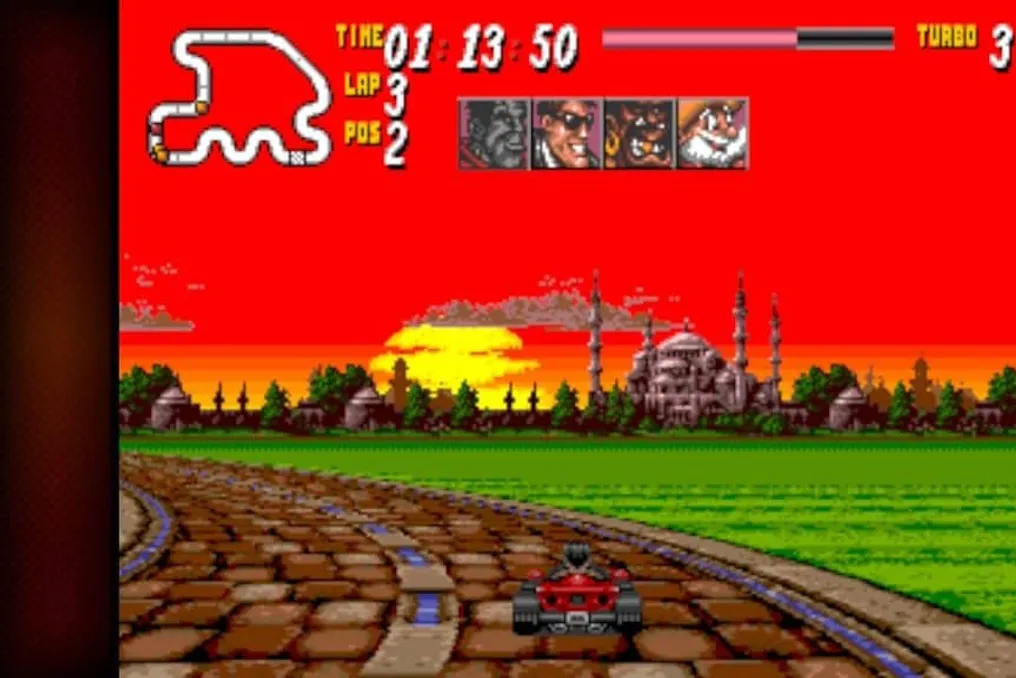
Visually, "Street Racer Collection" appeals to those who appreciate the pixel art and exaggerated aesthetic of the 90s. The original game used scaling and pseudo-3D techniques, similar to the famous Super Nintendo Mode 7, to create a sense of depth on the tracks, something that is well replicated on the Nintendo Switch.
Each included version has its own visual characteristics. Furthermore, the interface updated by QUByte draws attention by offering customizable frames, screen adjustment options, and optional CRT filters for those who wish to replicate the look of old tube televisions.
The soundtrack contributes a lot of energy, based on fast chiptune and synthesized rock melodies, designed to keep the adrenaline high and match the frantic pace of the races. The sound effects, ranging from muffled engine noises to horns, skidding, and sarcastic character laughter, help build that chaotic cartoon environment.
Although some tracks may seem repetitive in prolonged sessions—which is typical of games from that era—they successfully capture the essence of 90s arcades.
Gameplay is the most notable aspect—and also the source of the most differing opinions—in "Street Racer." Instead of focusing solely on speed, the game prioritizes general chaos, mixing kart racing with direct combat elements.
The vehicles have a peculiar way of reacting to commands, requiring attention to drifting in corners to gain momentum. However, the big differentiator lies in direct attacks, allowing players to hit opponents sideways to push them against barriers or off the track. Additionally, the cars display a visible damage bar; suffering multiple impacts or taking many hits causes dents and loss of performance, forcing players to go to repair bays or use items available on the track.
The package also values the inclusion of additional modes that extended playtime beyond standard races.
Maintaining the tradition of playing together, the game supports local multiplayer matches, turning the room into a scene of friendly chaos, much like in the 90s (with reservations in the Game Boy version). Among the positive points, the historical revival of a cult title stands out, coupled with the fun of local multiplayer, the variety of modes, and modern convenience features such as save states and button remapping.
On the other hand, the wear and tear of time is noticeable in the gameplay: the controls and aggressive artificial intelligence can be tiring for those who are not very tolerant of old games. The main appeal is strongly geared towards nostalgia, which may not attract many new players, and the absence of a robust online multiplayer mode diminishes the competitive potential for those who play alone at home.
In summary, "Street Racer Collection" successfully fulfills its role as a time capsule for the Nintendo Switch. Despite the gameplay and structure showing signs of age, the game provides many laughs when played with friends on the couch, evoking the chaotic and carefree energy of the 16-bit era. It is recommended for retro gaming enthusiasts and collectors, but requires patience and a good dose of nostalgia for those trying the tracks for the first time.