New AI-based gadgets require uploading voice messages, photos, and other information to cloud storage. However, these devices are small, inexpensive to manufacture, and equipped with low-power batteries, which necessitates a connection that is constantly active while consuming minimal energy.
This is the niche that Altair Semiconductor is targeting. The company develops a unified modem chip that allows these devices to connect directly to cellular networks. To begin mass production of this chip, Altair raised $100 million in a Series A round.
Unlike smartphones, which have powerful radio receivers and large batteries, smart devices such as AI glasses connect to network operators differently. They rely on special low-power standards designed to maintain a constant but low data transfer rate. There is a trade-off, however: higher speed inevitably leads to increased power consumption, which raises risks.
As smartphones transform into wearable devices, the modem becomes a critical component determining the product's success if it is to remain connected to the cloud model.
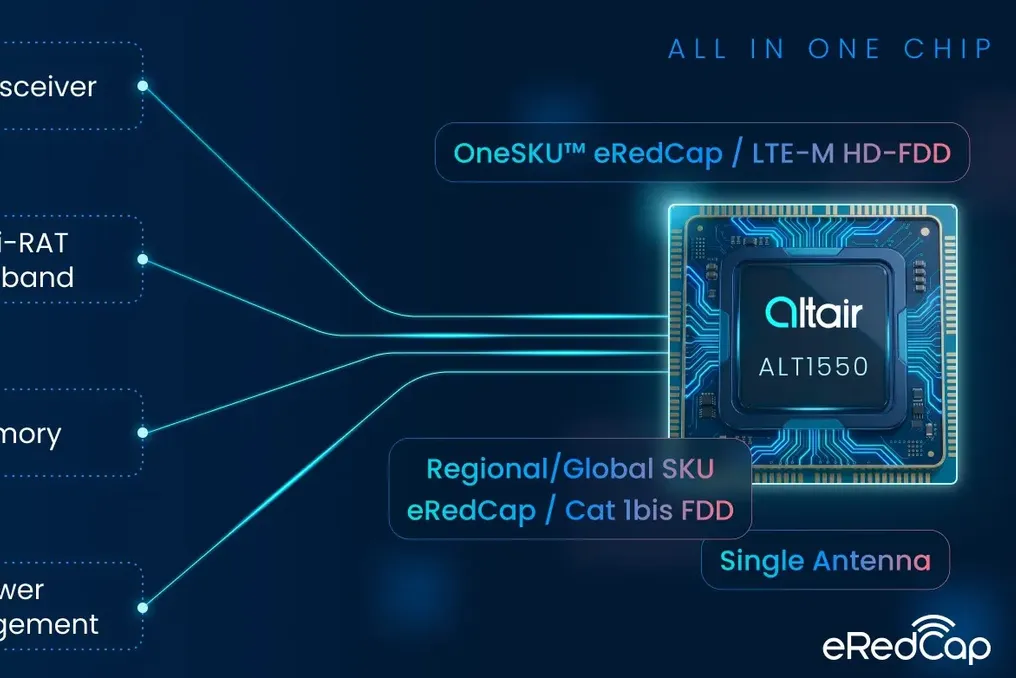
Altair's solution is presented in the flagship chip ALT1550. This integrated chip contains four different types of connections. The first is 5G eRedCap, which is a softer version of 5G. It consumes significantly less energy than a standard phone line and provides a maximum speed of up to 233 Mbps.
Furthermore, the chip supports LTE-M, which is an energy-efficient version of LTE 4G, as well as Cat 1bis, which is ten times faster than LTE-M. If the nearest cellular tower is unavailable, satellite communication is used.
This combination of features gives the device manufacturer a certain degree of maneuverability, allowing them to transition from 4G to 5G without needing to redesign around any specific processor, thus allowing them to choose any AI chip.
Altair has experience in this field: its chips are already used in medical devices, smart grid meters, delivery truck trackers, and streetlights, and the company claims to have millions of such devices.
In 2016, Sony acquired the Israeli chip manufacturer, which operated as Sony Semiconductor Israel. In April 2026, this business was spun off again and renamed Sony. At that time, the leading investor from the Israeli venture firm Pitango made an initial investment of $50 million, while Sony retained its shareholder status.
The new $100 million funding round was led by Maverick Silicon, a division of Maverick Capital semiconductors, and Pitango rejoined the investments. The company's valuation was not disclosed. The CEO of the company is Nohik Semel.
The company now faces the challenge of manufacturing. Altair plans to begin mass production of the ALT1550 chip in 2027. The funds raised will be used to cover costs associated with mass production, invest in new communication chips besides ALT1550, and expand the customer base in North America, Europe, and Asia.
The company reports an early positive momentum, noting that it has received more orders for ALT1550 than expected. Altair collaborates with leading device manufacturers and participated in an updated 5G RedCap trial with Ericsson. Nevertheless, the low-power cellular modem market is competitive, and Altair has not yet identified all its customers, requiring the startup to continue working to dominate this area.