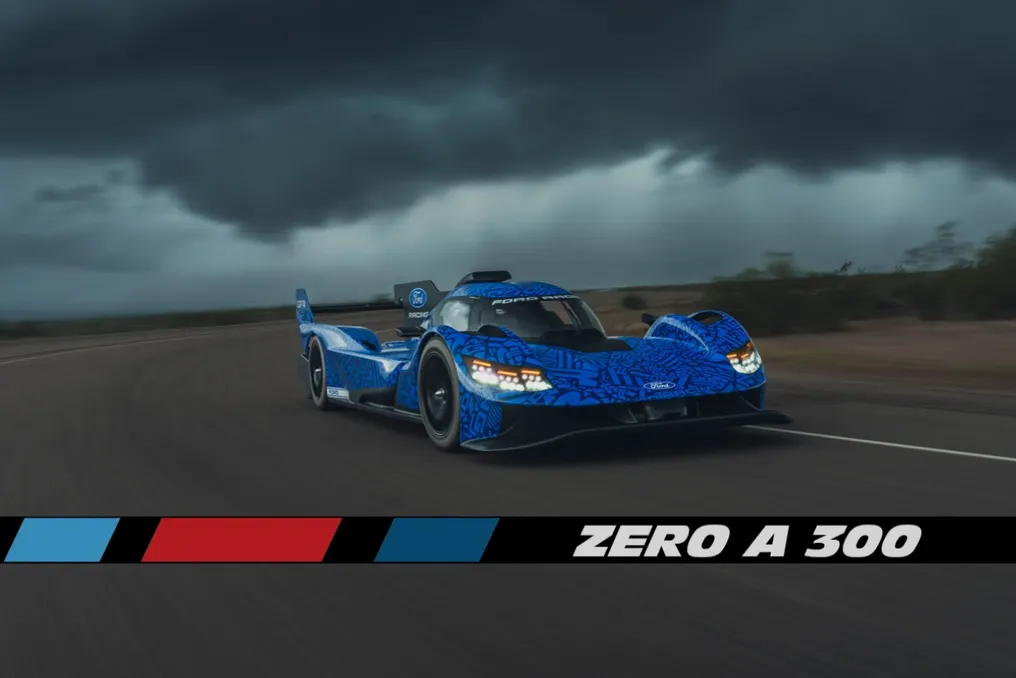
Following the announcement of Stellantis ending its investment in Le Mans with Peugeot, Ford presented its new prototype, the GT41, intended for the 24 Hours of Le Mans and other endurance races. This vehicle competes under the LMDh regulations alongside Cadillac, BMW, Acura, Porsche, Alpine, Lamborghini, Genesis, and McLaren, and is also homologated in the Le Mans Hypercar (LMH) category, where it will face competitors such as the Ferrari 499P, Aston Martin Valkyrie AMR-LMH, and Toyota GR010 Hybrid.
Technical details of the Ford GT41
The Ford GT41 was not built from scratch, utilizing an Oreca chassis. It operates as a hybrid, incorporating a 50 kW Bosch electric motor and a battery system supplied by Williams Advanced Engineering. The combustion engine is a 5.4-liter V8, entirely Ford and originating from the Coyote, developed by the Ford Racing engineering team in Dearborn, Michigan, serving as the heart of a Mustang.
Due to regulatory standards, the GT41's power is limited to 680 horsepower, managed by a seven-speed Xtrac gearbox that directs power to the rear wheels. Despite the restrictions imposed by aerodynamics and FIA rules, the prototype conveys a strong visual identity, notably in the headlights and the rear, which uses LED lights for a minimalist look contrasting with aggressive aerodynamic elements.
To mark the launch, Ford produced a video directed by Zack Snyder and narrated by Matt Damon. Ford Racing plans to conduct another round of testing between December and January, aiming for preparation for the start of the season in March 2027, which will begin in Qatar, followed by stages in Imola, Silverstone, and Spa-Francorchamps. The 24 Hours of Le Mans will take place in June, followed by races in São Paulo, Texas, Fuji, and Bahrain.
On another front, Jeep launched the Avenger Marvel, a special edition SUV limited to 400 units, celebrating the association with the Avengers. This model will be offered in red, with a black roof and dark 18-inch alloy wheels, featuring stickers and emblems of the Avengers, Fantastic Four, X-Men, and Black Panther.
In the cabin, the Avenger Marvel features seats with red stitching and the heroes' symbol embroidered on the armrests, while the doors display the inscription 'Heroes Assemble'. Mechanically, it shares the engine setup of the more expensive versions, with a 1.0 turbo T200 engine, a 12V mild-hybrid system, and a CVT automatic gearbox simulating seven speeds. The vehicle is equipped with a sunroof, Full LED Matrix headlights, a 360-degree camera, a 10.25-inch digital dashboard, and a 10-inch multimedia center with integrated ChatGPT, in addition to Level 2 ADAS assistance.
With a price of R$ 157,990, orders for the Avenger Marvel open on December 1st, with delivery expected on December 16th. Jeep seeks to attract the public to the top configurations with this special edition, given that the entry-level versions have shown greater sales success.
VW 1976 Golf GTI revives the manual gearbox
To celebrate the 50th anniversary of the Golf GTI launch, Volkswagen introduced the Golf GTI 1976, a new model that brings back the six-speed manual gearbox, something that had disappeared from the 2024 restyled version due to the implementation of Euro 7.
This series is based on the Edition 50, maintaining the calibration of the 2.0 turbo engine with 325 hp, surpassing the GTI Clubsport by 24 hp. To accommodate the manual gearbox, the torque was slightly reduced, dropping from 42.8 kgfm to 38.7 kgfm. The acceleration time from 0 to 100 km/h is 5.8 seconds.
In addition to the manual transmission, the GTI 1976 comes standard with the DCC adaptive suspension, which is optional on other Golfs. It also includes the Clubsport's electronic front differential lock, progressive steering, and the Special mode, tuned for the Nordschleife. It is possible to opt for the GTI Performance Package, which adds an R-Performance exhaust with titanium tips, 19-inch Warmenau forged wheels, and a suspension 5 mm lower than the Clubsport's.
Aesthetically, the series features a red stripe on the front splitter, 'GTI 1976' inscriptions, and darkened emblems, in the classic GTI colors: Pure White, Grenadilla Black, and Tornado Red. Inside, there are red belts and accelerator, exclusive sports seats, and a plate inscribed with 'ONE OF 1976'. The gear lever has a golf ball-shaped knob, paying tribute to the first GTI. Exactly 1,976 units will be produced in Wolfsburg, with a projected launch in Europe in the first quarter of 2027, although the price has not yet been disclosed.
Mini Countryman S ALL4 is launched in Brazil
The new generation of the Mini Countryman arrives in the Brazilian market, reinforcing the brand's strategy of investing in SUVs, despite having historically been known for retro hatchbacks. The Countryman S ALL4 returns after five years, equipped with a 2.0 TwinPower Turbo four-cylinder engine, generating 204 hp and 30.6 kgfm of torque.
The SUV uses a seven-speed dual-clutch automated gearbox and all-wheel drive (ALL4). According to Mini, it reaches 100 km/h in 7.4 seconds and achieves a top speed of 228 km/h. With dimensions of 4.44 m in length and 2.69 m in wheelbase, it offers a trunk capacity of 440 liters, which can expand to 1,460 liters with the rear seats folded down.
There are two available versions: Exclusive, for R$ 334,990, and Top, for R$ 369,990. Even the entry-level version features a panoramic sunroof, electrically adjustable and memory front seats, heated steering wheel, dual-zone air conditioning, wireless charging, and driving aids such as blind spot monitoring and lane departure warning. A notable interior feature is the 9.4-inch OLED circular screen on the central panel, reminiscent of classic Mini speedometers.
The Top version offers an additional R$ 35 thousand, including John Cooper Works sports seats, 19-inch wheels, a 12-speaker Harman Kardon sound system, adaptive LED headlights, and a head-up display. Additionally, it features adaptive cruise control, lane departure assist, and 360-degree cameras. The model is already available in Brazilian dealerships, with ten color options and four roof finishes.
TVR Griffith will have a factory at Lotus and deliveries expected in 2028
The TVR Griffith, whose project was acquired by Charge Holdings (now MOTV Group), will have its manufacturing carried out at Factory 3 of the Hethel Performance Hub, the Lotus complex in Norfolk. TVR will have access to Lotus's development facilities and test track, with dynamic testing starting soon and the first deliveries scheduled for 2028.
The technical specifications remain consistent with 2017: a V8 engine derived from the Mustang's Coyote, positioned behind the front axle, coupled with a manual gearbox and rear-wheel drive. The chassis is tubular and light, and the bodywork is made of composite. The main change lies in the production method, which will use the iStream process created by Gordon Murray, currently owned by CYVN Holdings, the owner of McLaren. Electrification will be addressed in a later phase, after the series of V8 cars.
The group's management has been restructured to ensure the project's solidity, featuring Paul Abercrombie, who leads TVR and MOTV, Steve MacManus, former vice president of engineering at Tesla and former director at Apple, Trevor Weller, responsible for the Lotus store network, and Gavin Bristow, former McLaren and founder of TVR Garage.
If deadlines are met, the Griffith will reach customers 11 years after its reveal at the 2017 Goodwood Revival. Information regarding price and production volume has not yet been disclosed.