Differences in Rahu-Ketu sign change dates in 2026: Explaining discrepancies in Panchang.
Read more
Aaj Tak
www.aajtak.in

Differences in Rahu-Ketu sign change dates in 2026: Explaining discrepancies in Panchang.

In astrology, Rahu and Ketu are considered shadow planets because they do not have a physical body like the Sun and Moon. They represent mathematical points where the Moon's orbit intersects the imaginary path of the Sun (the ecliptic). Rahu and Ketu are always 180 degrees apart from each other. Typically, it takes about 18 months for them to move from one zodiac sign to another.

Despite the general periodicity, the dates for the Rahu-Ketu sign change can differ across various Panchangs and astrological software. The reason for this lies in the use of different calculation methods.

There are two main methods for determining the position of Rahu-Ketu: the Mean Node and the True Node. Calculating the Mean Node uses the average speed of the ascending and descending points of the Moon's orbit, assuming regular movement. This leads to relatively uniform changes in position.

Whereas calculating the True Node accounts for fluctuations in the speed of the Moon's nodes in astronomical calculations, which are not absolutely constant. Because of this, the position of the True Node may slightly precede or lag behind the Mean Node. When this difference approaches the boundary of a sign, the sign change dates in the two methods become different.

According to one calculation, Rahu-Ketu change signs on November 25th, while another methodology indicates a transition on December 5th.

When conducting astrological analysis, it is crucial to ensure consistency between the birth chart and the transit. If the birth chart was compiled based on the Mean Node, the transit analysis must also be conducted using this same basis. Similarly, if the chart is based on the True Node, the True Node transit should be considered.

Combining the results of both methods can lead to confusion. However, the Mean Node cannot be considered mandatory in all cases. Both methods are used in traditional astrology. Therefore, the astrologer must determine which specific Panchang, Ayana, and calculation method they are applying. Since Ketu enters the opposite sign along with Rahu, the position and time of the sign change for both must be considered using the same calculation methodology.
Similar stories

Moon Phase on November 27, 2026: Details about the Lunar Cycle
Read more
olhardigital.com.br

Moon Phase on November 27, 2026: Details about the Lunar Cycle

On November 27, 2026, the Moon was in the full phase, showing 87% visibility. The complete calendar of lunar phases for that month was released by the National Institute of Meteorology (Inmet).

The lunar cycle for November began with the Waning Moon on the 1st at 5:30 PM Brasília time. Subsequently, the New Moon occurred on the 9th at 4:02 AM. The Crescent phase appeared on the 17th at 8:48 AM, culminating in the Full Moon on the 24th at 11:55 AM.

A lunar cycle, also known as a lunation, refers to the time interval between two new moons and has an average duration of 29.5 days. During this period, the Moon passes through four main phases: new, crescent, full, and waning, with each phase lasting approximately seven days.

In addition to these main phases, there are so-called 'interphases,' such as the first quarter crescent and the gibbous crescent (located between the new and full phases), and the gibbous waning and the last quarter waning (between the full and waning phases).

Details of the Lunar Phases

During the New Moon phase, the satellite is positioned between the Earth and the Sun. This results in only the side illuminated towards the Sun, while the dark side faces us, making the Moon invisible in the night sky. This phase signals the beginning of a new lunar cycle and is associated with renewal and new opportunities.

After the New Moon, the Crescent phase begins. Slowly, a thin band of light starts to be observed in the sky, progressively increasing each night. Initially, only a faint arc of light is seen, but as the days advance, the illuminated area grows until half of the Moon is visible, a stage called First Quarter. This phase represents development, growth, and the building of new paths.

In the Full Moon phase, the Earth is situated between the Sun and the Moon. This configuration allows the entire lunar face facing us to receive complete illumination, making it completely bright in the sky. This is the period of maximum luminous intensity, occurring when the Moon rises on the horizon simultaneously with sunset. The Full Moon is associated with fullness, the peak of processes, and energy at its highest point.

After the Full Moon, the lunar luminosity begins to gradually decline. Each night, the illuminated portion of the surface decreases. When half of the Moon is visible, the Last Quarter occurs, which is the opposite of the First Quarter. The Moon continues to lose brightness until it returns to the New Moon, thus restarting the cycle. The Waning phase symbolizes reflection, conclusion, and preparation for subsequent beginnings.

On the specified day, the Moon was in the Full phase.

Moon Phase on November 19, 2026 is Waxing, According to Inmet
Read more
olhardigital.com.br

Moon Phase on November 19, 2026 is Waxing, According to Inmet

On November 19, 2026, the Moon will be in the waxing phase and will have 74% visibility. The National Institute of Meteorology (Inmet) has made available the complete calendar of lunar phases for the month.

The November phases began with the Waning Moon on the 1st at 5:30 PM Brasília time. Subsequently, the New Moon occurred on the 9th at 4:02 AM. The Waxing Moon appeared on the 17th at 8:48 AM, and the Full Moon is scheduled for the 24th at 11:55 AM.

A lunar cycle, also known as a lunation, is the time interval between two new moons and has an average duration of 29.5 days. During this period, the Moon passes through four main phases: new, waxing, full, and waning, with each phase lasting approximately seven days.

In addition to these main phases, there are so-called 'interphases,' which include the quarter waxing and the gibbous waxing (located between the new and full phases), and the gibbous waning and the quarter waning (between the full and waning phases).

Details about Lunar Phases

During the New Moon phase, the satellite is positioned between the Earth and the Sun. This results in only the side illuminated by the Sun facing the Sun, while the dark side faces us, making the Moon invisible in the night sky. This phase signals the beginning of a new lunar cycle, associated with renewal and new opportunities.

After the New Moon, the Waxing phase begins. A thin band of light starts to be observed in the sky and progressively increases each night. Initially, only a faint arc of light is seen, but this illuminated area grows until half of the Moon is visible, marking the Quarter Waxing. This stage symbolizes development, growth, and the building of new paths.

In the Full Moon phase, the Earth is located between the Sun and the Moon. This configuration allows the entire lunar face facing the Earth to receive complete illumination, making it fully visible and bright in the firmament. It is the period of peak luminosity, occurring when the Moon rises on the horizon simultaneously with sunset. The Full Moon is linked to fullness, the apex of processes, and maximum energy.

After the Full Moon, the lunar luminosity begins to gradually decline. Each night, the illuminated portion decreases. When half of the Moon is visible, the Quarter Waning occurs, which is the opposite of the Quarter Waxing. The Moon continues to lose brightness until it returns to the New Moon, restarting the cycle. The Waning phase represents reflection, closure, and preparation for subsequent beginnings.

Currently, the Moon is in the Waxing phase.

Physicists developed optical clocks for high-precision measurement of solar motion
Read more
nplus1.ru

Physicists developed optical clocks for high-precision measurement of solar motion

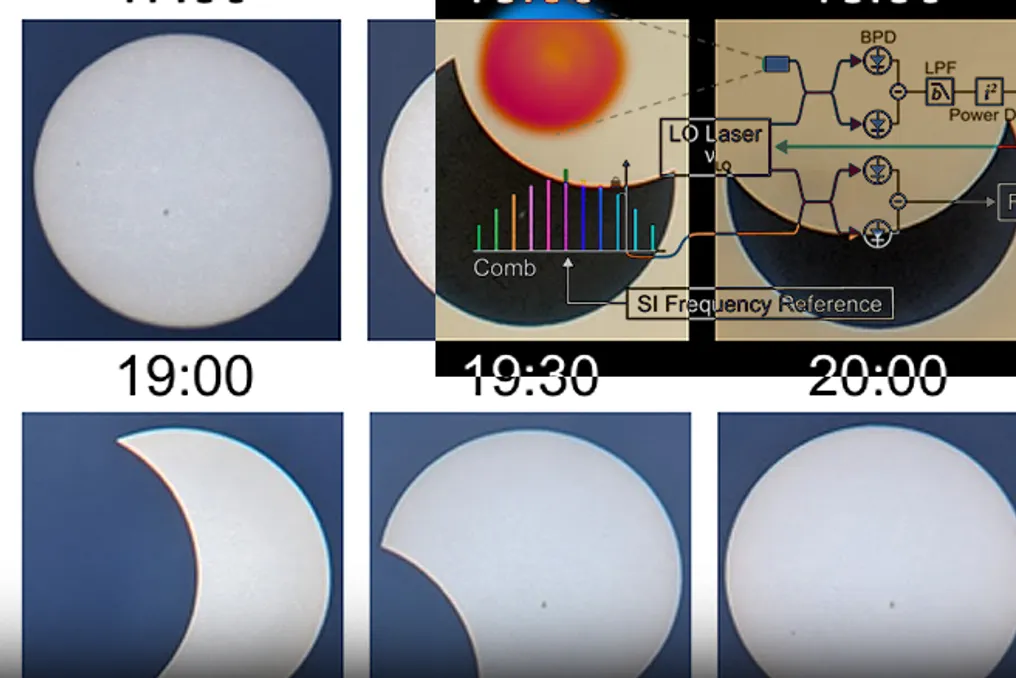
American physicists applied the operating principles of optical clocks to determine the Doppler shifts of one spectral line of the Sun with high accuracy, achieving a value of 30 centimeters per second.

During the experiment, they stabilized the frequency of a laboratory laser relative to the neutral iron absorption line present in the solar spectrum. Subsequently, the laser frequency was measured using an optical frequency comb.

The created device allowed not only the recording of five-minute acoustic oscillations of the Sun but also the observation of the Rossiter-McLaughlin effect during a solar eclipse.

In the future, it is expected that optical clocks will be applicable in the search for exoplanets around other stars. The results of this scientific work are presented as a preprint on the arXiv.org platform.

Popular