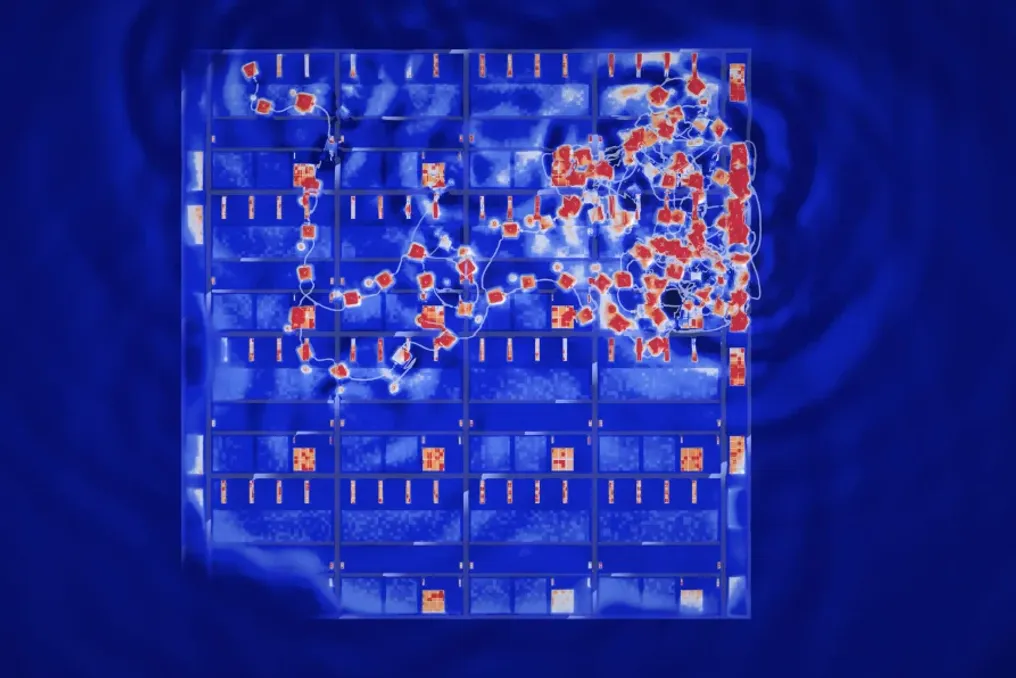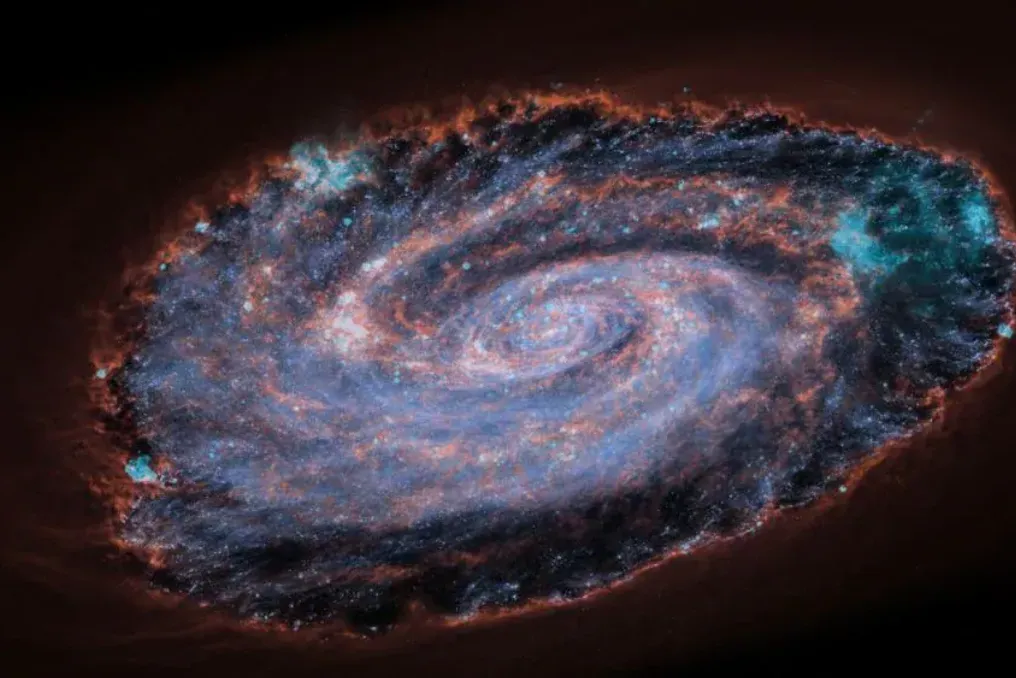
Scientists used a combination of artificial intelligence (AI) and three supercomputers to conduct a detailed simulation of the Milky Way, reaching the level of isolated stars and employing up to 5.4 trillion particles.
This advancement, detailed in a study conducted by Keiya Hirashima, a researcher at the Japanese institute RIKEN, significantly raises the degree of detail in galactic models, aiding in the investigation of how stellar events impact the overall structure of the galaxy.
Previously, reference simulations used sets of stars represented by particles with mass equivalent to about one hundred times the solar mass, which resulted in the dilution of individual stellar behavior. In the new research, the particles have solar mass and serve as a representation of the stellar population, totaling approximately ten thousand times more data than previous advanced simulations.
To achieve such a level of detail, the researchers integrated three exascale supercomputers: Aurora, Frontier, and JUPITER. These machines ran the same software in various processor configurations, including CPUs and GPUs from Intel, NVIDIA, and AMD. The work was presented at the SC26 conference, focused on high-performance computing.
Despite the vast computational capacity, reproducing areas with dense gas and rapid changes requires extremely short calculation intervals, drastically increasing the necessary processing. To overcome this obstacle, Hirashima developed PHEASANT, an AI model designed to predict the evolution of gas around supernova explosions over time.
Hirashima explained that if the process were calculated directly, time steps of approximately one hundred years would be required; however, his model can predict the distribution of gas after one hundred thousand years. This functionality allows the galactic simulation to use larger intervals, eliminating the need for the individual calculation of all intermediate phases of gas evolution, thus allowing phenomena to be represented on smaller scales without requiring the same volume of processing as a direct calculation.
The tool also enables the study of how occurrences involving singular stars affect the galaxy as a whole. For example, massive stars can end their lives in supernovae, generating large bubbles in the interstellar gas, displacing matter, and influencing the birth of new stars.