Despite the strained relations between India and Pakistan on Earth, there is an interesting connection between these two countries in space. A Pakistani astronaut recited a poem by the renowned poet Allama Iqbal aboard the Chinese space station.
It is important to note that this is not the first instance of Iqbal's poetry being heard in space. Previously, India's first astronaut Rakesh Sharma and Indian-origin astronaut Kalpana Chawla also mentioned Iqbal's verses from space.
Thus, over approximately four decades, Iqbal's poetry has been heard in space three times, creating a unique link between astronauts from India, Pakistan, and China.
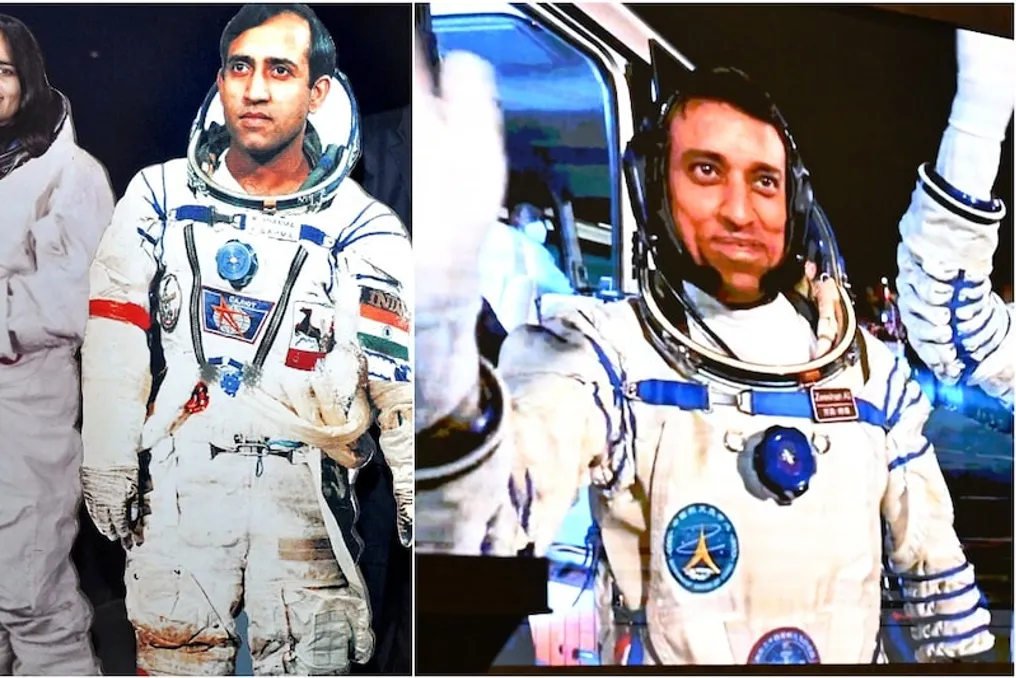
The first Pakistani astronaut, Ali, recited a famous poem by Allama Iqbal before his Chinese colleagues on the Chinese space station. He uttered the lines: 'Sitaron se aage jahan aur bhi hain...'
During the recitation, Ali paused and then continued the first line, completing it. Reciting the poem in zero gravity was a special experience for him. Afterward, he explained the meaning of the poem in Mandarin, stating that there are countless worlds beyond the stars and many more tasks remain to be accomplished. His Chinese colleagues applauded him.
However, this tradition of reciting Iqbal's poetry in space is quite old. Before this, Indian astronauts and prime ministers also shared lines from this poet from space.
India's first astronaut, Rakesh Sharma, began his space flight on April 3, 1984, on the Soviet Union's Soyuz T-11 mission. He was aboard the Salyut-7 space station for about eight days. During this stay, then Prime Minister of India Indira Gandhi spoke with him on television. In the conversation, Indira Gandhi asked a question that is still remembered in Indian history: 'What does India look like from above?'
To this question, Rakesh Sharma immediately replied: 'Ji, main bagair kisi jhijhak ke keh sakta hoon ki saare jahan se achha, Hindostan hamara.' This answer is related to a line from Allama Iqbal's poem 'Tarana-e-Hindi'. Iqbal wrote this poem in 1904, and its most famous line is: 'Saare jahan se achha, Hindostan hamara.'
Later, this poem was performed as a song. It gained great popularity during the struggle for independence and remains one of India's most popular patriotic songs, performed by the Indian army orchestras on special occasions.
Another interesting episode related to the recitation of Iqbal's poetry in space occurred in 1997. At that time, Indian-origin astronaut Kalpana Chawla made her first space flight. Her space shuttle 'Columbia' was launched on November 19, 1997. During this mission, then Prime Minister of India Kumar Gurjar conversed with Kalpana Chawla from space. Gurjar was particularly fond of Urdu and poetry. During the conversation, he mentioned Allama Iqbal and quoted one of his lines. He said that one of the famous poets of our subcontinent, Iqbal, has a saying.
After that, he uttered the same phrase that the Pakistani astronaut Ali repeated almost three decades later on the Chinese space station: 'Sitaron se aage jahan aur bhi hain.' Then Gurjar asked Kalpana Chawla how she felt seeing the world beyond the stars. Kalpana Chawla replied that it was an incredible feeling. She said that Iqbal's words gain reality in space. Describing the views from space, she mentioned that only stars are visible in the dark sky everywhere, which resembles a storybook.
Later, in 2003, during her second space flight, Kalpana Chawla died in the Columbia space shuttle accident, in which other mission astronauts also perished.
Allama Iqbal was one of the most famous poets, philosophers, and political thinkers of South Asia. He was born on November 9, 1877, in Sialkot, British India, which is now part of Pakistan. He studied in Lahore, England, and Germany. He received a degree in law and a doctorate in philosophy. Iqbal primarily wrote poems in Urdu and Persian. His Persian works are very popular in Iran, where he is known as 'Iqbal-e-Lahori'. In South Asia, he is respectfully called 'Allama', which means a highly educated person.
Iqbal's identity was not just that of a poet; his ideas profoundly influenced the politics of South Asia. In 1930, chairing the annual meeting of the Muslim League in Allahabad, he...