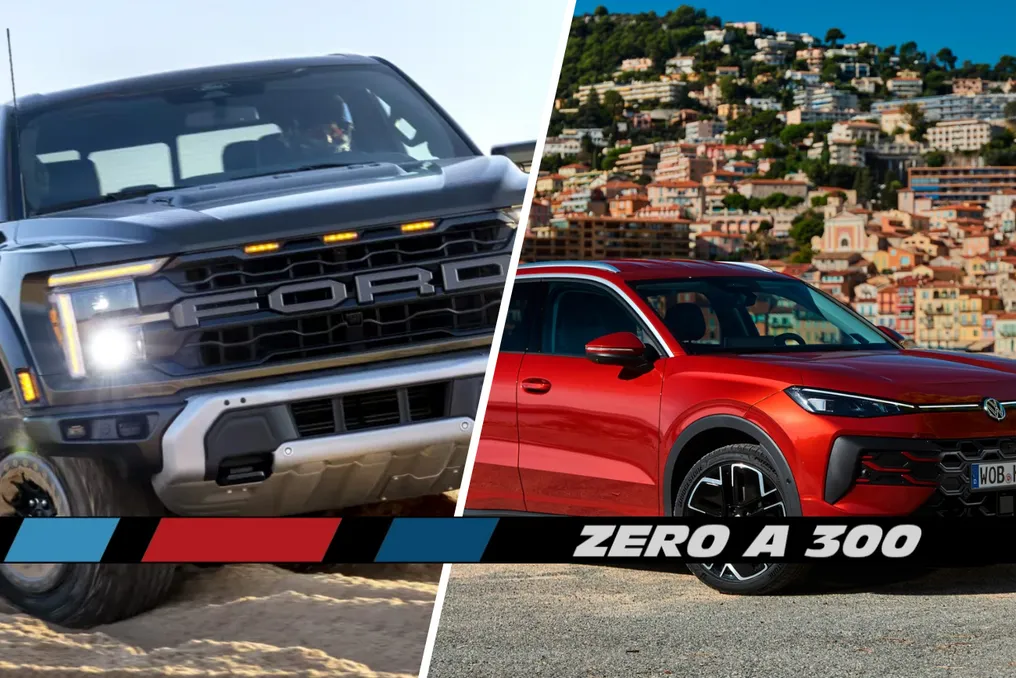
Ford confirmed that the pre-sale of the F-150 Raptor will begin in April 2027, marking the official arrival of the sports pickup truck in Brazil. This launch follows confirmation made by Ford during the Interlagos Festival in August and represents the first time the vehicle will be sold in the country without relying on independent importers.
The introduction of the F-150 Raptor meets the existing demand in the Brazilian pickup market, offering a larger and more powerful option compared to the Ranger Raptor, which has been available since 2023. Although the final price has not been disclosed, the F-150 Raptor is estimated to cost over R$ 700,000, while the Ranger Raptor is priced at R$ 499,000. The standard F-150 is sold in Lariat versions for R$ 540,000 and Tremor for R$ 580,000.
In terms of powertrain, the F-150 Raptor shares similarities with the Ranger Raptor. While the Ranger uses a three-liter biturbo V6 with 397 hp and 59.4 kgfm of torque, the F-150 Raptor employs a 3.5-liter biturbo V6, generating 456 hp and 70.5 kgfm of torque. For those who prefer a V8 engine, like in previous Raptor versions, they should opt for the Lariat or Tremor versions, which use Ford's five-liter Coyote V8, capable of producing 405 hp and 56.7 kgfm of torque. All versions share a ten-speed automatic transmission with four-wheel drive.
Besides the engine, the F-150 Raptor is distinguished by its enhanced chassis, equipped with electronically adjustable FOX Racing shocks and a rigid axle with five control arms and helical springs, which provides greater refinement to the vehicle's dynamics. It also offers several driving modes that modify the suspension, engine response, transmission behavior, and steering, complemented by the aggressive look characteristic of the Raptor family, including exclusive grille and body kits.
Volkswagen presents its new flex hybrid engine in Brazil
In response to the growth of electrification promoted by Chinese manufacturers, Volkswagen recently launched its first national flex hybrid engine. It is a four-cylinder, 1.5-liter turbo engine called Evo2 Hybrid Flex. This engine will be produced at the VW Anchieta plant, located in São Bernardo do Campo (SP).
The Evo2 Hybrid Flex is based on the 1.4 turbo TSI engine, already used in models such as Polo, Nivus, and T-Cross, incorporating the Miller cycle, variable geometry turbo, and cylinder deactivation system to optimize consumption and reduce emissions. Volkswagen has not disclosed specific data on power, torque, or consumption, but confirmed that the powertrain will integrate a full hybrid system (HEV), using a battery that captures energy from braking and the combustion engine itself, eliminating the need for external recharging.
The automaker also informed that this new engine will be applied in a model built on the MQB37 Evo platform. Although Volkswagen has not specified which vehicle this will be, the strongest speculation points to the Saga Project, a new SUV derived from the internationally sold T-Roc, which could succeed the VW Taos, positioning itself between the T-Cross and the Tiguan in size and price.
Ferrari restores 365 GTB4 that was missing for 37 years
Ferrari has a rich legacy, and the restoration of its Ferrari 365 GTB4 example, known as Daytona, which was missing for 37 years, is an example of this appreciation for heritage. The car was recovered and is now displayed in perfect condition.
This vehicle is a one-off. When the 365 GTB4 was launched in 1968, Ferrari produced five aluminum-bodied units for racing. However, Luciano Conti, a businessman close to Enzo Ferrari, commissioned a sixth unit, also in aluminum, but intended for road use. Identified by chassis number 12653, this car was lighter than the common models and did not have the flared fenders of the racing versions.
Conti received the car in 1969 and sold it the following year. In 1971, he exported it to Japan, where it remained abandoned due to a gearbox problem that was not resolved locally. The last record of the vehicle dates back to 1980, beginning a long period of absence until it was rediscovered in 2017.
In the same year, a Danish collector acquired the Daytona at an auction organized by RM Sotheby’s, paying € 1.8 million for the 'barn find' specimen—complete, but damaged by time. The car only returned to Maranello in 2023, joining Ferrari Classiche, the division responsible for the conservation and restoration of the brand's historic models. The restoration process lasted 20 months. Ferrari reported that despite years of abandonment and exposure to humidity, all original components were maintained. Every part was disassembled, recovered, and reinstalled in operational condition. In 2026, the Ferrari Daytona No. 12653 was presented at the Cavallino Classic Modena, more than five decades after leaving Maranello.
European Union imposes quotas on Chinese hybrids—and on those from everywhere
The European Union will implement restrictions on the import of hybrid vehicles (including full, mild, and plug-in) starting December 1st, establishing quotas by country of origin, valid for 200 days. This measure aims to curb the exponential increase in Chinese hybrid imports into Europe, which quadrupled in less than three years.
This escalation occurred after the EU imposed tariffs on Chinese electric vehicles but kept hybrids exempt. To avoid WTO sanctions, Europe extended the scope of the quotas to cover all hybrids manufactured outside the European Union. The quotas are calculated based on projected sales volumes for 2025, plus approximately 15%. For countries like Japan (with 170,889 cars) and the United Kingdom (with 105,402), whose sales are declining, the change does not significantly alter the scenario. However, for China, the annual quota is 350,000 units, equivalent to 191,780 in the 200-day period, representing a 30% reduction in current volume.
The European strategy is analogous to the proposal made by Anfavea to the government at the end of October, which suggested a limit of 2.5% to 3% of the Brazilian market. The main difference is that the Brazilian proposal protected the local industry, whereas the European safeguard does not allow such favoritism. The final quotas must be defined by July 2027.
Gordon Ramsay is the new host of Top Gear
The BBC announced Gordon Ramsay as the new driver of Top Gear, taking command of the program's new phase following Freddie Flintoff's accident. Previously, there were speculations about the participation of Jimmy Carr or Joe Marler.
Filming for the program will begin in 2027, with the premiere scheduled for 2028. The Stig will return, and the other presenters have yet to be announced. The BBC promised that the format will bring 'epic adventures, daring tests, and spectacular acrobatics,' maintaining the essence of the program under Clarkson's management.
Ramsay already had a history with Top Gear, having been invited three times: the first in 2002, during the initial season of the Clarkson era, and the last in 2017. His best performance in the affordable car segment was 1 minute and 46 seconds and 3, using a Chevrolet Lacetti. Furthermore, Ramsay owns a Ferrari F40 in his garage and mentioned that his interest in automobiles began in childhood, when he lived near Silverstone and watched races jumping the fence.