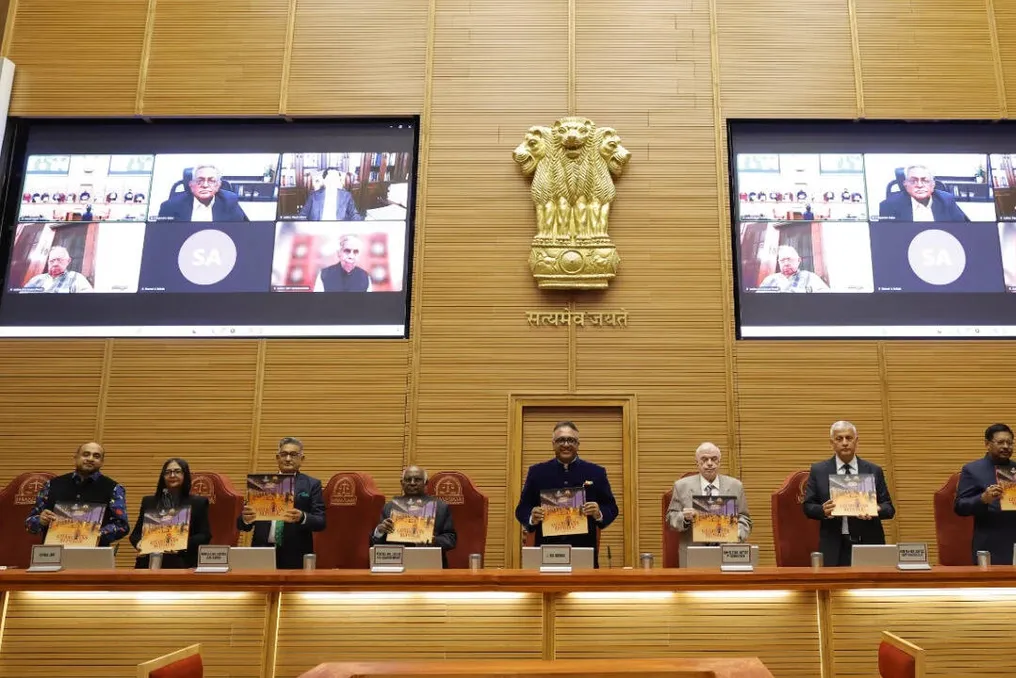
On Wednesday, the first museum in India dedicated to the Chief Justices of India opened at OP Jindal Global University (JGU) in Sonipat. Ten former Chief Justices of India attended the event, either in person or virtually.
The museum, which was grandly inaugurated on the eve of Constitution Day, aims to document the lives and contributions of former Chief Justices, as well as trace the development of the Supreme Court and the constitutional structure of India.
It consists of five exhibition halls and includes over 280 busts of Supreme Court judges, models of 25 High Courts, 22 language tapestries, 20 interactive biographical pillars, and exhibits dedicated to 20 landmark judicial decisions.
Former Chief Justices present at the opening ceremony included MN Venkatachalia, BN Kirpal, S Rajendra Babu, KG Balakrishnan, P Satasivam, RM Lodha, Dipak Misra, Sharad A Bobde, UU Lalit, and BR Gavai.
According to the university, the museum's goal is to present the office of the Chief Justice as an institution of central importance to constitutional governance, while simultaneously recording the people, decisions, and discussions that have shaped the judicial system.
The exhibitions feature a holographic courtroom, works of art, sculptures, and installations, alongside biographical materials and recordings from former judges.
Former Chief Justice MN Venkatachalia noted that the rule of law and democratic freedoms have played a vital role in India's progress, adding that the museum can contribute to legal education and the training of future professionals.
Former Chief Justice BR Gavai stated that the museum highlights the work of successive Chief Justices and the contribution of the Supreme Court to constitutional law over the past 76 years. He also emphasized the Constitution's focus on inclusion and representation, mentioning the participation of lower castes, indigenous peoples, minorities, and women in public institutions.
Former Chief Justice UU Lalit reported that the museum demonstrates the evolution of jurisprudence parallel to the country's growth. He linked the evolution of law to economic development and public welfare.
Former Chief Justice Sharad A Bobde spoke about the judiciary's responsibility for upholding the rule of law and recalled the functioning of the Supreme Court during the Covid pandemic, including the implementation of online hearings.
Former Chief Justice RM Lodha mentioned that the exhibits feature decisions that defined the constitutional framework of India. He referred to the growing public interest and the basic structure doctrine, while acknowledging the periods of difficulty faced by the judicial system.
Former Chief Justice P Satasivam noted that the Supreme Court has significantly strengthened its significance since commencing operations in January 1950. He called independence from the executive branch, integrity, and transparency as essential conditions for maintaining public trust in the institution.
Former Chief Justice Dipak Misra believes that the museum will help students understand constitutional values such as liberty, equality, and fraternity. Former Chief Justice S. Rajendra Babu noted that the exhibits will be useful for legal scholars and researchers in understanding the evolution of the judicial system and the issues it addressed.
Former Chief Justice KG Balakrishnan urged law students to study the Constitution and realize their responsibilities as future lawyers. Former Chief Justice BN Kirpal also participated in the event.
The museum is divided into five galleries: 'Pathways of Justice', 'Pillars of Justice', 'Hall of Constitutional Voices', 'Keystones of Justice', and 'Ideas of Justice'.
The 'Pathways of Justice' gallery explores the historical and social foundations of justice through 10 marble slabs reminiscent of colonial India's processes. Its artworks address themes such as untouchability, dowry, bonded labor, education, transparency, workplace dignity, and climate justice. This gallery also features a model of the Supreme Court and an exhibit titled 'Branches of Justice.'
'Pillars of Justice' focuses on the lives of former Chief Justices through 20 interactive pillars, each equipped with four screens. It also houses 22 regional woven tapestries representing the languages listed in the Eighth Schedule of the Constitution, as well as models of 25 High Courts.
'Hall of Constitutional Voices' contains recordings of 11 figures associated with India's constitutional history. It also includes a oral history project featuring conversations with former Chief Justices and other senior judges.
'Keystones of Justice' analyzes 20 landmark judicial decisions and the principles underlying them. The exhibits include a holographic courtroom and an installation titled 'From Paper to Precedent', created from ceramics, paper, and jute.
The 'Ideas of Justice' gallery presents a sculpture garden and busts of judges. Among its installations are 'Mantle of Justice' and 'Right to Fly', which refers to the judicial dispute of JGU founder Navin Jindal regarding citizens' right to fly the national flag.
Jindal noted that the museum expands the existing University Constitution Museum by focusing on the Supreme Court's role in defending constitutional values. JGU Founder Vice-Chancellor K. Raj Kumar stated that the project aims to unite law, history, memory, and public participation to document the institutional constitutional role.