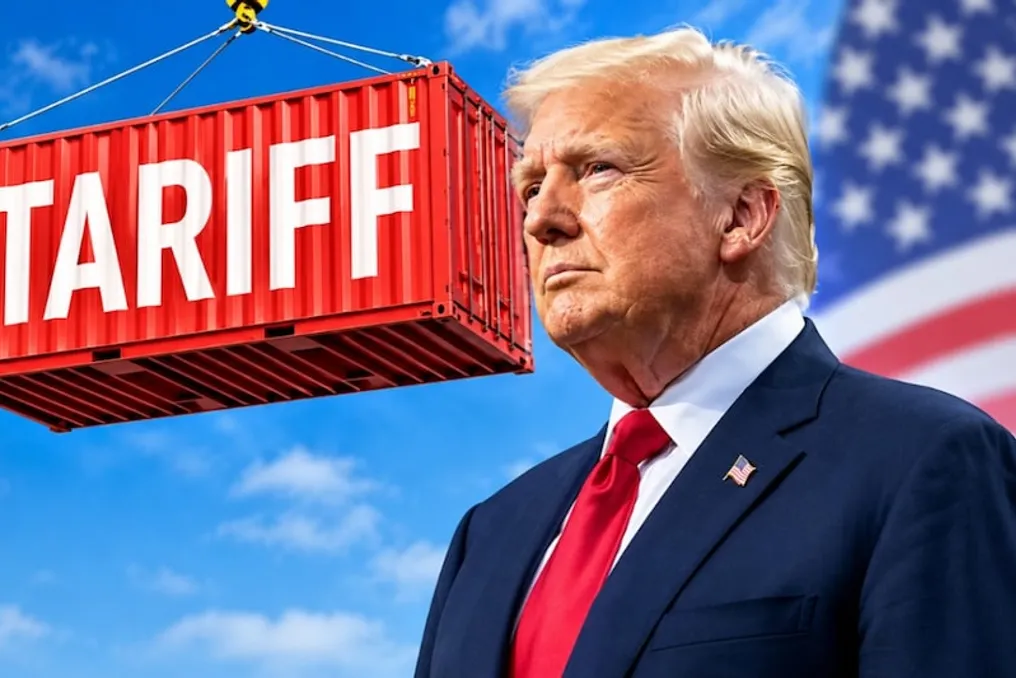
Countries, including China and Japan, protest proposed US tariff hikes
Read more
Aaj Tak
www.aajtak.in

Countries, including China and Japan, protest proposed US tariff hikes

China, Japan, and other US trading partners have opposed the tariff increases proposed by the Trump administration. These countries have also firmly denied accusations of having excess production capacity.

China stated that the tax imposed by the US is based on a 'false premise.' The new tariffs proposed by Trump could take effect in January and aim to reintroduce duties on several economies.

It should be noted that in February, the Supreme Court overturned extensive tariffs introduced by President Donald Trump last year. The new import charges are being introduced following months of investigation under 'Section 301.'

A representative from the US Trade Mission, Jameson Greer, reported that the investigation found that the production capabilities and policies of 14 economies were unfounded and created a burden or restricted American trade.

China, as the largest US trading partner, was subjected to a 20 percent tariff. Beijing rejected the overproduction argument, calling it a flawed method. Foreign Ministry spokesperson Gao Jiakun stated at a regular press conference that China opposes this because it is used as a pretext for political maneuvers. He emphasized that no party benefits from trade wars.

The US and China extended their trade agreement for another two months, which was set to expire on January 10, 2027. Both countries also agreed to reduce tariffs on a list of non-sensitive goods worth about $60 billion.

The US imposed new tariffs of up to 15 percent on Japan. The Japanese government officially expressed its protest to Washington. Chief Cabinet Secretary Shinzo Kishida stated at a press conference on Thursday that Japan has neither non-market policies nor excess production capacity (structural overcapacity). He expressed regret over the US announcement of such measures against Japan, adding that they had informed the American side of their position.

The US proposed a 20 percent tariff on Singapore. Singapore expressed 'great disappointment' with the American proposal. Singapore's Ministry of Energy, Trade and Industry stated that its economic policy does not protect the domestic market or subsidize production for export. Malaysia also stated that its production sectors do not have excess capacity that could disrupt global markets, and that it will continue consultations and negotiations with the US.

According to AP, analysts believe that the 14 economies targeted by the Trump administration account for about half of the world economy. Stefan Braun, chief economist at Capital Economics, noted that the new US tariffs are not as alarming as they seem. In fact, they replace tariffs related to forced labor allegations announced earlier, rather than being added to existing ones.

Nevertheless, he warned that these new tariffs could lead to price increases, and core inflation could remain high next year. In Thailand, government representative Lalida Perswivatana reported on Thursday that the new US proposal, setting a tariff limit of 18 percent, was better than expected.
Similar stories

US Proposed Tariffs Up to 25% on Goods from Six Countries Including India, and 40% on China
Read more
www.aajtak.in

US Proposed Tariffs Up to 25% on Goods from Six Countries Including India, and 40% on China

The United States has proposed imposing tariffs of up to 25 percent on Indian goods. In addition to India, this proposal extends to six other countries. Furthermore, a higher tariff of 40 percent is proposed for China.

According to an official statement provided to Reuters, India is among the seven countries for which the US Trade Representative (USTR) proposes introducing tariffs of up to 25 percent under the new plan. This group also includes Cambodia, Indonesia, South Korea, Malaysia, Taiwan, and Thailand.

Moreover, the USTR proposed tariff rates of up to 20 percent for Bangladesh, the European Union (EU), Japan, Switzerland, and Singapore, up to 35 percent for Vietnam, and up to 40 percent for China. The USTR also specified that for Cambodia, Indonesia, Malaysia, Thailand, and Bangladesh, the tariff rates will be limited to a maximum of 18 percent.

For South Korea, Taiwan, the EU, Japan, and Switzerland, these rates will be 15 percent (excluding the most favored nation duty). Regarding China, in addition to existing duties, an additional rate of 20 percent will be added. A hearing has been scheduled for changes to tariffs for Brazil on January 14, 2027.

The report indicates that the introduction of these tariffs is due to the need to restrict excess industrial capacity in America's major trading partners.

Trump's Dollar: 16 Countries Under Threat of Tariff Hikes, Including India
Read more
www.aajtak.in

Trump's Dollar: 16 Countries Under Threat of Tariff Hikes, Including India

Donald Trump is preparing to introduce a new wave of tariffs, dubbed the 'Trump bomb,' and this new list includes 16 countries. According to one report, the inclusion of India in this list is a cause for serious concern. It is reported that the US plans to increase existing tariffs on these countries, and India faces the threat of new American tariffs.

According to a report by The Wall Street Journal, India may face another round of tariffs. This is because President Donald Trump's administration intends to increase tariffs on countries that, according to the administration, receive government support in the form of subsidies and other aid for their domestic industries. Major economies such as China, India, Japan, South Korea, and the European Union are expected to fall under the scope of Trump's tariffs.

These tariff actions are the result of months of US investigation into industrial subsidization. America claims that such support gives foreign producers an unfair advantage over American companies because they produce goods at lower prices and bring them to the international market in large volumes. Simply put, in the view of the US, financial assistance and other political support allow foreign producers to create products more cheaply, enabling them to sell them on the global market at favorable prices, hindering competition for American manufacturers. The Trump administration states that this weakens domestic production in the US.

According to data cited in the WSJ report, representatives associated with Trump's tariff plan stated that US Trade Representative Jamison Greer may announce the results of the US investigation this week, although he warned that timelines could change. For India, this Trump tariff plan is particularly complex, as New Delhi and Washington are still negotiating a trade agreement. Due to a Supreme Court ruling regarding Trump, this agreement has not yet been concluded, despite changes in US trade policy.

The Wall Street Journal indicates that the proposed tariffs by the Trump administration will cover most goods exported by the target economies. However, some industrial goods, such as steel, aluminum, and automobiles, may be excluded because separate tariffs based on national security are already in effect on them. Although the final rates of Trump's tariffs for India or any other country on the list have not yet been determined, American officials have repeatedly hinted at the Trump administration's desire to impose duties equivalent to those imposed in 2025. It is noted, however, that the impact will not be the same for all countries. According to sources, Japan, the EU, and South Korea, which have discussed trade agreements with the US, may face a tariff of 15% or less.

Popular