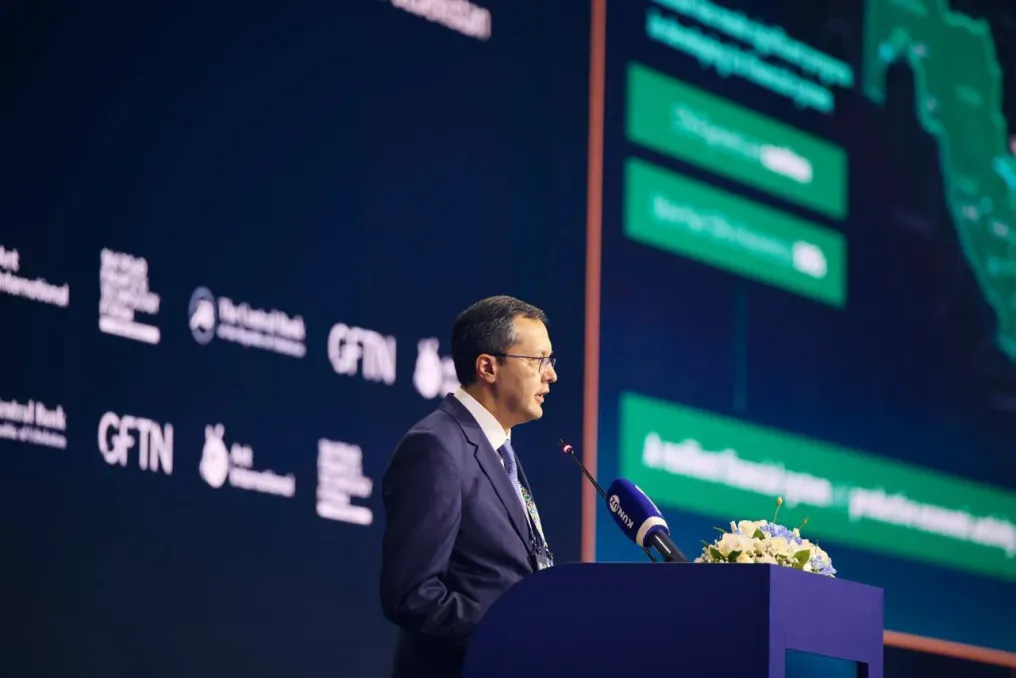
The Chairman of the Central Bank of Uzbekistan, Timur Ishmetov, stated that the country plans to expand lending and savings in sums to decrease the economy's dependence on foreign currencies and limit currency risks.
These goals were announced by Ishmetov at a meeting chaired by President Shavkat Mirziyoyev on November 13. The agenda included the draft state budget for 2027, key macroeconomic forecasts, and economic policy priorities.
According to the head of the Central Bank, 2027 will be a critically important stage for achieving the country's long-term economic objectives. This requires stable prices, a more effective monetary policy, and the continuation of banking sector reforms.
Reducing dependence on foreign currency
One of the regulator's main tasks is to decrease the economy's reliance on foreign currencies. Ishmetov emphasized that the key problem lies in reducing the level of dollarization and increasing confidence in the national currency. To strengthen confidence in the sum, it is necessary to increase borrowing and lending in sums, as well as increase the share of household deposits and loans denominated in sums.
Reducing dollarization is required to minimize risks associated with operations and loans in foreign currency. When the sum weakens, the cost of servicing foreign currency loans is expressed in sums, which is particularly difficult for borrowers earning income in sums but having debts in US dollars or other currencies.
Another task for the regulator is to improve the effectiveness of monetary policy tools. The Central Bank intends to expand its capabilities in managing liquidity and developing domestic financial markets. Ishmetov reported that new instruments will be introduced in both the foreign exchange and interbank markets, which will generally improve the effectiveness of the Central Bank's monetary policy tools.
At the meeting, the Central Bank was also instructed to slow inflation and achieve the target price stability rate in the medium term. During the budget discussion, the regulator was tasked with keeping inflation at no more than 6% next year, followed by a reduction to 5%.
Previously, the Central Bank presented the draft of the basic monetary policy guidelines for the period 2027–2029. According to the baseline scenario, inflation is expected to fall to the target level of 5% in the second half of 2027. The draft provides for improvements in bank liquidity management, revision of the interest rate corridor, and strengthening the role of the UZONIA rate as a benchmark for the money market. It also provides for the development of tools for hedging interest rate and exchange rate risks. The regulator also plans to develop the derivatives market, which will allow market participants to hedge against unfavorable fluctuations in exchange rates and interest rates.
Accelerating reforms of state banks
Ishmetov separately noted the need to accelerate the transformation of state banks and the privatization of some of them. He stated that this is necessary to bring economic growth to a new level over the next decade and improve the quality of the economy, which requires a corresponding banking system.
In Ishmetov's opinion, modernizing banks is one of the conditions for the economy's transition to a new stage of development. An official statement following the meeting also indicated that the banking system should attract more private capital, increase credit resources, and improve the financing of investment projects.
Privatization is ongoing, but state-owned banks still hold a significant share of the market. According to the Central Bank, as of October 1, 2026, they owned 60.8% of the banking system's assets, amounting to 634.9 trillion sums out of a total of 1.045 quadrillion sums. State banks also accounted for 64.6% of the total loan portfolio, or 425.8 trillion sums out of 659.1 trillion sums. Their share in banking capital was 57.8%, or 88.3 trillion sums out of 152.9 trillion sums. They held 50.2% of deposits, totaling 251.5 trillion sums out of 501 trillion sums.
As of October 1, commercial banks issued loans totaling 659.1 trillion sums, including 252.3 trillion sums in foreign currency. The share of foreign currency loans decreased by one percentage point over the year, from 39.3% to 38.3%. Nevertheless, the nominal value of foreign currency loans in sum equivalent increased by 10.3%, from 228.7 trillion to 252.3 trillion sums. This occurred due to the expansion of the total loan portfolio, not a decrease in the volume of such lending.
Dollarization is decreasing faster in the deposit segment. As of October 1, the total amount of bank deposits was 501 trillion sums, of which 93.1 trillion sums were in foreign currency. The share of foreign currency deposits fell from 22.5% to 18.6% over the year, a decrease of 3.9 percentage points. However, their nominal value increased from 83.7 trillion to 93.1 trillion sums. Despite this, foreign currency loans still account for more than a third of all banking lending.