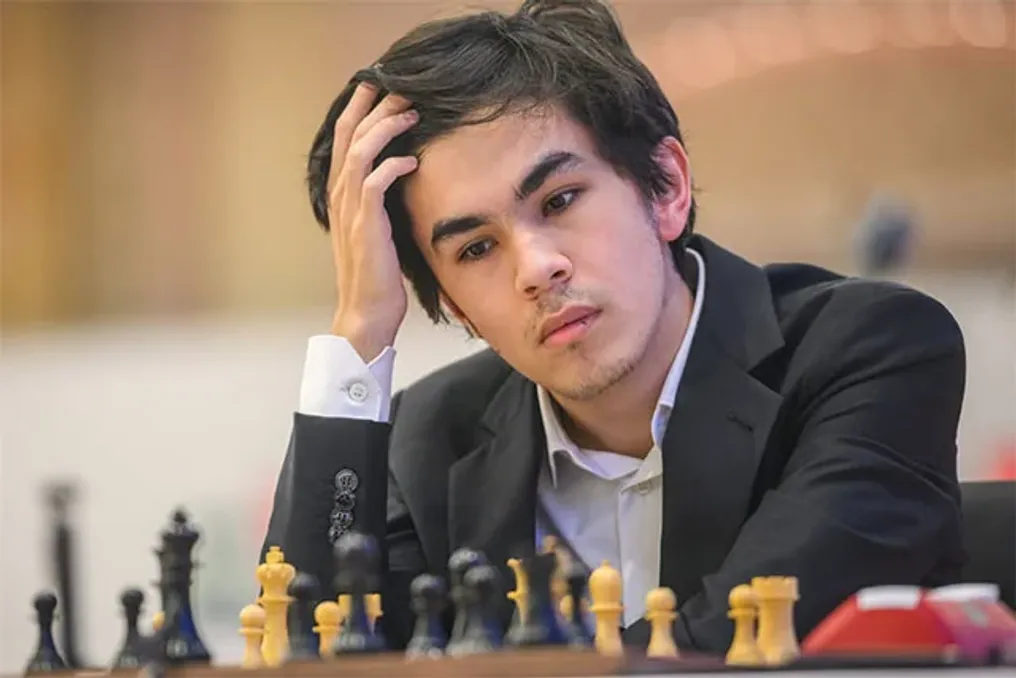
Sindarov discusses preparation for using the London System against Gukesh at the World Chess Championship
Read more
UzDaily
uzdaily.uz

Sindarov discusses preparation for using the London System against Gukesh at the World Chess Championship

Javokhir Sindarov stated that he did not expect Gukesh to use the London System in the second game of the World Chess Championship match, but he had thoroughly analyzed this variation in advance. The discussion took place at a press conference in Geneva.

Sindarov noted that this was not a big surprise for him because this variation is very playable. He mentioned that the move Qb6, which commentators discussed, as well as the moment it was introduced, were part of his preparation.

Gukesh explained that modern chess engines make almost any opening line accessible to both sides. He emphasized that no opening can be considered better than another, adding that the London System can provide a small element of surprise at the beginning of the match.

The world champion admitted that he knew about the Qb6 move but could not fully recall his subsequent plans. He added that he could have remembered more from his notes. Gukesh also stated that not gaining an advantage in the opening is common in a world championship match.

He highly praised his opponent, noting that Sindarov was well-prepared and knew about the variation, despite being surprised by the choice of opening. Sindarov reported that his plan included the moves Qd8 and Bb8, followed by a knight maneuver to e7 and f5. He asserted that he implemented his plan at the most appropriate moment.

Gukesh admitted that he underestimated the plan involving Be8 and Nd7. After the move f5, he could not find a way to advance either e4 or c4, especially after the moves f3 and Nf6. Before the move f3, Gukesh spent about thirty minutes thinking and trying to find a possibility through c4. Sindarov stated that he was ready to play against c4 and calculate all variations. Nevertheless, at first glance, Black's position looked solid.

After cxd5, Sindarov would reply with Nc5. Gukesh agreed that this move would deprive White of chances for progress. At some point, Gukesh considered capturing the pawn on e5, which would allow for a tactical response Ne4. He assessed that Black would have sufficient compensation in this position.

The move a5 was the best choice according to both the chess engine and FIDE's prediction service. However, Gukesh said that even after this move, he did not see how to continue the game. Sindarov added that he would reply with either a6 or Nh8, noting the difficulty of formulating plans in such a situation.

The Uzbek player expected the game to end in a draw due to the significant time Gukesh spent thinking. The Indian player had about 45 minutes left for the next 20 moves. According to Sindarov, the position was very safe for both sides: it was difficult for White to advance e4 or c4, and for Black to play e5.

When asked why he decided not to continue the game, Gukesh replied that leveling the position with the opponent does not mean he is obliged to agree to a draw. He did not see how to create serious problems in this position, whereas active play involves risks. Gukesh added that he could have continued the game if the move c4 had been successful.

Gukesh recalled that if all games ended in draws, the match would go to a tie-break, and he would not retain the title without a win. He noted that the right moment to take risks depends on the development of the match, and it is too early to think about it. When asked about two consecutive draws at the start of the match, the world champion said he would prefer to win both games. He found it understandable that neither player had real chances of winning after several months of preparation.

The match consists of 14 games, so Gukesh considers it premature to think about the overall score. He added that he feels good and energetic. Gukesh also explained why he did not respond to Qb6 with Qb3. Although this move was not bad, it would allow Nh5 in this position. He also knew that he needed to play Rb1, meaning he was still following his preparation.

A journalist from Lichess.org reminded that Gukesh used the London System against Alireza Firouzja in a chess tournament in Norway in 2023. At that time, Hikaru Nakamura suggested that Gukesh was trying to lead his opponent away from established theory. Gukesh stated that the London System today also contains significant theoretical material, and he expected his opponent to have prepared something. He added that it is 'not some deep strategy.'

Gukesh mentioned that he extensively practiced the London System, likely during the pandemic quarantine, and therefore called it a nostalgic opening. Players were also asked about the so-called 'rapid classical' games with a time control of 45 minutes plus 30 seconds per move, used in the Total Chess tournament. Gukesh stated that 45 minutes is closer to a 30-minute rapid match and questioned the appropriateness of classifying such games as classical chess. He cited an example of a queen blunder in a tournament in Prague that was counted in the classical rating. He called it 'simply sad', arguing that games played under such time controls should not be counted in the classical rating.

Sindarov agreed that this format is somewhere between rapid and classical chess. He noted that he has never played under such conditions himself and will give his opinion after participating in the first tournament. He found this format interesting for spectators but more demanding than classical chess. Players compete in two games a day, and time runs out faster than it seems at first.

When asked about enough sleep, Sindarov replied that he feels good and sleeps normally. During his opponent's contemplation, he tried to relax a little but continued to consider possible moves. He explained that calculating long variations in such positions is impossible, so instead he considered ideas his opponent might play. The chess player stated: 'I am always focused.'

The moderator added that players yawn during games due to nervous tension, not boredom. Before the game, Sindarov spoke with his seconds, Nikita. He reported that their conversations were not about variations but about psychological issues. Sometimes they didn't discuss chess at all, allowing him to relax and avoid nervousness. The journalist referenced comments from Sindarov's coach, International Master Roman Vidonyak, who said that his main goal in Geneva was providing psychological support. Sindarov explained that this was a new experience for both of them, and they were trying to understand the demands of a match at this level. They talked about daily life and sometimes played card games and other mini-games around midnight.

Gukesh recounted that in 2024, his father accompanied him while he traveled to Geneva with his friends Shikhar and Charmi. He described them as some of his closest friends and said that the time spent with them helped relieve stress. Gaevsky was also with him in Geneva. Gukesh noted that he enjoyed spending time with him outside of chess work.

When asked if his team had changed since the Singapore match, Gukesh replied that Gaevsky was with him in Geneva, and he could elaborate more about the rest of the team later. He added that he feels much happier away from the chessboard than in Singapore, attributing much of this change to his friends. Speaking of working with Paddy, Gukesh reported that they discussed general matters, including performance, behavior at the board, and preparation. He linked his calmness to his young age and the fact that people change over time. He said he just became a bit calmer, and this change was unplanned.

Sindarov was asked if he could play the King's Indian Defense against 1.d4 during the match. He replied: 'We shall see. Who knows?', adding that players do not discuss such things at press conferences. Gukesh explained that before the game, he went out of the playing room to the restroom.
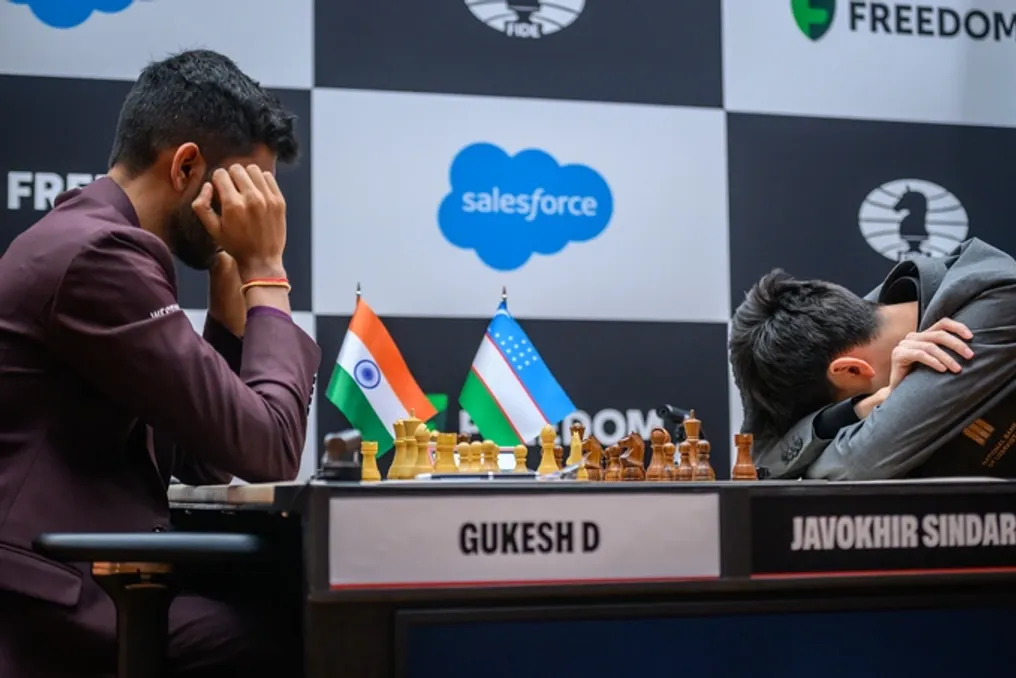
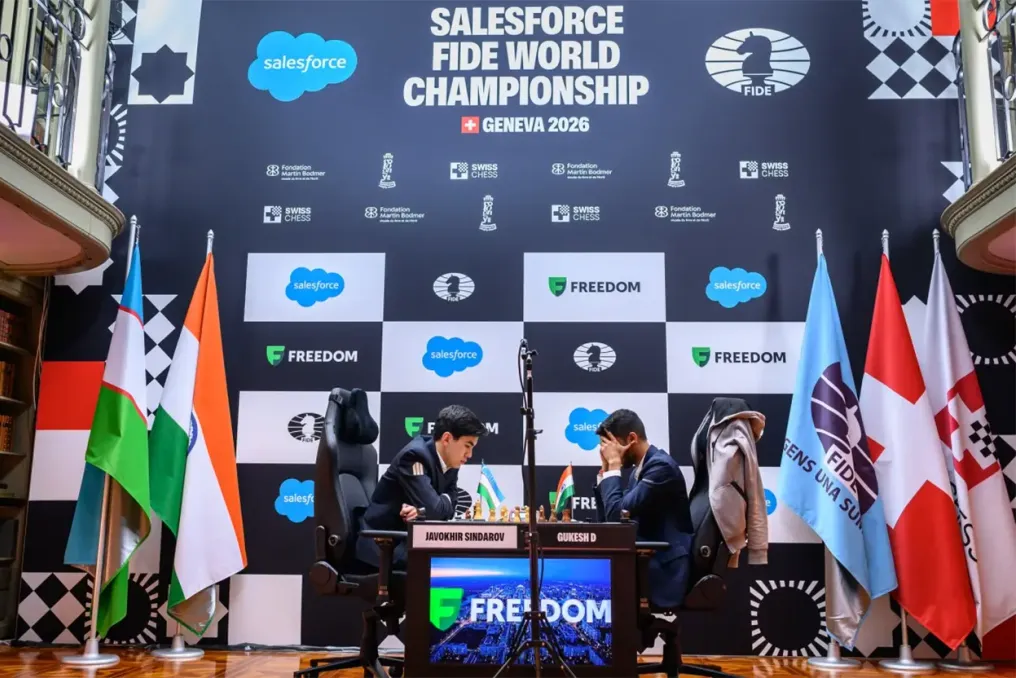
Similar stories

Sindarov and Gukesh Drew the Second Game of the World Chess Championship Match
Read more
gazeta.uz

Sindarov and Gukesh Drew the Second Game of the World Chess Championship Match

Uzbek grandmaster Javhohir Sindarov drew with reigning world chess champion Gukesh Dhummaraju of India in the second game of the World Chess Championship match, which was held in Geneva (Switzerland) on November 25th.

Sindarov's preparation, including work with coaches and participation in international competitions, including this match, is supported financially by the National Bank of Uzbekistan.

In the second encounter, unlike the first game which lasted 38 moves, the game ended on the twentieth move due to threefold repetition, with most pieces remaining on the board. Both athletes played one game with white and one with black, resulting in an overall match score of 1:1.

If Sindarov faced the Berlin Defense in the first match, Gukesh, playing white in the second, chose the London System. This opening is characterized by white's aim for gradual piece development and the formation of a stable playing position.

On the seventh move, the Indian grandmaster placed his knight on e5 (7.Ne5). Sindarov did not immediately exchange knights but instead moved his queen to b6 (7...Qb6), allowing the Uzbek to limit the opponent's attacking potential. Subsequently, on the eleventh move, Sindarov returned his queen to its starting position (11...Qd8), after which the chess players transitioned to a more open phase of the game.

Gukesh decided to avoid risk and opted for a repetition of moves, leading to Sindarov's claim of a draw due to threefold repetition. The game concluded on the 20th move. Broadcast commentators suggested that the choice of the London System might have been part of Gukesh's team's tactics in analyzing the opponent's opening preparation. Peter Svidler noted: 'They are still studying the territory, trying to understand what the opponent plans. I think the choice of the London System today was one of those exploratory steps by Gukesh's team. It gave him nothing [on the board], but he certainly gained some information in return.'

It was also observed that Gukesh spent about half an hour contemplating the pawn move to f3, but could not find a specific continuation that would give him an advantage.

After the game, Javhohir Sindarov stated that the London System turned out to be one of the least expected opening choices for him when playing black in the first game. He added: 'I think we are both getting into the tournament. Honestly, the London System is an opening I least expected in my first game [with black]. But I was ready and glad that I managed to equalize the position well.'

World champion Gukesh, for his part, admitted that he could not achieve a significant advantage in the opening. He commented: 'Today was a rather calm game. [...] I didn't gain much in the opening, but it was a normal game.'

Questions about the London System, which is often criticized in the chess community, were also posed to both players. Sindarov stated that he sees nothing negative in this opening. He explained: 'I think overall it is a good opening, like any other. Of course, since this variation has been played very many times, people don't like it. But overall, I am fine with it. I think it is a good opening.'

Gukesh supported his opponent's opinion, noting: 'I don't know why it is so disliked. It is a great opening.'

When asked about recommending this system to beginner chess players, Sindarov gave a positive answer: 'Yes, why not? There are just logical moves here; you try to develop your pieces. I think it is a good option if you start the game with d4.'

The third game of the World Championship match is scheduled for November 26th at 19:00 Tashkent time, followed by a rest day for the participants on November 27th. The World Chess Championship match is planned for up to 14 games with classical time control. To win the title, 7.5 points must be scored; in case of a 7:7 tie, the winner will be determined by a tie-break. The total prize fund is 2.5 million dollars, with a reward of 200 thousand dollars for each win in a classical game, and the remaining amount will be divided among the participants.

Sindarov and Gukesh Explain Draw in Opening Round of World Chess Championship
Read more
uzdaily.uz

Sindarov and Gukesh Explain Draw in Opening Round of World Chess Championship

The first game of the 2026 World Chess Championship match between Uzbek player Javohir Sindarov and Indian Gukesh Dommaraju ended in a draw. The match took place in Geneva, where Sindarov played White. As reported by FIDE, both athletes highly praised the quality of play at the post-match press conference.

The game began with the Berlin Defense. Sindarov noted that players usually use the first game of a match to assess their opponent and adopt a cautious approach. He stated: 'If you have a chance, you always try to win, regardless of which game it is. But in the first game, you will most likely try to understand your opponent and play safely. I did the same: I tried to keep the position under control and put pressure on the clock. But closer to the end, my opponent defended very well, and a draw is not a bad result.'

A representative from Chess.com mentioned that Sindarov previously had about twenty chances to exchange pieces on c6 and enter a Berlin endgame, but never did so. The Uzbek player explained his choice by saying he wanted to get used to the playing hall and maintain control without forcing the position.

Key Moments of the Game

Sindarov identified Gukesh's Bd7 move as the first important moment. Although he knew this move, he considered it illogical and deliberated over it for a long time. Initially, the Uzbek player planned to play Rd2, but instead chose c4. After the game, he concluded that the rook move could have been practically stronger, as it would have allowed him to conceal his intentions longer.

Gukesh named the 17th move as key. After b3, he played Bb4 and Rh6, noting that he spent a lot of time searching for this precise continuation. He also described White's Ke1 move as very interesting.

Sindarov admitted that he underestimated the strength of Kf6, which allowed the black king to reach a safe position. In his opinion, Rb2 offered better practical chances, as it would have left black in an extremely uncomfortable position. Gukesh reported that he considered Rb2 but could not recall what he intended to play in response.

On the 19th move, Sindarov considered the options Kh2 and Ng3. He explained that he chose Ng3 hoping to start advancing the pawns g4, f4, and f5. When asked about the other variation, he jokingly demonstrated a line on the board that, according to him, led to a draw: 'and you can go home.'

Time Management

Gukesh faced a time shortage because extra time was not provided during the first time control. Nevertheless, he noted that the situation remained under control since he had already thought through the next moves. He admitted that he played slowly at first and then sped up towards the end.

According to Sindarov, Gukesh spent about 40 minutes on one move. While his opponent was thinking, Sindarov went to the players' lounge. He explained: 'I am not just wasting time. I am thinking about what moves my opponent might make.'

Sindarov expected Gukesh to spend no more than 20–25 minutes contemplating these moves, but the position remained equal. He added that he has experience with similar breaks from the Candidates Tournament.

Reasons Why the Draw Was Not Agreed Upon Immediately

Sindarov believed the position had repeated three times. However, the arbiter clarified that the rules require the player to record the move and then offer a draw. The players made two more moves before Sindarov offered the draw. He emphasized: 'Rules are rules.'

Match Atmosphere

Sindarov acknowledged that the chess world is watching the match, and the pressure was significant, but he tried to concentrate solely on the game. VIP guests arrive on the upper level of the playing hall every hour. The press conference moderator explained that spectators' phones were approved by the organizers and were only intended for photography. A Chess.com representative specified that the devices did not have SIM cards.

Gukesh noted that spectators enter and leave the hall as viewing groups change, and sometimes the floor creaks, but these things do not distract him. He compared it to when there were far fewer spectators near the glass playing box in Singapore, where he participated in his previous World Championship match. He viewed the possibility for spectators to see the players up close as a positive feature.

Sindarov stated that professional players must be ready to compete under any conditions. He expressed satisfaction that fans can watch the match up close, and that playing on a board without spectators would be boring.

When asked about behavior behind the board, Gukesh said that both players have their habits: Sindarov rocks his leg, and he closes his eyes. He added that they behave this way in every tournament. Sindarov also noted that Indian chess players often meditate behind the board, and he is accustomed to it.

The second game of the match will take place the next day at 15:00 Geneva time.

Javokhir Sindarov готовится к матчу за титул чемпиона мира по шахматам
Read more
uzdaily.uz

Javokhir Sindarov готовится к матчу за титул чемпиона мира по шахматам

Uzbek grandmaster Javokhir Sindarov is currently training for a match against the current world champion, Gukesh Dommaraju, to compete for the world chess title. The International Chess Federation (FIDE) provided details regarding his career, accomplishments, and preparations for this significant encounter in an article released on November 13th.

Born in Tashkent on December 8, 2005, Sindarov began learning chess at the age of four. His early successes included winning the Asian School Chess Championship in the under-seven division. He achieved the International Master title in October 2017, followed by the Grandmaster title a year later. At that time, he became the second youngest chess player in history to attain the GM title, being just over twelve years old.

Sindarov demonstrated consistent national dominance, securing the Uzbekistan Chess Championship in 2019 with 10 out of 12 points possible. He successfully defended this title in the national championships in 2021 and again in 2024. Early in 2021, the President of Uzbekistan, Shavkat Mirziyoyev, issued a decree intended to foster the nation's growth into a premier global chess hub.

FIDE noted that the governmental support program played a crucial role in establishing favorable conditions for the advancement of top Uzbek chess players. Following a period of uncertainty, Sindarov made the decision to dedicate himself fully to chess. His initial major international breakthrough occurred at the 2021 World Cup held in Sochi, where he eliminated one of the tournament favorites, Alireza Firouzja, in the second round.

In 2022, Sindarov represented Uzbekistan at the Chess Olympiad in Chennai. Playing on the third board, he accumulated 6.5 points across 10 games, contributing significantly to the team's triumph. This victory marked the first time Uzbekistan had won Olympic gold in its history. Throughout 2023, Sindarov continued to improve his standing in world rankings, achieving strong results at the World Cup in Baku and the Asian Games in Hangzhou, pushing his rating past 2,700 by year's end.

A pivotal moment in his career arrived in 2025 when Sindarov triumphed at the World Cup in Goa, India. This win guaranteed him a spot in the Candidates Tournament. This tournament, which took place in Cyprus during March and April 2026, featured eight of the world's elite chess players vying for the chance to challenge the reigning world champion. Sindarov excelled, winning five of his initial six matches, and ultimately claimed first place.

This victory granted the Uzbek grandmaster the qualification to challenge Gukesh Dommaraju for the title. The Salesforce FIDE World Championship Match 2026 is set to occur in Geneva, Switzerland, spanning from November 22nd to December 12th. Furthermore, Sindarov bolstered his confidence during the Chess Olympiad in Samarkand in September 2026. Playing on the second board, he scored seven points in 10 games and secured an individual bronze medal, helping Uzbekistan claim its second Olympic gold medal.

FIDE highlighted several attributes of Sindarov's play, such as his aggressive playing style, speed, and precision in calculating variations, alongside his tactical readiness. The opening preparation undertaken by both competitors is also expected to be highly influential in the forthcoming match. According to the article's author, mental fortitude will be a primary determinant in the contest, noting that both players possess the capacity to manage pressure and recover from less successful games. While recent results might afford Sindarov a psychological edge, the final result will also hinge on how each player approaches the opening stages and manages the stress of competing for the world championship.

Popular