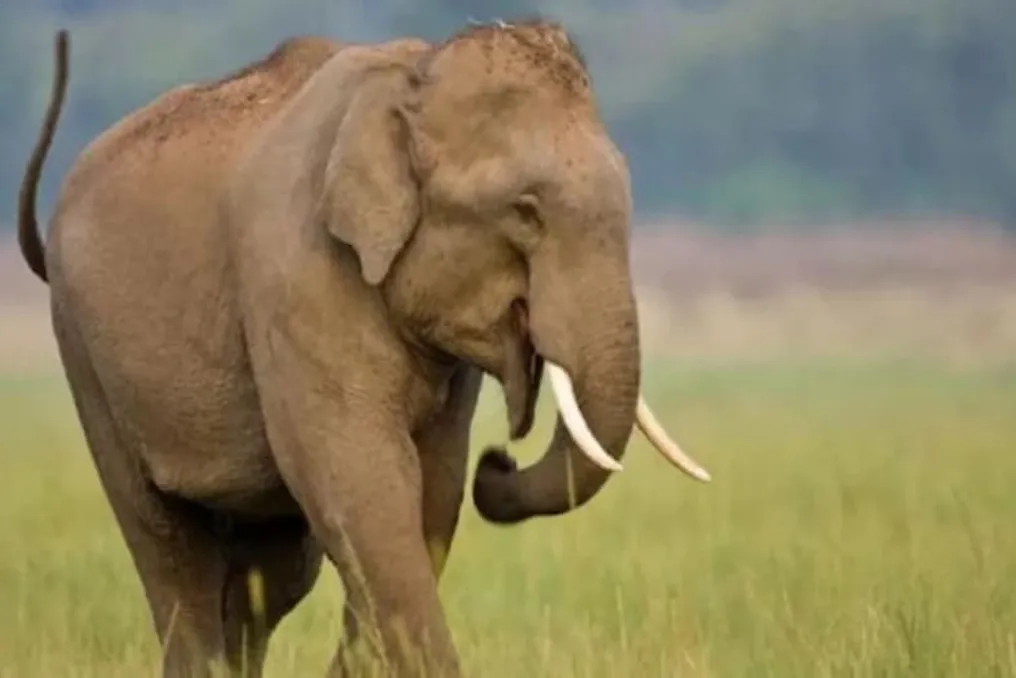
In the village of Chinnakanal, Idukki district, Kerala state, the wild elephant named Chakkakomban often becomes a source of anxiety and fear for local residents. It leaves the forest and moves near residential settlements. However, 65-year-old Mariamma, who lives in this area, holds a completely different view. She is not afraid of this elephant; on the contrary, she believes it guards her home.
According to her, when Chakkakomban passes by her house, she is certain that no one will dare to steal. Mariamma lives alone in her small house. When she learns about the elephant's approach, she turns on the light, closes the door, and goes to sleep. In the morning, she sees traces of its passage on the road.
Mariamma lives in the Bi-El Ram Chinnakanal area. The road where Chakkakomban walks runs behind her house. Sometimes local residents call her to warn her about the approaching elephant and advise her to turn on the light. Mariamma follows these advices, turning on the light, locking up, and falling asleep. In an interview with media representatives, she stated that she is not afraid of it because she believes thieves will not approach while the elephant is walking down this road. Despite living alone, she does not feel unsafe.
Mariamma arrived in Chinnakanal from Tamil Nadu at the age of 12. More than five decades have passed, but she still lives in this place. Her husband, Subedar Rajan, served in the Indian Army. During his military service, he traveled to various parts of the country, and Mariamma holds many memories of that time that give her strength to this day. Local residents also call the road behind her house the 'Military Home' path, which is related to her husband's service in the army. Mariamma has two married granddaughters, and they visit her every week.
When people tell her not to be afraid because her husband served in the army, she replies, why should I be afraid? Where should I go? She has no other place to live. She has lived here all these years and wants to stay right here. This is why her view of Chakkakomban's movements differs from those around her. While some people worry about the elephant, Mariamma perceives it as an animal that provides her with a sense of security in the vicinity of her home.
Chakkakomban is a well-known wild elephant in the area. He received this name due to his fondness for cashew nuts. He often comes near human settlements looking for cashews. Because of this, he has become part of the discussion about the growing conflict between humans and elephants in Chinnakanal. The Forest Department is concerned about Chakkakomban and plans to capture him to fit him with a radio collar to track his movements.
A full-day operation was conducted on Wednesday regarding this, but due to rain and thick fog, officials had to suspend the operation. Besides Chakkakomban, there is also a plan to catch another wild elephant named Murival. However, some conservation organizations have opposed this. A group called 'Co-Existence Collective' submitted a petition to the Ministry of Environment, Forests and Climate Change, demanding an end to the capture of elephants.
The group insists that scientific, ecological, and veterinary checks must be conducted before capturing or relocating elephants. They also demand the restoration of traditional routes and water sources for elephants in the area. This petition also proposes measures such as creating canals and early warning systems to reduce human-elephant conflicts.
For some, Chakkakomban represents a threat, but for Mariamma, he is a guardian of the home. Nevertheless, given the nature and strength of the elephant, distance and caution must be maintained. The calm appearance of the wild elephant does not mean it is safe. Mariamma's belief has its place, but the resolution of the growing human-elephant conflict in Chinnakanal will not be found solely through trust. Better coordination between forest trails, water sources, and residential settlements is also necessary.