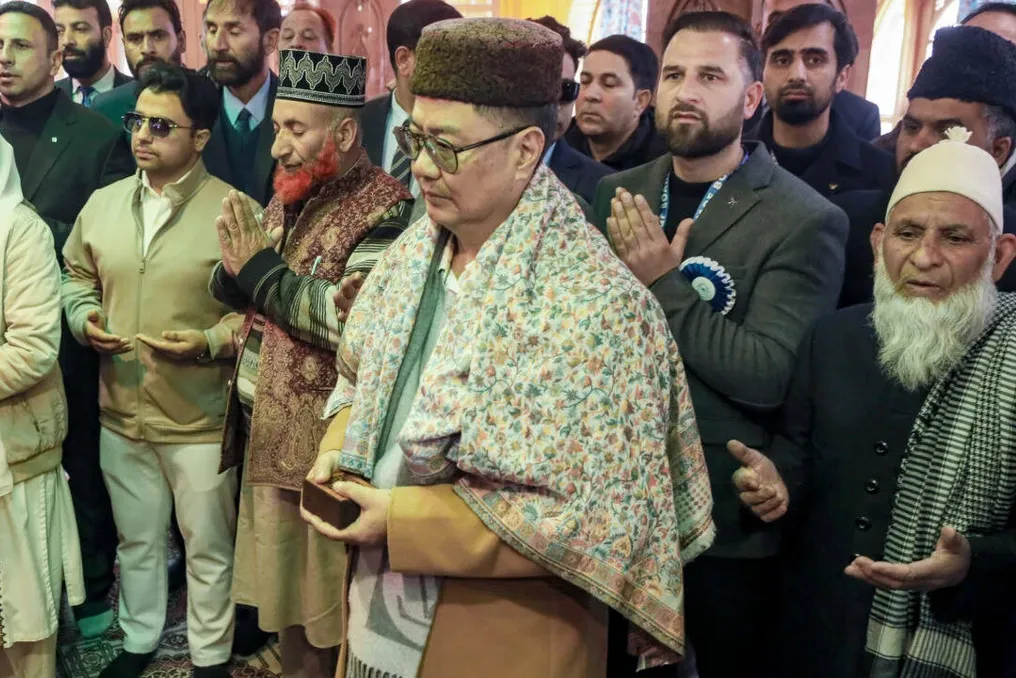
Several Muslim theologians present at the Waqf Council event in Jammu and Kashmir, where the song 'Vande Mataram' was performed in its entirety, expressed regret and stated that they prayed for repentance, as the national song provoked a religious conflict in Kashmir.
The theologians, who attended the Waqf event in Srinagar on Monday, reported that they neither approved of nor verbally endorsed this song. In a statement made on Wednesday, they emphasized: 'Since we were present at the gathering, if our participation offended anyone's religious sentiments, we sincerely repent before Allah and pray that He accepts our repentance.'
The event was attended by Union Minister for Minority Affairs Kiren Rijiju, Chairman of the Waqf Council and senior politician from the Bharatiya Janata Party (BJP) Dr. Darshan Andrabi, Lok Sabha MP Mian Altaf Ahmad, and other high-ranking officials.
All six verses of Bankim Chandra Chattopadhyay's poem 'Vande Mataram,' written in 1875, were performed in accordance with a directive from the Union Home Ministry issued earlier this year, which mandated the recitation of the full version at state events, official functions, and legislative sessions.
In August, the President approved the National Dignity Offence Prevention Act (Amendment), granting 'Vande Mataram' status comparable to a national anthem. This amendment did not change the verses themselves but made disrespect or interruption of the performance impermissible.
Initially adopted as a slogan during the freedom movement, the poem was shortened in 1937 after the Congress Working Committee approved only the first two verses to respect religious diversity.
The leader of Mutahida Majlis-e-Ulama (MMU), headed by Mirwaiz Umar Farooq, an alliance of religious organizations and institutions, stated that there is no legal obligation to perform the song at an official event. MMU criticized the Waqf Council for playing the song at an event organized by an institution responsible for protecting Muslim religious property.
MMU stated that the performance of 'Vande Mataram' at this event contradicts the Islamic principle of Tawhid, or the absolute oneness of Allah. 'Although Islam encourages love for one's homeland, it draws a clear distinction between love for the homeland and worshipping it. Any expression or practice attributing divinity to the motherland contradicts the fundamental Islamic belief of Tawhid and is therefore un-Islamic and unacceptable to Muslims,' the MMU statement reads.
The organization announced that it is seeking legal consultation and strongly urged Muslims fulfilling religious duties to uphold their beliefs without compromise. Dr. Andrabi could not comment on the situation.