NASA seeks business partners to develop lunar nuclear reactor
Read more
Olhar Digital
olhardigital.com.br

NASA seeks business partners to develop lunar nuclear reactor

NASA has issued a public call directed at companies interested in collaborating on the development and testing of the first nuclear reactor designed to generate electricity on the Moon. This system, named Lunar Reactor-1 (LR-1), has the capacity to produce 20 kilowatts of electrical energy.

The space agency plans for this equipment to be ready for launch in 2030. After being installed on the lunar surface, the reactor is expected to remain operational for a minimum period of five years. The central objective of this project is to ensure a constant supply of electricity for future lunar operations.

Unlike solar panels, whose operation depends on light incidence, a nuclear reactor offers the advantage of being able to generate energy even during the lunar night, which lasts approximately two weeks. According to NASA, the electricity generated by LR-1 will power habitats, communication systems, robotic exploration vehicles known as rovers, and various scientific instruments.

The equipment's operation is based on nuclear fission, a process that releases energy through the division of atomic nuclei. Maintaining this continuous generation is a primary focus of the project, especially when sunlight is not available.

Brian Giblin, Lunar Reactor-1 program manager, emphasized that having an abundant, safe, and reliable energy source is crucial for exploration on both the Moon and Mars. He stressed that space nuclear systems have the potential to provide electricity without depending on solar illumination.

The call for partnerships was released after NASA integrated contributions from the industrial sector into its request for proposals document. Initially, a preliminary version had been made available in August, and the agency organized a meeting with industry representatives in September, held at the Ohio Aerospace Institute in Cleveland.

All submitted proposals must adhere to the rigorous nuclear safety standards established by the U.S. Department of Energy (DOE). The LR-1 program is managed by NASA's space reactor division in collaboration with the said department. The deadline for submitting applications is December 21. With this process, NASA aims to advance the development and testing of the reactor, maintaining the goal of having it ready for launch in 2030. Furthermore, NASA announced that it may issue other service orders to assist in the development of complementary space nuclear energy systems.

Similar stories

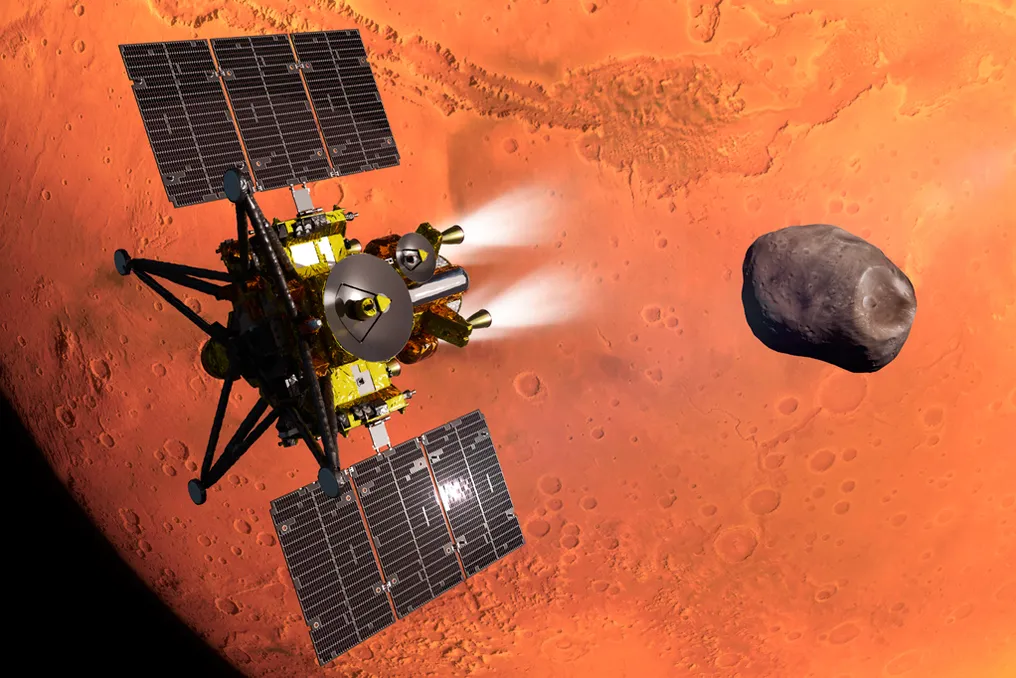
Japanese Space Mission MMX Plans to Collect Samples from Mars' Moon Phobos
Read more
super.abril.com.br

Japanese Space Mission MMX Plans to Collect Samples from Mars' Moon Phobos

The Japanese space mission is heading towards Mars, but its objective is not to land on the planet itself. Instead, the Martian Moons Exploration (MMX) mission will focus on Phobos, the largest of Mars' two small moons.

The satellite was launched on October 19 at 16:41 Brazilian time using the H3 rocket from the Tanegashima Space Center in southern Japan. This marks the beginning of a five-year mission during which the spacecraft will orbit Phobos, explore it, and deploy a module for landing and collecting soil and small rocks. For the first time in history, these samples will be delivered to Earth for laboratory analysis.

MMX is led by the Japan Aerospace Exploration Agency (JAXA) in collaboration with the USA, France, Germany, and the European Space Agency (ESA). The overall scientific goal of the mission is to determine the origin of both Martian moons, including the smaller one named Deimos. Scientists also intend to study the broader evolution of Mars and its local space environment.

There is currently no clear understanding of how the Red Planet acquired its two natural satellites. These natural satellites could have been asteroids that passed by Mars and were captured by its gravity. Another theory suggests they formed as a result of an asteroid impact with Mars, ejecting rocky material into space, which gradually clumped together to form Phobos and Deimos. The chemical composition of Phobos, which the MMX mission will provide, will help determine which of these hypotheses is more likely.

However, collecting samples from Phobos will not be an easy task. Russia attempted this in 2011 with its Phobos Grunt mission. The spacecraft was successfully launched into low Earth orbit but failed to activate its engines to move toward Mars.

Nevertheless, JAXA is well-prepared for success. The Japanese space agency has already demonstrated the ability to deliver asteroid samples through its Hayabusa missions conducted between 2003 and 2010 (Hayabusa) and between 2018 and 2020 (Hayabusa 2).

MMX will test sophisticated sample collection methods specifically designed for Phobos' low gravity. The Martian moon has only about 0.1% of Earth's gravity, meaning a person on Phobos could make a horizontal jump of 1.5 km without much effort.

The mission will also serve as a test of communication between the spacecraft and a newly developed ground station. After the launch of MMX, it will take almost a year to reach Mars, with an expected arrival in August 2027. It will first fly around the Red Planet and then enter orbit around Phobos in about a month.

The spacecraft consists of three modules with different functions: a propulsion module to place MMX into orbit around Mars, an exploration module with equipment for landing and sample collection on Phobos, and a return module to deliver the sample to Earth.

The satellite is equipped with 13 scientific instruments to study Phobos. The high-resolution cameras Tengoo and Orochi map the surface of the Martian moon, while a laser altimeter (Lidar) creates an image of its contours using laser pulses to measure the distance between the spacecraft and surface features. The infrared spectrometer MIRS will analyze Phobos' minerals, while the gamma and neutron radiation detector Megane will determine the elemental composition of the moon. At greater distances, MMX will also collect data on Deimos, Mars' smaller moon.

The instruments will transmit data that mission controllers use to make decisions about the landing site and method on Phobos.

In early 2029, the MMX exploration module will release a small microwave oven-sized rover called Idefix, jointly developed by JAXA, the French space agency Cnes, and the German Aerospace Center (DLR). Idefix will descend onto the surface of Phobos from an altitude of 40 to 100 meters. The rover will then straighten up and move across the surface during an operational period expected to last about 100 days. It will use various sensors, including a Raman spectrometer and a radiometer, to finalize the landing site for the exploration module.

In 2030, the exploration module will descend and land on Phobos, remaining on the surface for about 2.5 hours. It will be able to collect samples from the surface once or possibly twice, landing in different locations. The ability to collect samples from multiple points on Phobos is vital for understanding the moon's composition.

The exploration module will use an instrument called C-sampler to drill a core sample or a P-sampler device that emits a jet of nitrogen gas to remove loose soil and gravel from the surface and deliver them to the sample collection chamber. The C-sampler can collect a sample up to 2 cm deep, providing the mission with a sample whose chemical composition has not been altered by solar radiation causing chemical changes on planetary surfaces over time. The P-sampler is a backup option but carries a small risk of the spacecraft falling into weak gravitational fields, such as those of Phobos.

After collecting at least 10 grams of material, the exploration module will leave the Martian moon, detaching from the landing strut. It will then head back to Earth, arriving in 2031. Upon approaching our planet, it will eject its sample capsule, which will then pass through the Earth's atmosphere. It will land via parachute in Australia, from where it will be retrieved and transported to Japan.

An additional potential benefit of the mission is that the Phobos samples may contain Martian material. Phobos orbits very close to the Red Planet, and it is believed to constantly collect Martian soil ejected regularly from the planet's surface due to asteroid impacts.

Thus, MMX can be seen as a simplified version of the Mars Sample Return (MSR) mission. MSR, a joint project of US and European space agencies, was intended to bring rock samples from the surface of Mars back to Earth. However, budget constraints led the US Congress to cancel this program.

If scientists obtain successful samples from MMX, they may receive a good consolation prize.

Ten Winners Visit NASA Space Center
Read more
uza.uz

Ten Winners Visit NASA Space Center

The national stage of the 'NASA International Space Apps Challenge 2026' has concluded in Uzbekistan.

Ten winners of this event are planning to visit the NASA Space Center.

NASA opens astronaut recruitment for 2026 missions to the Moon and Mars
Read more
www.aajtak.in

NASA opens astronaut recruitment for 2026 missions to the Moon and Mars

The National Aeronautics and Space Administration (NASA) has begun accepting applications from candidates for new astronaut programs that will participate in missions to establish a permanent human presence on the Moon. Selected specialists will contribute to the preparation for the Artemis program, the future lunar base, and subsequent missions to Mars.

The American space agency is looking for people capable of working at the proposed lunar base. These astronauts will also help accumulate the necessary technologies and experience for sending humans to Mars. NASA plans to send astronauts back to the lunar surface in 2028.

Applications are open only to US citizens, and the deadline for submission is set for December 4th at 10:29 AM Indian Time. The agency reports that the next crew will undergo training to perform complex missions, including expeditions to the lunar surface. Final selection is expected to be announced in late 2027.

The lunar base project is part of NASA's large-scale plan to ensure long-term human presence on the Moon. The goal is not just to send astronauts for a short time and bring them back to Earth, but to create conditions for prolonged work and life on the Moon.

As part of the Artemis program, NASA aims to return astronauts to the lunar surface. The agency is developing plans to explore areas near the Moon's south pole and gradually create the infrastructure necessary for long-term habitation. NASA Moon Base previously stated that 'there is no such thing as too high a goal, too distant a path, or too difficult terrain; we are going back to the Moon. This time, we are going to live there.'

The proposed lunar base may include living quarters, power sources, vehicles, and robotic equipment. This will allow astronauts to conduct scientific research, explore the surroundings, and work on the Moon for extended periods. The Moon's south pole is of particular significance because scientists believe there is water ice present in permanently shadowed regions, which could serve as a source of water and oxygen for future missions.

NASA's long-term goal is to use the experience gained on the Moon to prepare for sending humans to Mars.

Under the Artemis program, NASA has set a goal to land astronauts on the lunar surface in 2028. These missions are intended to lay the foundation for a long-term human presence on the Moon. Private companies such as SpaceX and Blue Origin, which develop spacecraft and lunar landing systems for NASA, are involved in the planning.

However, creating a fully functional lunar base will take significantly longer than the first landing. This will require regular mission launches and the gradual creation of equipment and infrastructure capable of meeting astronauts' needs far from Earth.

Recruitment is exclusively open to US citizens. Candidates must hold a master's degree in science, technology, engineering, or mathematics, along with at least three years of professional experience in the relevant field. Medical qualifications or certain doctoral degrees and test pilot training may substitute for the educational requirement. Pilots must meet established flight hour requirements.

All applicants must undergo a NASA medical examination to participate in long-duration space flights. In addition to professional skills, the agency will assess the candidate's abilities in leadership, teamwork, and communication.

NASA Moon Base reported in a post dated August 4, 2026, that the clean room access process had begun. This announcement presented commercial spacecraft from Blue Origin, Firefly Space, Int Machines, and Voyager Tech, which will deliver NASA scientific developments and technologies to the Moon to build the first lunar base.

Popular