Startup Architect Labs developed CPU architecture that is nearly 4.6 times more efficient
Read more
Tecnoblog
tecnoblog.net

Startup Architect Labs developed CPU architecture that is nearly 4.6 times more efficient

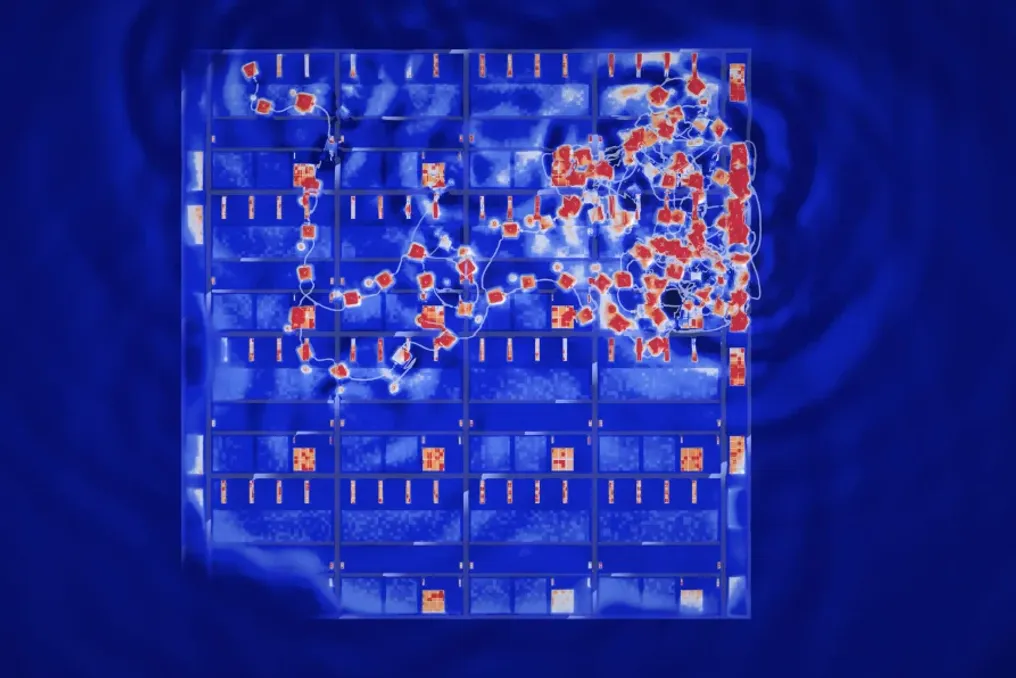
The startup Architect Labs announced that artificial intelligence agents created a central processing unit (CPU) architecture with energy efficiency nearly 4.6 times higher than a standard reference core. This project, named Frostbite, achieved this result during simulations, according to data published by the company.

The specified number reflects performance per watt, meaning the amount of work the processor performs relative to the power consumed. Although the project reached the physical schematic stage, it has not yet been manufactured to confirm actual power consumption.

The resulting figure represents the geometric mean of gains calculated based on 25 programs. Ten programs were used in the optimization phase, where a 6.02-fold advantage was achieved. In the remaining 15 programs intended for final evaluation, the gain was 3.83 times.

When comparing, it is important to consider the baseline: the company contrasted four smaller Frostbite blocks against one equivalent standard core, both designed for 7-nanometer technology. The identity of the competing core was not disclosed.

These achievements do not mean that the chip will be four times faster in every program or surpass modern PC processors by such a proportion. Human specialists defined the tasks that were supposed to guide the project. AI agents studied scientific literature, created models in Python, and worked on the compiler, instructions, and the schematics themselves.

Frostbite has its own set of instructions—a language of operations understandable by the processor—and requires tools to convert programs for the new hardware. The basis for development was interaction networks, a computational model presented in 1990, where a program is represented as connected nodes, and operations can occur simultaneously. In Architect Labs' design, computational blocks search for tasks in neighboring blocks when they become free; if no available work exists, they can enter a standby mode. According to the company, this mechanism arose during optimization using AI, without direct request from researchers.

Frostbite uses its own instruction set and the experimental Vine language. Programs must be compiled specifically for this architecture, as files already compiled for x86 or Arm will not run directly. The application of AI in chip development has precedents: in 2021, Google used machine learning to order the components of its AI accelerators, addressing the task of positioning these components.

Architect Labs plans to provide the schematic design and the instruction set, as well as conduct a comparison of Frostbite with more complex cores.


Similar stories

UPSC Implements AI Facial Verification and Random Interview Panel Generation to Enhance Exam Transparency
Read more
www.aajtak.in

UPSC Implements AI Facial Verification and Random Interview Panel Generation to Enhance Exam Transparency

The issue of transparency and integrity in the process is always a critical concern when conducting the country's most prestigious government and civil service examinations. However, as methods of fraud and technological abuse become increasingly sophisticated, the organizational structures managing the exams are also strengthening their measures.

At a one-day seminar organized for state service secretaries, Ajai Kumar, Chairman of the Union Public Service Commission (UPSC), stated resolutely: 'When technology begins to outpace the system, the only way to bring it under control is to use even more advanced technologies.' He emphasized that the adoption of technology has become not an option, but a necessity to ensure the complete transparency, security, and impartiality of government examinations across the country.

UPSC Measures to Prevent Violations and Strengthen Security System

To enhance the security system and combat malpractice during entrance examinations, UPSC has taken several significant and modern steps. Among the key initiatives mentioned by Chairman Ajai Kumar at the seminar are the following:

  • AI-based Facial Authorization: An Artificial Intelligence (AI) facial recognition system (Facial Authentication) is being implemented in examination centers for reliable participant identification, thereby eliminating the possibility of proxy candidates.
  • Unified Registration Number: A system of a common registration number has been introduced to simplify and enhance the security of the application process.
  • Computerized Random Assignment of Interview Panels: To completely eliminate any suspicion of bias or irregularities during interviews, the composition of the interview panel is now automatically distributed by a computer.
  • Digitalization: Proposals and documents from departmental employee promotion bodies are being converted into a fully digital format to speed up work and maintain process transparency.

Need for State Collaboration

The goal of this seminar was not merely to inform about UPSC's methods, but also to unite all public service commissions across the country on a single platform. UPSC Secretary Shashi Ranjan Kumar noted that this is not a one-way training, but a mutual exchange of views among officials performing similar constitutional duties in different states. He reported that many state commissions have developed effective methods for processing forms digitally, conducting exams in regional languages, and resolving student grievances. These successful practices are being gathered to form a unified standard.

The knowledge-sharing process took place over four sessions. After the introductory part of the seminar, it was divided into four working sessions. Departments dealing with UPSC examinations, admission rules, and disciplinary matters presented their working methodologies. This was followed by an open discussion with representatives from state commissions to jointly find solutions to practical problems arising during these large-scale examinations.

WhatsApp CEO discusses the future of education: comparing CPU and GPU thinking in the AI era
Read more
www.aajtak.in

WhatsApp CEO discusses the future of education: comparing CPU and GPU thinking in the AI era

The question arises whether modern schools and colleges adhere to outdated teaching methods. The digitized world has sparked a discussion about what types of thinking will be valued in the future, especially with the development of artificial intelligence (AI).

Kunal Shah, CEO of WhatsApp and founder of Cred, shared an interesting opinion regarding the educational system and the evolution of human thought in the age of AI. He used the metaphor of computer processors—the Central Processing Unit (CPU) and the Graphics Processing Unit (GPU)—to explain which skills will become most in demand in the coming times.

Speaking on the social platform 'X', Kunal Shah noted that the current education system rewards 'CPU-type minds,' meaning those capable of solving one problem sequentially and methodically. However, he suggested that the future might belong to 'GPU-type minds,' adding that perhaps ADHD finally found its suitable platform.

To illustrate this point, he explained that the central processor (CPU) executes commands strictly in sequence. Similarly, traditional education trains children to focus on one task within an established structure. In contrast, the graphics processor (GPU) is designed to process multiple complex calculations and operations simultaneously. In Shah's view, the future belongs to those who can harmonize many different ideas, recognize patterns across various subjects, and connect what seems unrelated at first glance.

Kunal Shah also mentioned Attention-Deficit/Hyperactivity Disorder (ADHD), which is often viewed as a deficit or weakness in traditional classrooms. Although this is only a conceptual comparison, it indicates that ways of thinking different from the mainstream can possess unique strengths.

Following Kunal Shah's comment, an extensive and deep discussion began on social media about the readiness of modern schools and offices to accept different types of mental abilities. Many users cited large companies such as SpaceX and Nvidia, which encourage employees who think unconventionally and challenge traditional approaches.

Others recalled their school years, describing how rigid rules and the pressure to remain still in traditional classrooms stifled children whose minds moved faster or in a different direction. Public opinion leans toward the idea that as AI takes over routine work and paperwork, the ability to think independently, demonstrate creativity, and connect diverse ideas becomes the most valuable trait.

This issue goes beyond just technology; it concerns our entire way of life and upbringing. Should we continue to mold children into a single template, or should we teach them skills that allow them to utilize their unique abilities? The goal in the AI era is not to completely eliminate 'CPU-type minds,' but rather to create an inclusive environment and classrooms that respect all learning styles. Ultimately, when machines handle all the calculations and standard processes, the true strength of the human mind will lie in its ability to see multiple horizons simultaneously.

Artificial Intelligence Projects in China Remain Dependent on Nvidia Processors
Read more
olhardigital.com.br

Artificial Intelligence Projects in China Remain Dependent on Nvidia Processors

Chinese computing initiatives, totaling over $3 billion, remain dependent on restricted processors manufactured by Nvidia. Due to the tightening controls imposed by the United States and the departure of CEO Jensen Huang, these projects risk delays and supply issues.

A Reuters investigation revealed investments and contracts exceeding 23 billion yuan, equivalent to about $3.2 billion, distributed across various regions of China. The investigation analyzed over 150 tender notices, investment plans, construction contracts, and corporate announcements.

The examined documents show that the American company's technology is present in universities, regional computing centers, and locally supported ventures, in addition to large technology corporations. This amount includes both planned investments and already signed contracts and completed installations, including buildings, power systems, and other infrastructure, not just the acquisition of processors.

Among the mapped projects, regional computing centers and commercial facilities configured to receive specific Nvidia processors, such as the H100, H200, and H800 models, stand out. One such location is in Gansu province, in northwest China, and had plans to install thousands of chips before the end of the year, although it is unclear whether the equipment reached its destination.

Those responsible for these projects face potential supply interruptions, delays, and high readjustment costs if Washington intensifies restrictions. Huang's resignation could worsen the situation, as it weakens Nvidia's influence with American legislators who advocate for stricter regulations.

Nvidia's co-founder resigned as CEO on Thursday amid a scandal linked to his relationship with Alice Huang, a former executive associated with Megaspeed, the cloud service partner of the Singapore-based manufacturer. US authorities suspect this businesswoman may have intelligence ties to Beijing.

Megaspeed denied any illegal diversion of Nvidia processors to China. Nvidia's board launched an independent investigation and stated it had no reason to believe that corporate secrets or US national security were compromised.

US restrictions on Nvidia's advanced AI processors began in 2022 and were later expanded to cover modified versions aimed at the Chinese market, such as the H800. In January, the Trump administration began evaluating export licenses for the H200 to eligible Chinese customers under specific conditions.

In August, Nvidia claimed to be almost entirely excluded from the Chinese data center computing market. Jensen Huang had also stated the previous year that the company's share in the country dropped from 95% to zero, leading the manufacturer to exclude revenue from this market from its forecasts due to regulatory uncertainties.

However, distribution data suggests a different picture. An IDC report cited by Reuters in October estimated that Nvidia was responsible for 34% of AI accelerator shipments to China during the first half of 2026. The indicators used measure distinct aspects and do not clarify how restricted processors reached Chinese consumers.

For Sunny Cheung, an analyst at the Jamestown Foundation in Washington, it is crucial that US surveillance considers the end destination of the equipment. He stated that 'Washington must stop focusing only on who buys the chips on the surface and start examining who ultimately uses the computational power—and for what purpose.'

To date, there is no public confirmation that Huang violated export control laws. The Chinese projects identified by Reuters were also not linked to Megaspeed or the accusations involving the executive.

Popular