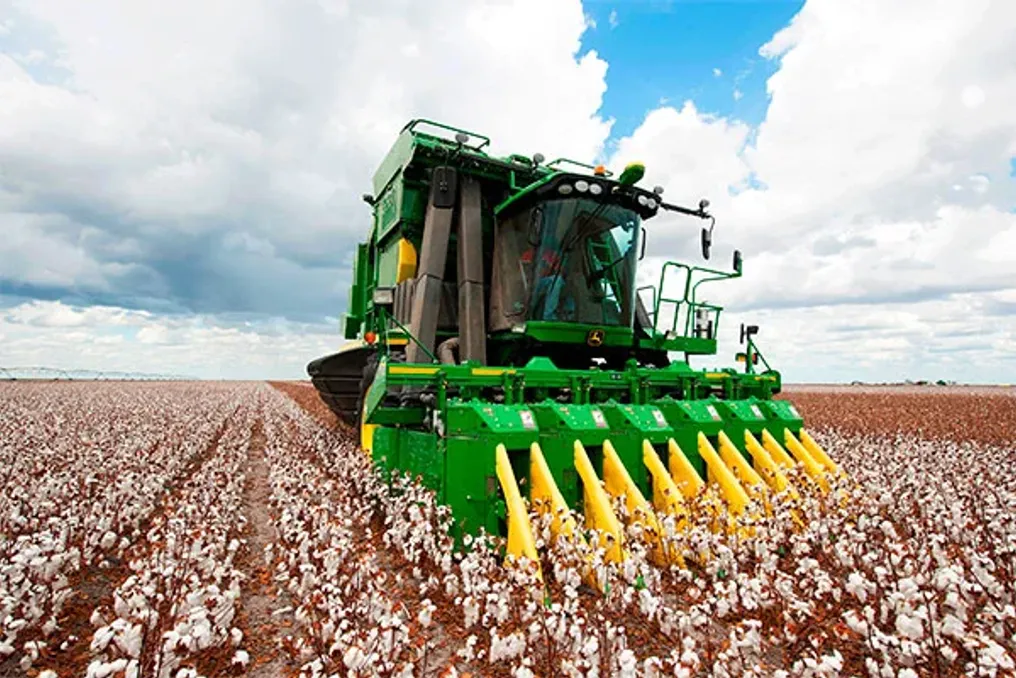
The Ministry of Agriculture reported that the cotton harvest in Uzbekistan is continuing, despite over 5.047 million tons having been collected since the beginning of the season. The Ministry provided clarifications regarding procurement volumes, harvest organization, and digital cotton accounting.
According to the Agrotarozi electronic platform, by November 13, 2026, the total amount of accepted cotton reached 5,047,095 tons, which accounted for 112.2% of the contractual target of 4.5 million tons. An additional 2,899 tons were purchased on the reporting day.
The Ministry emphasized that achieving the national goal does not mean the end of the harvest across all fields. Videos circulating on social networks showed fields where cotton had not yet been harvested, raising user questions about the reliability of the overall harvest data.
The Ministry clarified that the volume of cotton collected by a specific date cannot be confused with the completion of the harvest campaign, as the figures cover different reporting periods and increase as collection and acceptance continue.
Previously, on October 12, the declared procurement volume was 3.4 million tons, and by October 22, it reached 4.63 million tons. Noting the exceeding of five million tons, the President of Uzbekistan published a congratulatory message on November 4. However, the initial forecast for this year was 4.6 million tons, and exceeding this volume itself did not indicate any violations, as this figure was not the ceiling of possible yield.
Example from Bukhara Region
As an example, the Ministry cited data from the Bukhara region, where 530,677 tons of cotton had been collected since the beginning of the season, including an additional 1,228 tons on the reporting day. This figure exceeded the initial target of 442,000 tons by 88,677 tons. The Ministry stated that the harvest continued in most regions even after reaching the five million ton mark. Although the presented data does not provide a complete picture for every field in the Gizhduvan district, it does not confirm claims that the acceptance of additional cotton volumes ceased after the goal was announced.
Reasons for Harvest Delays
The Ministry separately examined fields where cotton remained unharvested, commenting on the condition of the plants shown in videos from the Gizhduvan district. The Ministry suggested that open cotton bolls along with remaining leaves might indicate that the farmer did not use cotton ripening technology or planted the crop late. Another possible reason was replanting cotton after wheat harvesting.
It was noted that with timely ripening, cotton on such fields could have been harvested mechanically within 35 days. A video from November 11 also showed green bolls and leaves. In the Ministry's opinion, this could indicate that measures to accelerate ripening and remove leaves were not implemented in a timely manner. The Ministry highlighted the timely application of Ethephon and Auguron as important agricultural operations.
The Ministry developed and communicated eight main rules to farmers to increase cotton yield. Nevertheless, the results depended on the timely and correct application of scientific recommendations and agrotechnologies. Farmers' responsibility for adhering to the deadlines for agricultural work and organizing the harvest was also emphasized.
By mid-November, deteriorating weather conditions made it almost impossible for heavy machinery to enter some fields, and the number of cotton pickers also decreased. Mechanical harvesting is difficult in fields where the leaves have not yet fallen. The Ministry reminded that in previous years, harvesting on some fields continued until snow fell, and therefore re-emphasized the importance of early cotton ripening technology, which has been used in Uzbekistan since August 1.
How Digital Cotton Accounting Works
The Ministry also explained the process of receiving and registering the harvest. Digital accounting is regulated by Cabinet of Ministers Decree No. 573 of September 9, 2025, which provides for the use of the Agrotarozi, Hosil qabuli, and AgroDocs information systems. According to established rules, cotton is accepted based on consignment notes indicating the exact land plot number where it was grown. Each batch is weighed on electronic scales in real time.
The information is transmitted to the Agroplatforma system, and daily reports are compiled in physical weight. Additional changes were introduced by Decree No. 295 of June 10, 2026, which improved the electronic accounting of cotton supplied under futures and forward contracts. Specifically, the Hosil qabuli system is used to issue consignment notes PK-17 and invoices for products weighed on electronic scales. These documents are certified using an electronic digital signature and transmitted to the exchange system.
Both the supplier and the recipient certify the consignment notes and invoices using electronic signatures. These documents are used to regulate financial relations between the parties, confirm supply volumes, and verify the fulfillment of contractual obligations. The signed documents are also transmitted through integration with tax authority information systems, serving as the basis for tax calculations and the application of certain tax benefits stipulated by law. A mechanism is introduced for providing state subsidies for every kilogram of harvested cotton based on issued invoices.
The Ministry noted that the electronic accounting system covers the entire process: from the land where the cotton is grown to its acceptance, documentation, and financial settlements. A video showing the same trailer repeatedly approaching weighing platforms was also commented on. The Ministry stated that this single fact is insufficient to prove that the same batch of cotton was registered more than once. If the receiving point is near the fields, vehicles may make several trips at intervals. Each batch is weighed separately, and the corresponding documents are processed according to established procedures. For each batch, the consignment note PK-17 is certified by the electronic signature of the supplier and recipient, and the invoice is then sent to the relevant information systems. This procedure links the physical volume of delivered cotton with the documents and financial settlements.
At the same time, the Ministry acknowledged that any suspicions of violating established rules must be investigated. It was stated that such cases must undergo objective legal assessment, and conclusions about violations should not be drawn solely based on individual video recordings.
Mechanization and Yield Improvement
In President Shavkat Mirziyoyev's congratulatory message of November 4, it was announced that 85% of the cotton harvest was collected in 30–35 days using more than 3,000 cotton harvesters. More than 2,000 modern machines were imported into the country over two years under preferential lease agreements. According to the presidential message, they worked in the fields for the first time in the country's history both day and night, operating for 16–18 hours a day.
The Ministry linked the expansion of mechanization to the reduction of heavy manual labor and the acceleration of the harvest. It also emphasized that higher yields depend not only on the varieties used or individual agrotechnical operations. Factors determining productivity included genetically adapted local material, planting schemes and density, balanced plant nutrition, water resource management, crop protection, and the timely implementation of ripening acceleration measures.
According to the Ministry, the average cotton yield increased by 40.4% between 2021 and 2025, and the total production volume grew by 19.3%, while sown areas decreased by 15.1%. The Ministry presented this data as evidence of changes in the sector over previous years. Euronews and IndexBox also covered the achievement of the five million ton mark, the introduction of new varieties, changes in planting methods, and mechanization of the harvest.
Ministry Comments on Farmer Payments
A separate part of the Ministry's explanation concerned complaints about delays in payments for supplied cotton and workers' wages. The Ministry stressed the importance of timely payment to both farmers and workers involved in the harvest. It emphasized that the volume of cotton collected and payment discipline are separate issues. Therefore, individual disputes over payments in Fergana or Namangan regions do not refute national procurement data.
However, general harvest data does not answer questions about unpaid payments to specific farmers. The reasons for such problems require individual study. The Ministry cited internal financial calculations, farmers' debts, inadequate work by local organizations, and financial literacy issues as possible causes. It also mentioned the projected net profit of 13–14 trillion sums for farmers, stated in the President's congratulatory message of November 4. This figure represented the expected economic result, not funds already paid to all farmers.
According to the Ministry, the reforms implemented allowed farmers who previously had debts to achieve higher yields. Over the past two years, farmers have gradually reduced debts accumulated in previous years, but some debts remain. The Ministry added that the results of the cotton campaign should be evaluated considering the dates of statistical data and the significance of each indicator. Furthermore, specific complaints about harvesting, crop acceptance, and payments require verification based on official documents and relevant evidence.