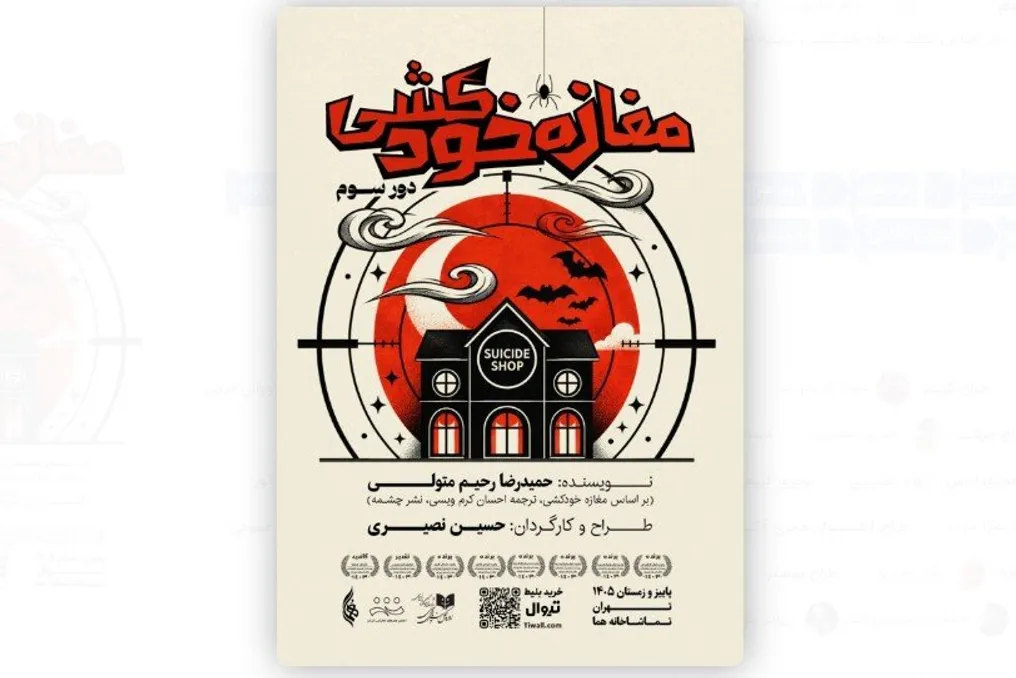
The third showing of the play 'The Suicide Shop,' which is a theatrical adaptation of the black comedy by French writer Jean Teol, is taking place in the Homa Theater hall in Tehran. Performances are scheduled until December 16th.
The work was written by Hamidreza Rahim Motavalli and is based on a Persian translation of the novel, done by Ehsan Karamveisi and published by Cheshmeh Publications. Hossein Nasiri directed the production.
The cast includes Davoud Geravand, Zohreh Najjar, Arezu Sarraf Rezai, Ali Hatibi, Yegane Nakfi, and Nazanin Zahra Bakainjad. This current run follows two previous performances, including a staging in March 2025 at the same theater, which was also overseen by Nasiri.
Originally published in 2006, the novel 'The Suicide Shop' (French: 'Le Magasin des suicides') is a dark comedy set in an anti-utopian city suffering from the devastating consequences of climate change, where universal despair has become part of daily life.
The central figure of the novel is the Tuvache family, whose name is inspired by three famous suicides: the father, nicknamed Mishima, pays homage to the Japanese author Yukio Mishima; the eldest son, Vincent Tuvache, is named after the troubled artist Vincent van Gogh; and their daughter, Marilyn Tuvache, resembles the iconic actress Marilyn Monroe. The youngest son, Alain, named after the brilliant mathematician Alan Turing, is the only ray of hope in a family immersed in hopelessness.
The Tuvache family runs a shop specializing in suicide paraphernalia, offering customers grim goods and instructions for ending their lives in an atmosphere of hopelessness.
However, Alain is born with an unwelcome spark of optimism that disrupts the melancholy accepted by the family. His siblings, Vincent and Marilyn, who each struggle with their own existential problems, try to suppress Alain's positivity. Vincent is portrayed as an exhausted figure consumed by creativity in creating the shop's dreary inventory, while Marilyn struggles with obesity and self-disgust.
As the plot develops, Alain's inner joy gradually changes the family dynamic, challenging the pervasive gloom enveloping the family. The family's attempts to pull Alain back into their cynical view of the world ultimately prove unsuccessful.
In an unexpected twist, 'The Suicide Shop' eventually transforms into a souvenir shop, abandoning its dark foundation and gaining an unexpected vitality. Paradoxically, despite its inspiring influence on the family, Alain's path ends in tragedy: he decides to take his own life, realizing that he gave others a purpose so they would reject despair and embrace life.
The novel's unique premise also served as inspiration for an animated adaptation directed by Patrice Leconte. Critics highly praised Teol's work, noting the subtle balance between humor and serious themes. In a review for Le Figaro, Mohammad Aissaoui noted the author's skillful combination of satire and imagination to address such a heavy topic.
The English translation of the novel was done by Sue Dyer, making this thought-provoking story accessible to a wider audience.