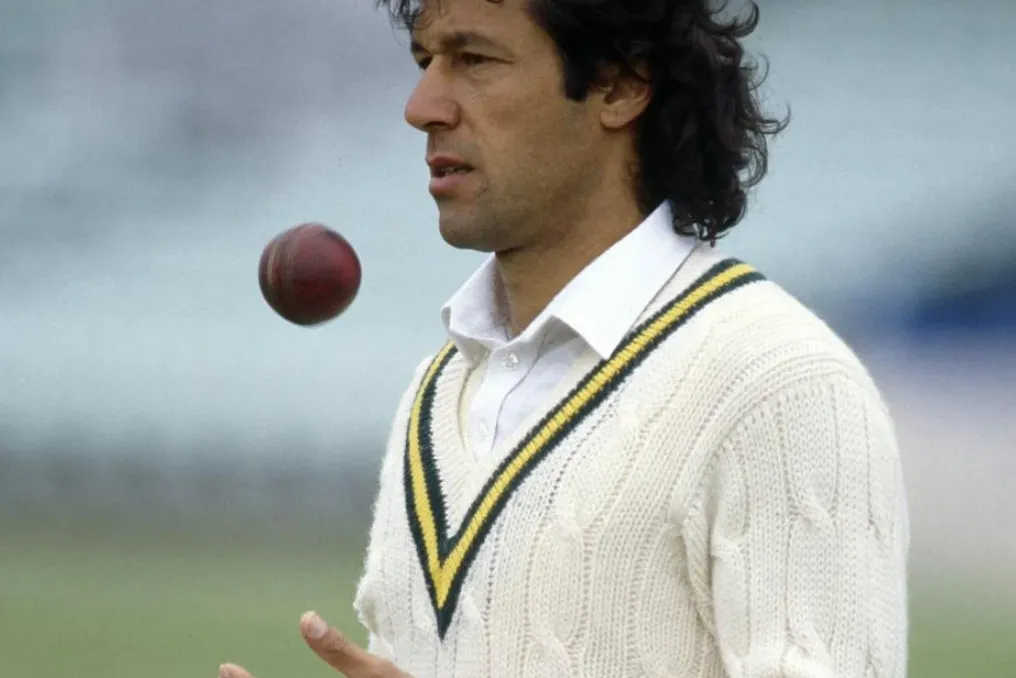
Forty-four years after Pakistani legend Imran Khan troubled India with his reverse swing during the 1982 Test series, it seems like a recent memory to Dilip Vengsarkar. Vengsarkar, who was 70 at the time, vividly remembers the old ball starting to swing during the match and how Imran became unbeatable, leading to strong media speculation about ball tampering.
The art of bowling with a reverse swing—whether through pure skill or illicit means—has once again become a subject of debate following a major statement by Usman Hawaji, a former Australian player born in Pakistan, in his new book 'Sabr,' concerning the so-called 'Sandpapergate.'
Hawaji's revelation that all members of the Australian team knew about the plan to apply sandpaper to the ball during the Test series in South Africa in 2018 sparked a serious rift in Australia. Although Hawaji's statement was supported by David Warner and Cameron Bancroft, who received lengthy bans for their role in it, the quick responses from Pat Cummins, the current captain of the Australian team, and Josh Hazlewood continue to deny knowledge of the team conspiracy aimed at violating reverse swing rules.
Australian bowlers also claim they do not recall any team discussions in the dressing room about using sandpaper on the field. However, Vengsarkar clearly remembers how Indian batsmen felt helpless when Imran began demonstrating his destructive reverse swing in the six-match series in 1982.
Imran took an impressive 40 wickets in six matches, securing a convincing 3-0 victory for Pakistan against their arch-rivals on home soil. While Pakistani fast bowlers, especially Saqib Nawaz, showed a great ability to make the old ball swing in the late 1970s, no one bowled as destructively with a reverse swing as Imran did in 1982. India found itself at the epicenter of the first truly great display of unconventional swing.
Vengsarkar told Khaleej Times: 'It was the first time we experienced this (reverse swing). We just saw that one side of the ball was darker, and the other was rough.' He added: 'In those days, even during the drinks break, the ball was never handed over to the umpire like it is now. And the ball would start swinging right after the break. There was huge swing. And Imran possessed incredible pace. When he started making the ball swing at such speed, he became unbeatable.'
Unusual Swing
In the second match in Karachi, after India gained a large advantage in the first innings and lost the first wicket at 28, Vengsarkar joined captain Sunil Gavaskar in the second innings. These two batsmen formed a solid partnership to mount a comeback, taking the score to 102 for one. But as soon as the old ball started moving in reverse, Imran re-entered the game, causing a stunning collapse in the attack as India crumbled from 102 for one to 114 for seven.
Vengsarkar (79) fought heroically for the bat, but the elegant middle-order batsman proved powerless against Imran, who took eight wickets for 60 runs, leading to Pakistan's victory by an innings and 86 runs. Vengsarkar recalled: 'Every time he (Imran) started using the reverse swing, he could take three or four wickets in a row, and it would be over. The swing was abnormal.'
Although the former Indian captain avoided prolonged rumors of ball tampering surrounding the 1982 series, Imran admitted to using a bottle cap to roughen one side of the ball during a match in Sussex and Hampshire in 1981. Since then, many incidents have occurred in international cricket where players were caught tampering with the ball, many of whom faced sanctions from the ICC (International Cricket Council).
Unfortunate Incident
Bancroft, Warner, and Smith paid a high price for Sandpapergate in 2018. Now, Hawaji's assertion that these three players sacrificed themselves to save the rest of the team in the biggest scandal in Australian cricket continues to raise uncomfortable questions.
In an extensive newspaper column, Bancroft supported Hawaji, reiterating that everyone on the team participated in the plan, including the bowlers. While Warner and Smith successfully returned after completing their one-year bans, Bancroft, one of the youngest members of the team in 2018 who received a nine-month ban, has never been able to resume his international career.
Vengsarkar stated: 'If three players were sacrificed, and if, as they say, the whole team knew about it, then why didn't the team support these three players? I mean, you can ask many questions about this.' He continued: 'Were they sacrificed because they were forced to do it? And when they were caught, the others said, 'We didn't know anything about it.' I mean, of course, it is the prerogative of Cricket Australia what they want to do about it. But it is an unfortunate incident.'
Various versions of the truth could become a nightmare for Cummins when he meets the media in the upcoming Test series against New Zealand. Until the full truth is revealed—not only about cheating but also about accountability—Australian bowlers will continue to face an element of suspicion in cricket.