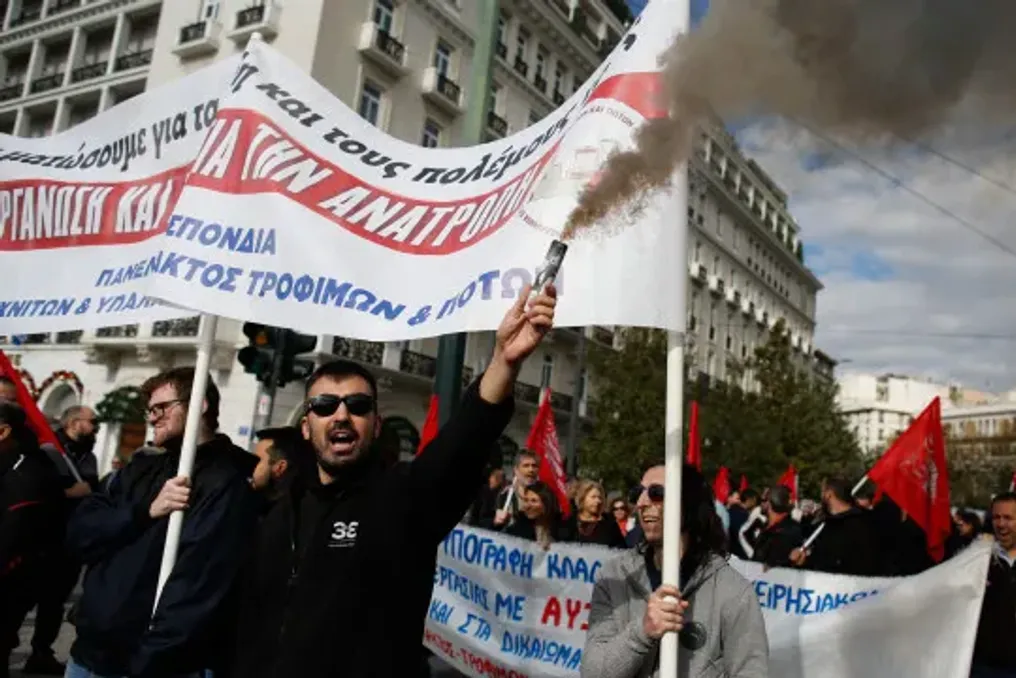
Thousands of citizens held demonstrations in major Greek cities during a public sector strike day. The main objective was to pressure the conservative Government for salary increases, implement urgent measures to combat the high cost of living, and allocate more resources to health and education.
The mobilization involved approximately 12,000 people, according to police estimates, and at least 20,000, according to the main public sector union, ADEDY, which organized the 24-hour general strike. In central Athens, the protesters were accompanied by students and other private sector representatives who supported the action.
Yorgos Petropulos, a member of the ADEDY Executive Committee, stated that students participated alongside workers because the high cost of living and low wages also affect their families. The central demand of the Greeks is the reinstatement of payments corresponding to the 13th and 14th months, amounts that were suppressed during the financial crisis experienced by Greece between 2010 and 2018 and have never been restored in the public sector.
Petropulos emphasized that the minimum wage in the public service is 15% lower than in the private sector, which he considers equally low. He argued that given the increase in the cost of living, it is understandable that workers face difficulties covering their monthly expenses.
The demonstrators marched through the center of the Greek capital towards parliament, displaying signs with messages such as 'Allocate funds to Education' and 'Students and workers united in one fist and one voice.' A notable moment of the protest included the performance of revolutionary songs by Mikis Theodorakis (1925-2021) by a group of musicians and teachers, along with the students.
The stoppage affected various services; the country began the day without passenger transport by sea or intercity trains, as sailors and railway workers also joined the strike. Furthermore, dozens of domestic flights at regional airports were canceled due to the strike by telecommunications workers from the Hellenic Civil Aviation Authority.
Healthcare professionals, secondary school teachers, and university faculty associations also participated in the strike, demanding salary increases, filling vacancies in both areas, and greater funding for academic research. Dimitris Fasuliotis, a Natural Sciences professor at the Capodistrian University of Athens, clarified that basic research in universities lacks resources and there is a major problem with state support for students.
Despite Greece, under the management of the conservative Government led by Kyriakos Mitsotakis, having managed to foster economic growth and substantially reduce public debt, the generalized increase in the cost of living and still modest salaries continue to significantly affect workers' incomes.
Data provided by the Greek Statistical Authority (Elstat) indicates that the accumulated inflation rate in the country between 2020 and 2026 reached almost 30%, while wages saw an average increase of only 20% over the same period. It is relevant to note that the national minimum wage grew by more than 41% between 2020 and 2026, rising from 650 to 920 gross euros per month.
Last October, annual inflation registered 5.7%, one of the highest levels in the European Union (EU), trailing only Bulgaria (5.9%), Lithuania (6.1%), and Romania (7.0%). In terms of purchasing power, Greece ranks at the bottom of the EU, tied with Bulgaria for last place in adjusted Gross Domestic Product (GDP) per capita, and occupies the last position in average wage purchasing power, according to Eurostat data.