Astronomers have identified the oldest known quasar—an object aged 13.1 billion years that formed just 630 million years after the Big Bang. Its supermassive black hole challenges current explanations of how such objects could grow so rapidly in the early Universe.
This discovery was presented on Tuesday (24) in the journal Astronomy and Astrophysics. The quasar, named Dún Aonghasa, surpasses the previous record holder by 40 million years.
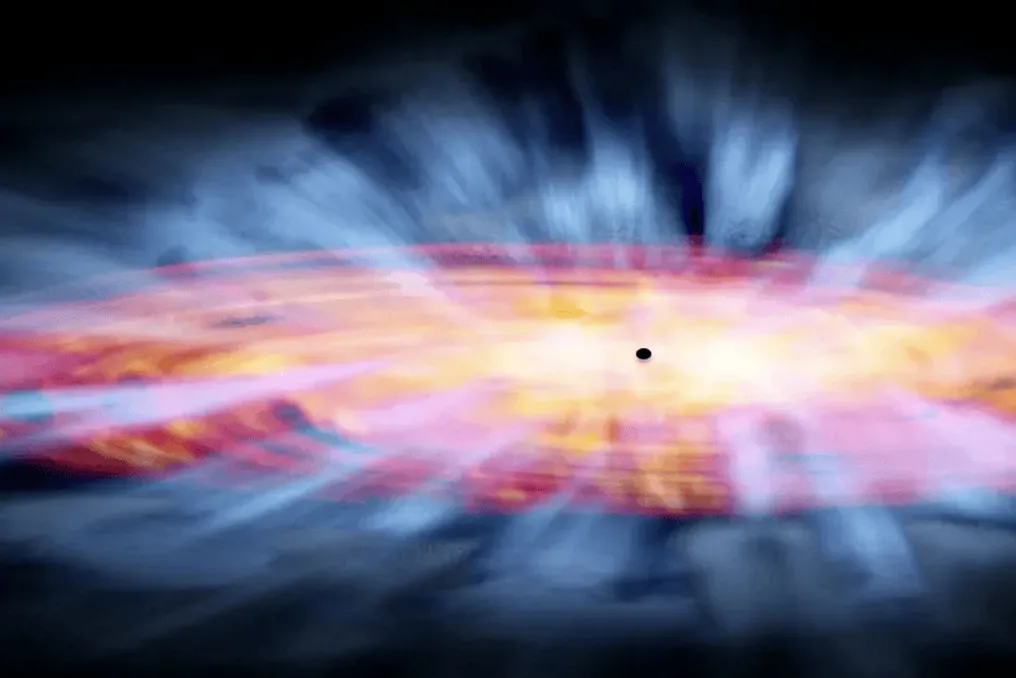
The intense luminosity of quasars is caused by material feeding the black holes at the centers of galaxies. Gas, dust, and other particles are drawn in by gravity and accumulate in a rotating structure called an accretion disk. The friction and compression of this material increase its temperature, causing powerful energy radiation that can be hundreds or thousands of times brighter than the rest of the galaxy.
In the case of Dún Aonghasa, the black hole has a mass approximately 90 times greater than that at the center of the Milky Way. Researchers chose this name in honor of an ancient stone fort in Ireland located on a cliff overlooking the Atlantic Ocean.
The initial detection of the object was made by the European Space Agency's (ESA) Euclid telescope. Later, the object underwent analysis combining observations from ground-based and space telescopes.
The discovery occurred during a period when the Universe had not yet completed its fundamental transformation. After the Big Bang, space was filled with neutral hydrogen fog that hindered light passage. The appearance of the first stars and galaxies changed this picture: the radiation from these bodies began to disperse the gas, gradually making the Cosmos transparent. Dún Aonghasa existed during this transition.
According to Silvia Belladitta, a co-author of the study, its size presents a problem for understanding black hole evolution. She noted: 'The black hole powering this quasar reached enormous mass in an extremely short period, challenging our understanding of how black holes can grow so quickly in the early Universe.' Belladitta is affiliated with the Max Planck Institute for Astronomy in Germany and the INAF Astrophysical and Space Science Observatory in Bologna, Italy.
Researchers consider two hypotheses regarding the origin of this black hole: firstly, Dún Aonghasa may not retain the title of the oldest known quasar for long, as they believe Euclid will be able to detect objects at greater distances corresponding to more distant epochs of cosmic history. Secondly, theoretical models suggest that the first quasars might have appeared between 270 and 470 million years after the Big Bang. Belladitta summarized the team's expectations: 'In short: it is the most distant quasar we have seen, but perhaps not the most distant one yet to be discovered.'