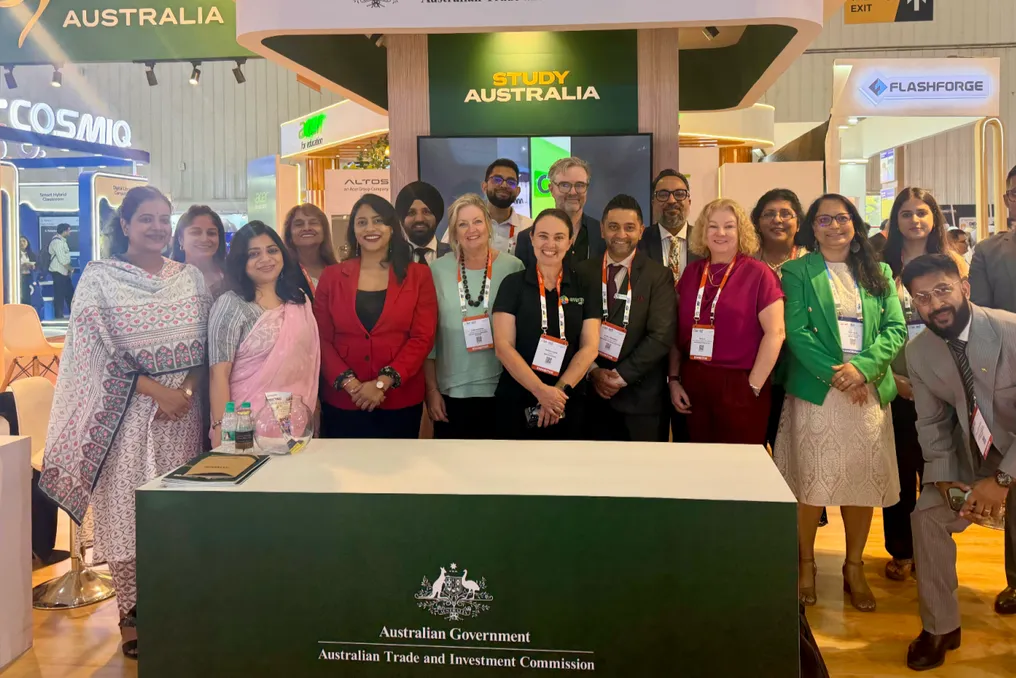
Australia is expanding its educational cooperation with India, focusing on joint learning, digital education, and workforce development. As part of this collaboration, a delegation of 21 members from Australia visited New Delhi and Bangalore from November 23 to 27.
The group, led by the Australian Trade and Investment Commission (Austrade) and supported by Investment NSW and Trade & Investment Queensland, is participating in the DIDAC India 2026 event, which will take place at the Bangalore International Exhibition Centre from November 25 to 27. The delegation includes universities, vocational institutions, and edtech firms operating in school education, employment, and workforce development sectors.
Vic Singh, Trade and Investment Commissioner for Austrade, noted that the delegation's goal is to more closely link education with economic needs. He emphasized that through this delegation, the focus is on skills development and EdTech, which allows for the integration of educational institutions, industry, governments, and students to build competencies required for future economic growth. This aims to create meaningful partnerships that bring together education, technology, and labor market needs.
Eight Australian universities either operate in India or are preparing to open representative offices. The Australian Department of Foreign Affairs and Trade has recorded the opening of five branches of Australian universities since 2024 in the cities of GIFT City, Bangalore, Mumbai, and Greater Noida in Gujarat.
Education is Australia's largest export service to India, reaching a value of AUD 9.4 billion in 2025, when over 140,000 Indian students were studying in Australia. India's National Education Policy (NEP) 2020 prioritizes accessibility, equity, quality, and internationalization of higher education. The University Grants Commission rules introduced in 2023 facilitated the possibility for relevant foreign universities to establish campuses.
In December 2025, the bilateral Council for Education and Skills supported online and blended learning, dual qualifications, and courses tailored to employer needs. Partnerships such as RMIT-BITS Pilani and the initiative by Maulana Azad University for teacher training in Uttar Pradesh were also mentioned.
In July 2026, the National Council for Vocational Education and Training of India (NCVET) and the Australian Skills Quality Authority (ASQA) signed a memorandum of understanding regarding the quality assurance of vocational training, including qualification benchmarking and potential mutual recognition in areas for further study. The Australia-India Future Skills Initiative, spanning four years, supports partnerships for short courses and micro-qualifications that certify specific skills in digital technology, energy, healthcare, and infrastructure.