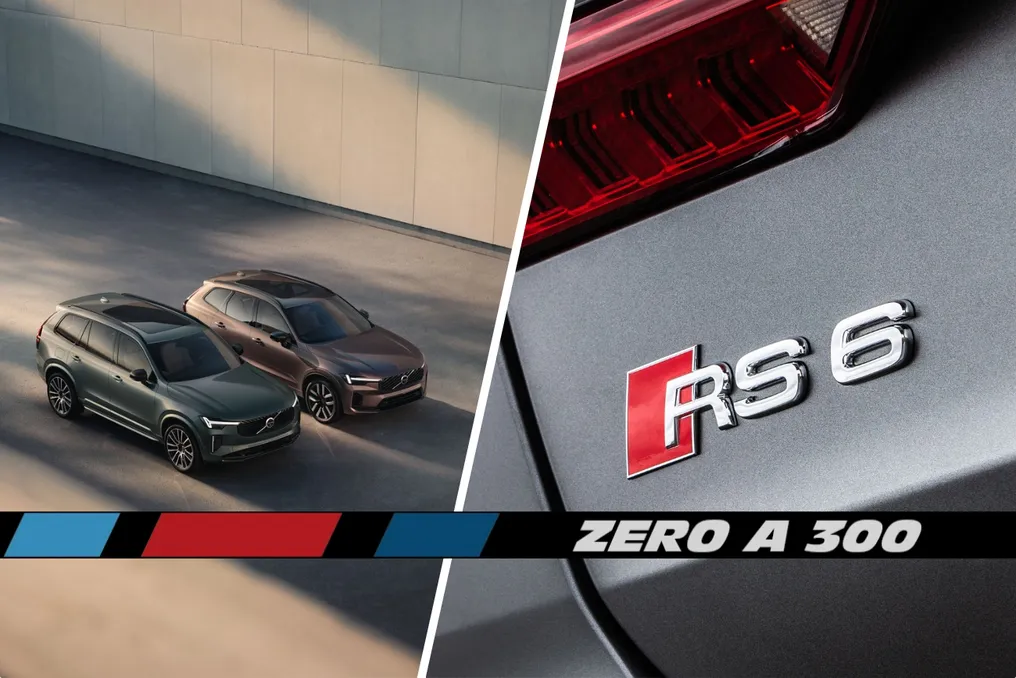
Volvo announced that the updated XC60 and XC90 models will be introduced to the Brazilian market during the second quarter of 2027, specifically between April and June. Both SUVs will be launched together, initially in the plug-in hybrid T8 AWD configuration. These new iterations will replace the currently available models, although the brand has not yet disclosed prices, anticipating a price adjustment.
The main improvement lies in the hybrid system, whose battery will be increased from 18.8 kWh to 41.2 kWh. This change allows the vehicles to be classified as Long Range PHEV, offering significantly greater range in pure electric mode. Specifically, the XC60 T8 achieves up to 189 km in the WLTP cycle, while the XC90 T8 can travel approximately 163 km without using the combustion engine. Both models share a combined power output of 461 hp.
Visual modifications are more noticeable on the XC60, which received a redesign of the front end, including the grille, hood, bumper, and headlights. The rear was also renewed with new taillights and a revised bumper. Internally, there are subtle adjustments to the door panels, lighting, and decorative finishes. The 11.2-inch multimedia system operates with Volvo Car UX, integrating Google Gemini assistant.
Regarding the XC90, Volvo maintained the design presented in the 2024 update, focusing innovations on engineering and onboard technology. This seven-seater SUV also incorporates the new long-range hybrid system, in addition to updates to electronic features and driver assistance systems. The AC charging capacity was improved, increasing from 6.4 kW to 11 kW. However, both models remain without support for fast DC charging, a feature observed in some newer plug-in hybrids. Volvo's strategy aims to maximize daily use in electric mode without giving up the gasoline engine for longer trips. Details such as prices and the complete equipment list should be released soon.
Audi plans to bring back the RS6 sedan
It is questioned whether we are witnessing a resurgence of sedans. A positive indication is the possible return of the three-volume version of the RS6 by Audi, directly targeting the BMW M5. A prototype of this vehicle was spotted undergoing tests at the Nürburgring circuit in Germany, displaying characteristics that should be incorporated into the final production model.
This prototype features wider front and rear fenders than the standard A6, along with specific bumpers, side skirts, oval exhaust tips, and a small spoiler integrated into the trunk lid. The LED taillights span almost the entire width of the rear, maintaining the visual identity of the new generation sedan. Although the engine is still a mystery, it is certain that electrification will be part of the configuration. The prototype sports high-voltage stickers, suggesting an electrified setup, likely plug-in hybrid. Possibilities include the electrified 2.9-liter biturbo V6 from the RS5, which produces 630 hp, or the 4.0-liter biturbo V8 hybrid used in Porsche and Bentley models. None of these options has been confirmed, but the RS6 will require significant power to compete with the M5's 717 hp.
The return of the sedan also ends a fifteen-year hiatus. The last time the RS6 had a three-volume body was in the C6 generation, equipped with a 5.0-liter biturbo V10. Since then, the two subsequent generations have been offered exclusively as Avants. The new C9 family should restore both body styles, with a launch forecast for 2027.
Following the mention of BYD reaching 500 km/h, Christian von Koenigsegg reaffirmed his focus on speed records. In a video posted on his Instagram on the 12th, he stated that Koenigsegg has not abandoned the search for the top speed record and that the Jesko Absolut still has potential for more. He clarified that the limiting factor for this attempt is the tires. There is no set deadline, only a request to wait in the description.
In February 2024, when Koenigsegg announced its intention to take the Jesko to 531 km/h that same year, mentioning only the need for a long, clear straightaway, it was commented that the technical challenges seemed overcome and the record depended only on space. However, a few months later, Koenigsegg itself communicated that the Absolut exceeded 500 km/h on a chassis dynamometer, in ninth gear and before the limiter, and Christian pointed to the tires, not the lack of road, as the obstacle for achieving it under real conditions.
The tire issue is not new. When Bugatti launched the Chiron, it already recognized that the critical point for reaching 490 or 500 km/h lay in the tires. Tire manufacturers are capable of producing a tire suitable for 500 km/h, but the challenge lies in making it practical and viable. It is no exaggeration to say that at 500 km/h, the Jesko's rear tire, a Michelin Pilot Sport Cup 2 325/30 R21 (the same as stock), rotates at about 3,600 rpm, and each segment of the tread experiences an acceleration of approximately 5,000 g. This force tries to dislodge the tread from the carcass and, at the limit, cause the tire to slip off the wheel. For the Chiron Super Sport 300+ to reach 490.48 km/h in 2019, Michelin had to reinforce the belts and test the tire on benches above 500 km/h, but customer cars remained limited to 440 km/h.
BYD opted for a path that ignores practicality and viability: it ordered a semi-slick tire from Giti developed specifically for record attempts and treated to prevent slippage. With this tire, Marc Basseng drove the U9 Xtreme to 503.17 km/h on a closed section of the E11 highway. This was the first 'mass-produced' car to exceed 500 km/h—with reservations, as such tires are not sold in stores. Christian von Koenigsegg always emphasized that the Bugatti record was achieved in a single direction, without considering the round-trip average that cancels out wind and incline effects, and with a vehicle in a non-consumer specification. The U9 Xtreme has the necessary independent certification (confirmed by the FIA), but Guinness explicitly registers it as a one-way record, using record tires and in a car with only 30 units.
For its part, Koenigsegg has stated since 2024 that it wants to set its record with a series Jesko, homologated and equipped with street tires. The best round-trip average (the effective record) still belongs to the SSC Tuatara, with 455.3 km/h—the same one that reached 508 km/h in a measurement later corrected by SSC itself. In practice, the problem persists, and our nearly three-year analysis remains current.
FuelTech opens new store in São Paulo this Sunday
FuelTech will open its new store in São Paulo this Sunday (29), named FT Store. This unit will be located inside the Gearhead Club, in the Anhanguera Business Center (Anhanguera Highway, 16,950, km 17, Vila Jaraguá), and will have infrastructure similar to the headquarters in Porto Alegre, offering product sales, technical support, commercial sector, and technical assistance.
The opening will be marked by the first FuelTech & Café event, an automotive gathering scheduled from 9 am to 2 pm. The program will include car exhibitions, food trucks, racing simulators, and the participation of Dub Boyz. The Claret Institute will also be present to collect food, clothing, and school supplies. The entrance fee is R$ 50, free for children under 12 years old. Tickets can be purchased through the website fueltechcafe.com.br.
The intention is for FuelTech & Café to become a monthly event at the location, following the model of FuelTech & Chimarrão, a tradition promoted by the company in Rio Grande do Sul. It is expected that the first São Paulo edition will receive about 2 thousand participants. The new FT Store will operate from Monday to Friday, from 9 am to 6 pm, and also on Sundays when the meeting takes place. The inauguration event will feature the presence of Anderson Dick, founder of FuelTech, and Leonardo Fontolan, CEO Brazil of the company. Juliano Barata will also be present this Sunday, and everyone is invited to visit him.
Toyota transforms new Hilux into a track project
The new Toyota Hilux is close to arriving in Brazil, expected early next year, and in November, the Hilux Travo Hyper Z emerges, an exclusive project developed by the Thai division of Toyota with the help of its Australian design studio. It is consistent that such a creation occurred in Thailand, given the high popularity of mid-size pickup trucks as passenger vehicles and as a base for projects in the country.
Inspired by this context, the body received a widebody kit comprising a new bumper with air vents and a prominent splitter, redesigned fenders, air intakes integrated into the bed, a substantial diffuser, and a wing reminiscent of WRC prototypes. The wheels were fitted with white aerodynamic covers and shod with semi-slick tires. Additionally, there is a second spoiler on the roof and aerodynamic elements inspired by aviation. The suspension was adapted to match the concept, using Öhlins dampers with external reservoirs, Swift springs, and modified suspension arms. The result is an extremely low Hilux, with widened bases and negative camber on the front wheels.
The interior was also equipped with competition components, such as Sabelt bucket seats, yellow seatbelts, a three-spoke steering wheel, a Race Dash digital panel, and a roll cage. Toyota did not disclose the mechanical data of the concept but confirmed the use of an internal combustion engine. Although the Hyper Z is a one-off piece, the idea derives from a production version, the Hilux Travo Z Edition, which is already sold in Thailand with lowered suspension, rear-wheel drive, 16-inch wheels, and certain sporty details. This configuration is more discreet but demonstrates how Toyota explores the urban and sporty aspect of the pickup in markets receptive to such customizations, serving as inspiration for those awaiting the new Hilux in Brazil.