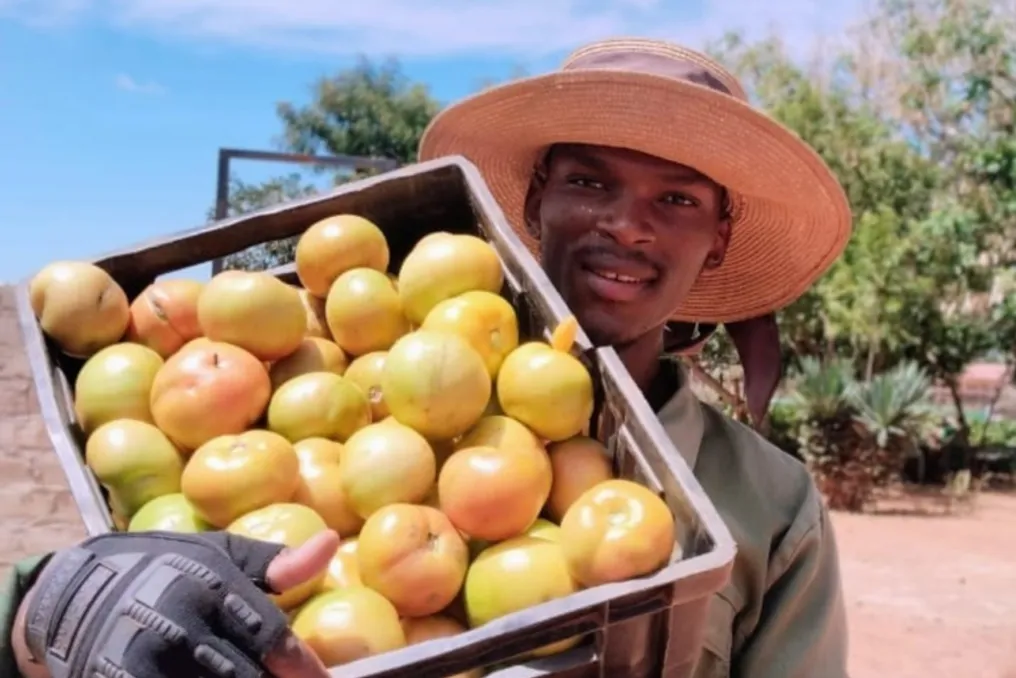
In 2023, Musa Sibanyoni turned to agriculture while trying to distract himself from the pressure of graduation year. A year later, he developed his home garden, registering it as a business called Musa Nhlapo’s Garden, making farming an integral part of his future.
He started growing tomatoes in the backyard in Kwandebele, Kwaaggafontein, Mpumalanga, relying on his family's experience, which previously sold tomatoes. He noticed market demand for this crop, prompting him to take his garden seriously.
Initially, he started with 100 tomato plants on public land of less than one hectare in Kwandebele, but since then has increased the harvest to 700 plants.
Although Sibanyoni was born in Gauteng, he spent most of his childhood in Mpumalanga. He shared that his mother, Jabili Sibanyoni, was the sole provider for the family, and meeting the household's needs was not always easy. In those years, neighbors showed kindness by giving him clothes when his family could not afford them.
His interest in growing tomatoes arose from observing how his mother cared for their home garden. After finishing school, Sibanyoni realized he could turn the knowledge gained from his mother into a commercial venture.
He noted: 'Tomatoes wouldn't last two days at home after harvesting. When I chose a crop to grow, it was easy because I saw how quickly neighbors used up them from my mom's garden.' He added: 'Even if improvement requires money, my mom is always ready to help with what she has.'
Sibanyoni built a customer base in his community by supplying products to local spaza shops and informal street vendors. Additionally, he advertises his products on social media. He emphasizes that good customer relations and maintaining tomato quality are crucial for retaining a stable customer base, and word-of-mouth helps attract more buyers and increase sales.
Sibanyoni told Food For Mzansi that choosing the right tomato variety is critical, as varieties differ in their characteristics. Farmers need to determine which variety best suits the growing conditions and production goals. Sibanyoni uses the hybrid Star 9009 F1, which, according to him, performs well in winter. He also notes that this variety is resistant to Mpumalanga's heat and offers some protection against diseases such as bacterial wilt, which is a problem for tomato farmers.
This variety yields a high harvest, with individual fruits weighing between 140 and 170 grams. Sibanyoni added that 'tomatoes can be stored on the shelf for about seven to fourteen days.'
Despite the successes, he explains that issues with pest and disease infestation remain relevant. Earlier this year, a separate project with 500 tomato plants failed due to phytophthora. However, Sibanyoni continues to learn from other tomato farmers who share their experiences on social media. Furthermore, last year he attended a training program organized by the Mpumalanga Department of Agriculture, which gave him useful knowledge about crop production.
He points out that growing tomatoes in winter can be difficult without a greenhouse. Sibanyoni strongly recommends that farmers follow a regular spraying program to minimize crop damage and protect product quality. He warns: 'When it comes to pests, you need to be vigilant because customers do not like damaged tomatoes.' He also advises: 'You should have a clear spraying program, even for fungal infections, because this is the main problem during the rainy season.'
Although he is already engaged in farming, Sibanyoni hopes to take a course related to farm management. His immediate goal is to increase production from 700 to 1500 tomato plants to provide customers for a longer period. In the coming years, he plans to supply formal retail outlets and explore ways to process surplus tomatoes into other products.
Sibanyoni also aims to enter the Tshwane market, where he dreams of seeing his products on shelves. Water scarcity in his area remains a problem. Although he installed a drip irrigation system, expanding the business will require more land and investment in infrastructure, including fencing, irrigation, and reliable water supply. Despite all the difficulties, he never gives up and works tirelessly to achieve his goals. With the necessary financial support, he expects to increase production and reach new markets.