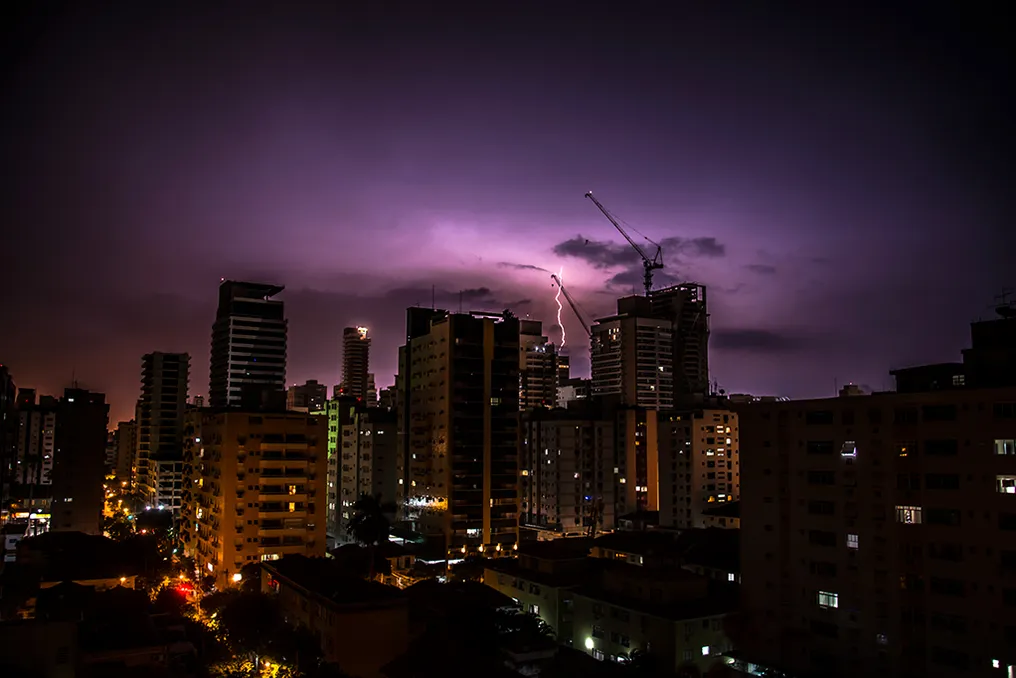
Brazil, recognized as the largest country in the planet's tropical zone, has a high incidence of atmospheric discharges, registering between 70 and 150 million lightning strikes annually, depending on the monitoring method, according to data from the National Institute for Space Research (INPE). Even specific locations, such as Christ the Redeemer, receive an average of six lightning strikes per year.
A recent study, published in the journal Earth’s Future this Tuesday (24th), suggests that the frequency of lightning strikes hitting the surface may increase significantly. Projections indicate that by the end of this century, lightning strikes could be 76% to 140% more frequent globally compared to the period between 1995 and 2014.
These estimates specifically refer to cloud-to-ground lightning, which are the most common and well-known, as they originate from clouds and strike the ground directly. Annually, these events are responsible for the destruction of physical infrastructure, electrical grids, and electronic equipment, in addition to causing deaths worldwide.
The main cause of this increase in lightning is linked to global warming. The rise in climatic temperature results in a greater concentration of vapor in the atmosphere, which acts as a catalyst for the formation of more vigorous storms and, consequently, for lightning generation.
To make these predictions about the density of electrical discharges under various climatic conditions, the team developed a machine learning model. This model was trained using lightning data and climate information collected in 2019, covering variables such as temperature, humidity, precipitation, atmospheric pressure, wind speed, and incident solar radiation.
Subsequently, the model was applied to climate records from the periods 1901 to 1920 and 1995 to 2014. The results showed that the frequency of lightning strikes on the ground grew by 11% during the 20th century, and that this growth could accelerate further in a future scenario characterized by high emissions.
Although researchers were already aware of the increase in lightning occurrences, historical analyses by INPE in Brazil already pointed to a growth in recent decades, driven by heat, humidity, and climate changes. However, the new estimates presented in this study exceed previously established forecasts.
The distribution of these events will not be uniform in all locations. The study predicts an increase in the total number of electrical discharges in tropical regions, where the phenomenon is already more recurrent. Among these, the Amazon, Southeast Asia, and Oceania stand out. However, for the Amazon, the projections carry a higher level of uncertainty, given that future climatic conditions may diverge from those historically observed and from the data used in the model.
The most drastic changes are expected at higher latitudes, where lightning incidence is less common. The model indicates that the density of electrical discharges could more than double in several regions; for example, Alaska could record between 116% and 594% more lightning strikes than currently.
The physics behind lightning is intrinsically linked to the climate: its formation depends on both heat and cold. When the air near the Earth's surface heats up, it rises, a process called convection. This triggers the formation of currents within storm clouds.
In these cold clouds, small ice crystals collide with each other and with larger particles. Over time, the lighter crystals, carrying a positive charge, rise, while the larger ones, with a negative charge, remain at the base. This arrangement generates an electric field that eventually dissipates in the form of lightning. In summary, the increase in temperature can intensify convection, resulting in more lightning.