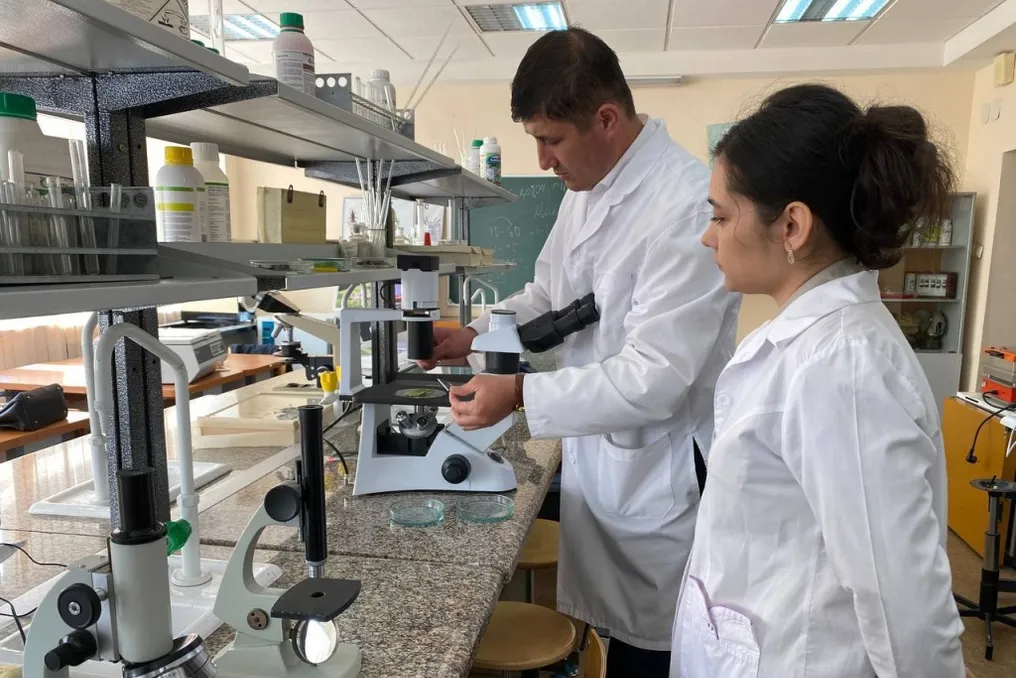
One hundred thirty-seven production tasks requiring scientific development were identified at major mining enterprises in Uzbekistan. In response to these requests, scientific institutions and higher educational institutions proposed 45 different developments and patents. The parties discussed the potential for integrating domestic technologies into the production process of critical minerals.
The interaction between science and industry was discussed on November 24th at an event held at the Center for Economic Research and Reforms (CERR). Representatives from the Academy of Sciences, relevant ministries, the Agency for Innovation Development, the Uzbek Technological Metals Combine (TMK), as well as scientific institutes and universities participated in this meeting.
Central attention was paid to issues of deep processing of mineral raw materials, the introduction of new technologies, and the creation of high value-added products. According to Shakhlokhon Turdikulova, Vice President of the Academy of Sciences, the enterprises stated 137 production tasks, and scientific structures provided 45 proposals for developments. The next step is planned to be the testing of these proposed solutions directly at production facilities.
Seven relevant educational and scientific organizations have already been involved in joint work with enterprises. The main vectors of cooperation include increasing productivity, reducing costs, and mastering new types of products.
Ural Yusupov, Deputy Minister of Mining and Geology, reported that in accordance with the President's decree No. PP-276 of July 24, 2026, a specialized system was created to detect technological difficulties at enterprises and search for scientific and innovative solutions. This system is currently operating in test mode, and thanks to it, the republic's production combines have formulated over 50 ideas.
The plans of the Uzbek Technological Metals Combine (TMK) were also presented at the meeting. According to Amir Abidov, Deputy Chairman of the Combine's Board, the enterprise has already mastered the production of five types of critical materials, including tungsten, molybdenum, and rhenium. Currently, TMK is developing more than 140 projects with a total investment volume of $4.2 billion, including projects for the production of ultra-pure metals.
Participants also discussed prospects for the development of tungsten and molybdenum clusters, the creation of joint research centers and startup consortia, as well as mechanisms for financing scientific initiatives and acquiring technological solutions.
The expansion of this area is driven by Uzbekistan's plans to increase the range of critical materials from five to sixteen types. President Shavkat Mirziyoyev set this goal at a meeting on November 5. The list of new areas includes the production of nickel, cobalt, graphite, antimony, tin, manganese, platinum, vanadium, mercury, and copper. By 2030, the cost of producing these 16 types of critical materials is expected to exceed $2.7 billion.
Previously, prospects for deep processing of mineral raw materials and the production of industrial products were also discussed with foreign partners. On October 19, Shavkat Mirziyoyev held negotiations with the management of American companies Wabtec and Traxys. During these talks, projects for the processing of critical minerals, as well as issues of locomotive supply with long-term maintenance and the creation of a service center for quarry equipment, were considered.
As a result of the meeting at the CERR premises, preliminary agreements were reached regarding the further development of scientific and industrial cooperation and the holding of training seminars on public procurement.