FSSAI chief Radhika Punhani announced the launch of a nationwide monitoring initiative to assess the quality of bottled drinking water. The results of this survey are expected to be available in one to two months.
This initiative is being conducted across the country as part of the regulator's ongoing efforts to check various categories of food products and ensure compliance with established standards. Punhani told reporters that the process has begun and covers the entire territory of the country, adding that the results will take at least one or two months.
He clarified that drinking water was included in the regulator's monitoring program not for any specific reason, but as part of a broader plan. Previously, last year, dairy products, meat, eggs, cereals, energy, and soft drinks were checked, and now water is also included in this process.
Furthermore, Punhani emphasized the need for food businesses to adhere to ethical norms in advertising, especially regarding product claims and promotion. He stressed that the regulator views this issue not only from a legal but also an ethical standpoint, urging the industry to focus on responsible advertising.
Conflict surrounding Bisleri
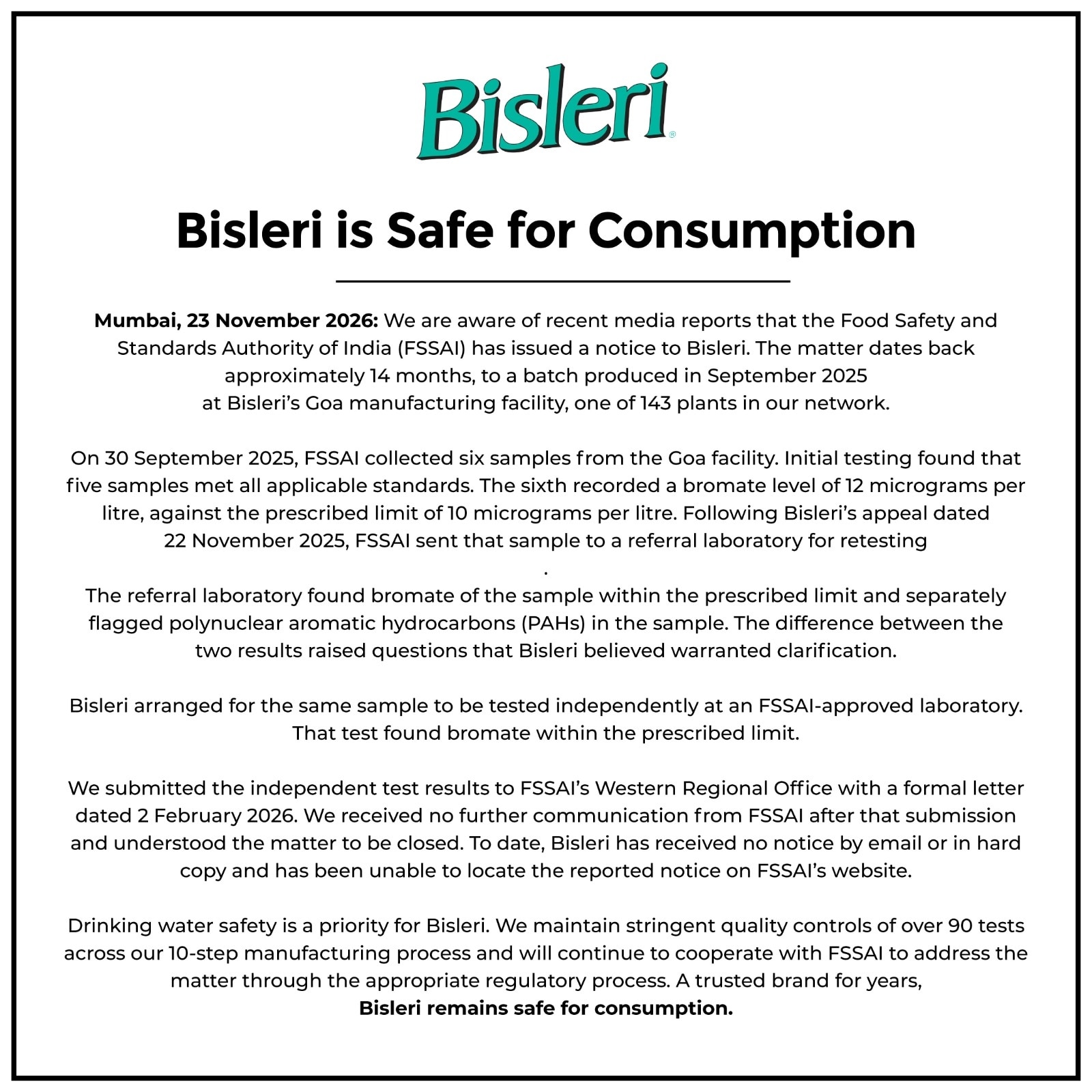
Punhani's statements and the nationwide inspection come against the backdrop of regulatory actions taken against the bottled drinking water manufacturer Bisleri International following the analysis of a sample taken from the company's facility in Goa. On November 23, FSSAI sanctioned legal proceedings against the company because the initial regulatory sample was found to be non-compliant with bromate limits and deemed unsafe under the Food Safety and Standards Act of 2006.
After an appeal from the company, the sample was sent to a referral food laboratory for further examination, which also deemed it unsafe after detecting polycyclic aromatic hydrocarbons (PAHs). However, on Monday, FSSAI clarified that this action related only to one sample from one batch, number GO 270, collected at the company's plant in Verna Electronic City, South Goa.
The regulator also issued an order prohibiting the sale of this batch in accordance with Section 36(3) of the Food Safety and Standards Act. Bisleri International subsequently welcomed this clarification, asserting that the sales ban applies only to the specific batch produced at the Goa plant on September 27, 2025. The company stated that it produces over 50,000 batches annually, and that there are currently no stocks of this particular batch in the market. Furthermore, the company insisted that retesting showed bromate levels below the permissible limit.