International Monetary Fund discussed economic and financial reforms with Uzbekistan
Read more
UzDaily
uzdaily.uz

International Monetary Fund discussed economic and financial reforms with Uzbekistan

Uzbekistan and the International Monetary Fund (IMF) held discussions on macroeconomic stability, as well as economic and financial reforms, and prospects for further cooperation.

Discussions took place in Tashkent

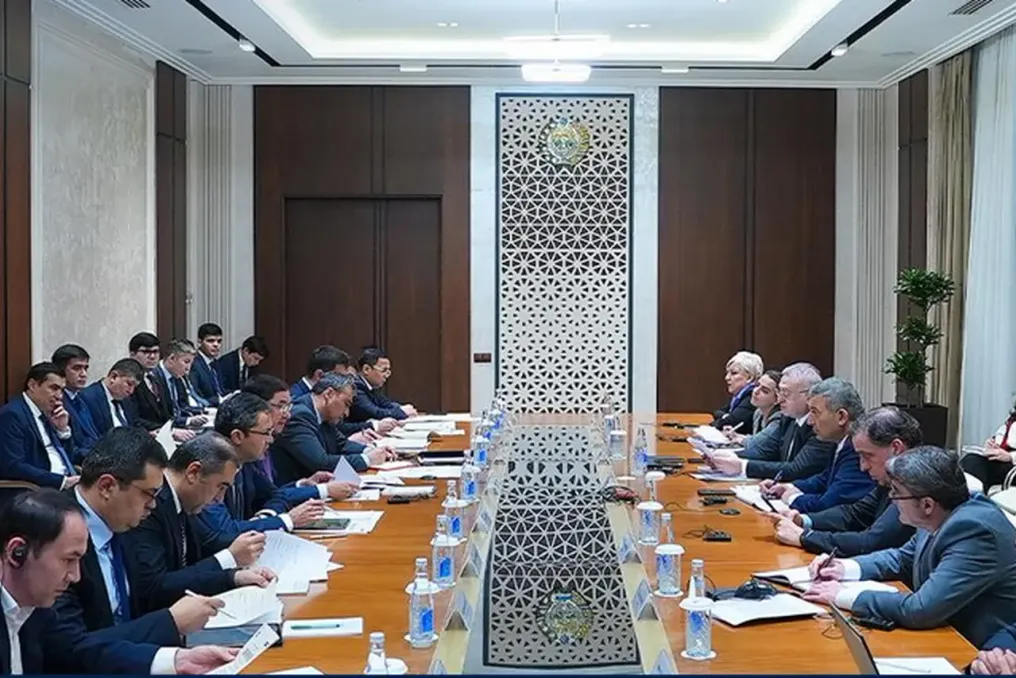
The meeting was held on November 24. Participants included Deputy Prime Minister and Minister of Economy and Finance Jamshid Kuchkarov and an IMF delegation led by Yasser Abdih, the fund's mission head in Uzbekistan.

Koba Gvenetadze, the IMF's Permanent Representative in Uzbekistan, along with economists and fund specialists, also took part in the negotiations. Uzbekistan was represented by Central Bank Chairman Timur Ishmetov, National Statistical Committee Chairman Behzod Khamraev, and representatives of relevant state agencies.

Both sides exchanged views on opportunities for cooperation, current socio-economic and financial transformations, and achieved results.

Main topics of discussion

A central theme was strengthening macroeconomic stability and accelerating structural reforms. Participants also discussed the need to coordinate monetary and fiscal policies to ensure a sustainable reduction in the inflation rate.

Particular attention was paid to improving the efficiency of budget processes, optimizing budget indicators, and strengthening public financial management. Furthermore, the agenda included the further development of tax and customs policy, improving governance in these areas, accelerating privatization, and expanding the role of the private sector in the economy.

IMF representatives gave a positive assessment of Uzbekistan's economic stability and high growth rates. They noted improvements in the country's key macroeconomic indicators despite global uncertainty.

At the end of the meeting, both sides agreed to strengthen practical interaction on the issues raised and expand the exchange of views on the discussed problems.

Similar stories

Uzbekistan and IMF Discuss Investments and WTO Accession in Tashkent
Read more
uzdaily.uz

Uzbekistan and IMF Discuss Investments and WTO Accession in Tashkent

The Ministry of Investment, Industry and Trade reported that a meeting took place in Tashkent on November 19 between Uzbekistan and the International Monetary Fund (IMF). During this meeting, issues of foreign trade, attracting foreign investment, and the country's process of joining the World Trade Organization (WTO) were discussed.

Discussion on Development and Trade Issues

Saikakhhor Kholkhozhayev, First Deputy Minister of Investment, Industry and Trade of Uzbekistan, met with Yasir Abdi, Advisor to the IMF's Middle East and Central Asia Department. During the negotiations, particular attention was paid to advancing the accession talks of Uzbekistan to the WTO and the need to improve national legislation within this process.

According to the ministry, Uzbekistan's exports, excluding special goods, reached 25.7 billion US dollars for the period from January to October 2026, representing a 33% increase compared to the same period last year. Furthermore, during the same period, $49.5 billion was attracted in the form of foreign investments and loans.

At the conclusion of the negotiations, both sides confirmed their readiness to continue constructive dialogue and strengthen cooperation.

IMF calls on Uzbekistan to accelerate pension reform implementation
Read more
podrobno.uz

IMF calls on Uzbekistan to accelerate pension reform implementation

The International Monetary Fund (IMF) considers pension reform a key aspect of Uzbekistan's further progress. According to the fund's assessments, although the necessary documents for transforming the pension system are ready, the changes themselves are still in the early stages of implementation.

These remarks were made during the presentation of the IMF's regional economic forecast, which took place at the Central Bank of Uzbekistan. The fund's Permanent Representative in the country, Koba Gvenetadze, emphasized that pension reform is important not only for the economy but also for the development of the financial sector. He noted that the prepared documents form the foundation for the upcoming transformations.

The IMF insists that Uzbekistan should ensure the financial stability of the pension system while maintaining an acceptable level of payments. Previously, fund experts advised conducting an actuarial analysis to assess the system's ability to meet its obligations to future pensioners, taking into account demographic changes such as population aging and changes in the working population size.

Furthermore, pension reform is closely linked to the development of the domestic financial market. Pension savings funds can serve as a source of long-term investments, including the purchase of government and corporate bonds. However, this requires the existence of a developed capital market and clear rules for regulating savings.

IMF representatives also drew attention to other areas requiring modernization: the labor market, education, energy, digitalization, and the integration of artificial intelligence. They particularly highlighted the need to maintain macroeconomic stability. It should be recalled that Uzbekistan previously announced its intention to achieve official recognition of citizens' foreign work experience when calculating pensions.

IMF classifies Uzbekistan's exchange rate as floating regime
Read more
uzdaily.uz

IMF classifies Uzbekistan's exchange rate as floating regime

The International Monetary Fund (IMF) has changed the classification of Uzbekistan's exchange rate regime, moving it from a system similar to a crawling peg to a floating exchange rate system. IMF representative Koba Gvenetadze recommended maintaining the flexibility of the sum to protect the economy from external shocks.

These statements were made during the presentation of the regional economic forecast at the Central Bank of Uzbekistan. Gvenetadze noted that the previous regime was similar to a crawling peg, and now it is floating.

According to Gvenetadze, just one or two years ago, market participants expected the sum to depreciate against the US dollar by 7–10% annually. However, this depreciation did not occur amid improving key economic indicators.

The IMF representative emphasized that a floating exchange rate is an integral part of the inflation targeting system used by the Central Bank. He added that the Central Bank of Uzbekistan has overcome the so-called 'fear of a floating rate,' and Uzbekistan now has a floating exchange rate.

IMF emphasizes the need to develop hedging instruments

The transition to a floating exchange rate requires the creation of tools for hedging currency risks. Gvenetadze advised the treasury departments of commercial banks to develop capabilities to offer such instruments to clients.

He described the main advantage of a flexible currency regime—its ability to mitigate the impact of external shocks on the economy because it 'isolates the economy from the shock.' To support this thesis, Gvenetadze referred to a study presented in the IMF report.

According to the fund's calculations, in countries with flexible exchange rates, supply shocks affect prices faster, but subsequent production losses are smaller. Under less flexible exchange rate regimes, the impact of such shocks on prices is weaker, but production reduction occurs more significantly in the second year after the shock.

IMF supports maintaining the key rate at 14%

The Central Bank of Uzbekistan has maintained its key policy rate at 14% since March 2025, which the IMF considers acceptable. The fund advises maintaining tight monetary conditions until inflation sustainably approaches the Central Bank's target of 5%.

Nodirbek Achilov, Deputy Chairman of the Central Bank of Uzbekistan, stated that further inflation reduction is becoming more difficult as it approaches the target. He explained that when they started inflation targeting, it was around 20%, and now it is in single digits, for example, around 6.5%, and changing these figures requires significant attention and multiple measures.

Popular