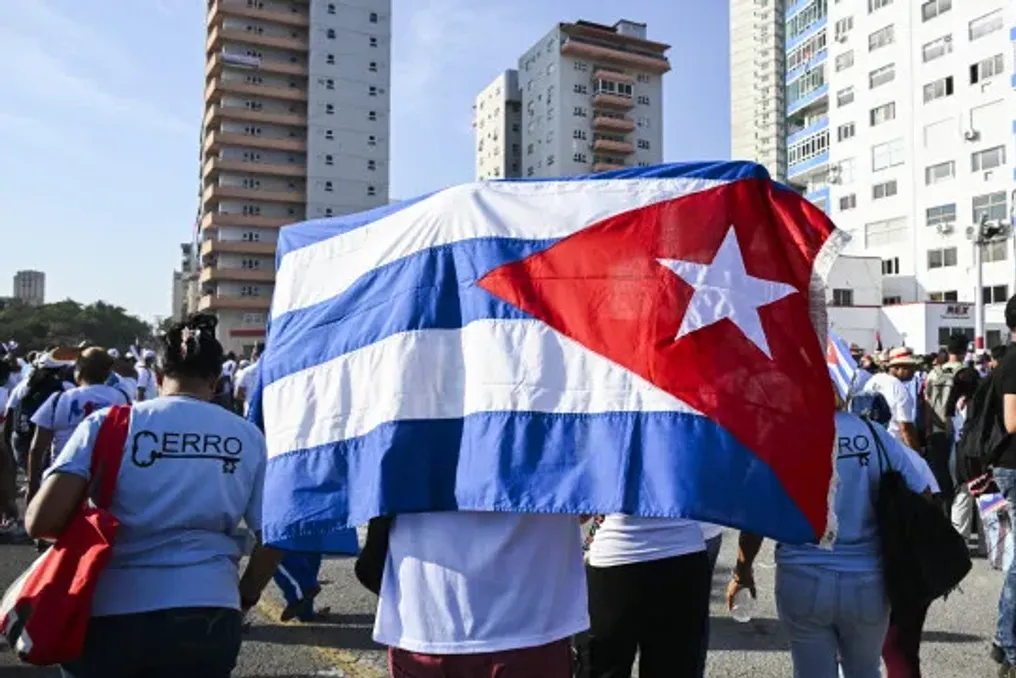
Cuba invites expatriate entrepreneurs to support economic reforms to restructure the national economy
Read more
Noticias ao Minuto
noticiasaominuto.com

Cuba invites expatriate entrepreneurs to support economic reforms to restructure the national economy

The Cuban government invited Cuban entrepreneurs residing abroad to actively participate in the process of economic and social reforms. This effort aims to revitalize the country's economy, which is facing a deep crisis.

Ana Teresita González Fraga, director-general of Consular Affairs and Assistance to Cubans Residing Abroad at the Ministry of Foreign Affairs, appealed to more than one hundred Cubans from this community. She asked them to 'contribute with what they know best' during the inauguration of the Business Forum, which is part of the 42nd Havana International Fair (Fihav) 2026.

The diplomat encouraged participants, both present and remote, to leave the fair with a 'decision to act,' emphasizing that 'the doors of Cuban institutions are open,' as reported by state media. González Fraga stressed that 'you are part of the essence of Cuba and Cuba needs you,' classifying the current reforms not as mere adjustments, but as 'a profound transformation of the socio-economic structure.'

She also highlighted that the Cuban community outside the country consists of professionals, technicians, and entrepreneurs, and considered that 'this human capital and experience are irreplaceable.' At the opening of Fihav 2026, which took place virtually this year, Óscar Pérez-Oliva, Cuban Minister of Foreign Trade, declared that 'Cuba's doors are open to the world' to attract foreign investment.

The official also mentioned the possibility of collaboration between international companies and the private and cooperative sectors, in addition to initiatives aimed at fostering a more active participation of Cubans residing abroad in the nation's socioeconomic development.

Fihav organizers announced that they will release information about the 176 economic reforms approved last June during an investment forum. This forum will present an update to Cuba's Business Opportunities Portfolio and will be the only in-person event of the fair, scheduled for November 26.

This set of 176 economic and social changes aims to liberalize and decentralize the Cuban economy, including modifications to stimulate trade relations and involve Cuban emigrants in local investments. The measures cover everything from the entry of 'new actors' and 'new modalities' in tourism to stimulating foreign direct investment, particularly by non-resident Cubans, and strengthening the role of the private sector.

Additionally, the reforms provide for changes to boost agriculture, foreign trade, and the real estate market, in addition to decentralizing decision-making and granting greater autonomy to state enterprises and municipalities.

These reforms occur against a backdrop where the Cuban economy registered a contraction of 15% between 2020 and 2025. This decline was attributed to the combination of the impacts of the pandemic, the worsening of US sanctions, and internal policies considered inadequate in monetary and economic spheres. Furthermore, the economic situation has worsened since January due to the 'maximum pressure' policy implemented by the United States against Cuba, through restrictions on oil supply and new sanctions aimed at promoting political and economic changes on the island.
Similar stories

Cuba adopts social security reform expanding private sector opportunities
Read more
noticiasaominuto.com

Cuba adopts social security reform expanding private sector opportunities

New Cuban legislation, which will take effect in seven days, introduces an annual mechanism for adjusting state employee pensions based on inflation, recognizes family care experience of up to ten years for pension contributions for the first time, and abolishes contribution limits in the private sector.

This reform comes against the backdrop of a national crisis characterized by rising cost of living and accelerated aging of the island's population. These changes are part of a broader package of 176 economic and social transformations approved by the Government to overcome the current situation. Some of these reforms include measures similar to European systems.

A significant novelty concerns the care system. Following recommendations from the International Labour Organization (ILO), unpaid family assistance is now included in the legal definition of an employee and is taken into account when calculating the pension.

For standard old-age pensions, time spent 'up to a maximum of ten years dedicated to caring for dependent relatives who need help with basic daily activities,' as well as periods of unpaid leave requested for this purpose, will be credited.

The legislation also provides an allowance for youth aged 18 to 30 who are neither studying nor working but are enrolled in preparatory courses. In such cases, the youth will receive a monthly income equivalent to the minimum wage, and the study period will be counted as work experience. This measure coincides with the mass exodus of youth from the island; estimates suggest Cuba has lost more than 10% of its total population.

Although this is a way to stimulate employment, the minimum wage is only 3,210 Cuban pesos, which corresponds to approximately 3–4 dollars on the informal market, exacerbating the unemployment problem.

The new rule stipulates that all types of reforms, whether for total disability or age, in both the state and private sectors, cannot be lower than the minimum pension established by the state. However, this pension currently amounts to 3,056 Cuban pesos, slightly more than three dollars at the informal exchange rate.

Furthermore, the regulation states that minimum pensions will be approved annually by the Council of Ministers 'taking into account achieved socio-economic development, economic conditions, and inflation trends.'

The reform also streamlines the emerging labor market on the island by regulating the concept of poly-practicing for the first time. Cubans will be able to legally combine work in the private and public sectors, as well as perform several different private jobs. On the other hand, upper limits on contribution rates in the non-state sector are abolished. Workers can contribute the desired amount for future pensions and sum contributions from different jobs. Nevertheless, work experience is accounted for chronologically linearly (although financial contributions are summed up, it is not duplicated for simultaneous performance of multiple jobs).

It is also emphasized that 'the affiliate contribution is 20% of the contribution base, determined based on the earned income, which cannot be lower than the minimum wage established in the country' amounting to 3,210 pesos per month (nearly 4 dollars at the informal exchange rate). The same rate applies to Cubans hired individually abroad and creative workers in communications who need to update their contribution bases by the end of this year.

Popular