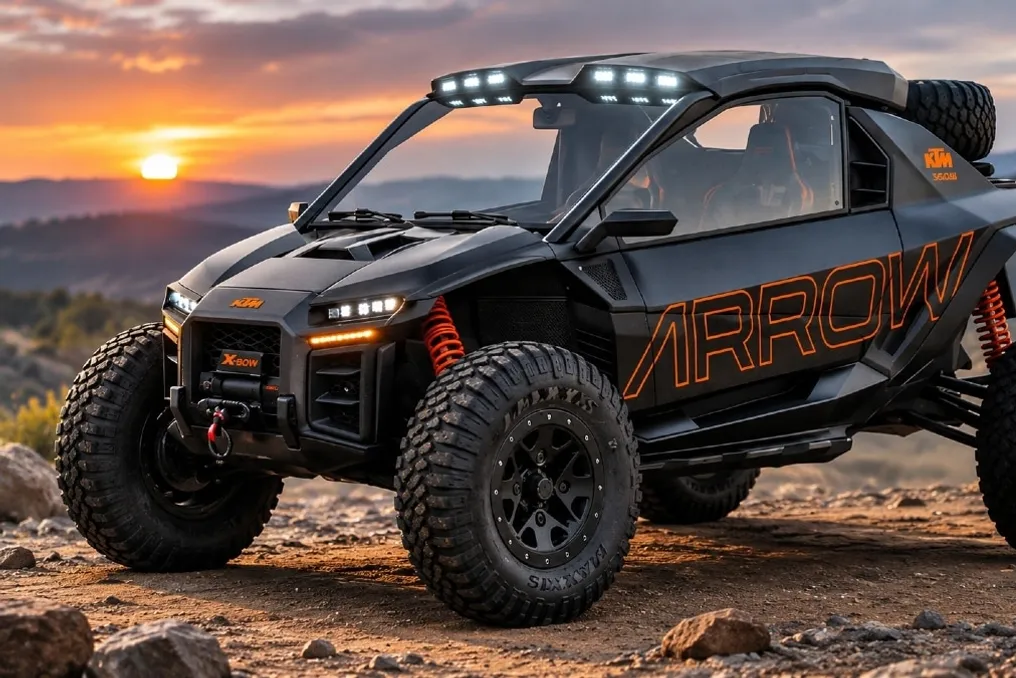
The Austrian automotive manufacturer KTM is known for its powerful motorcycles worldwide. However, the company has introduced a new off-road vehicle, the Arrow, as part of its adventure vehicle division, KTM X-Bow. This vehicle is a specialized machine for off-road use, designed for two passengers, and was developed taking into account the experience of racers who participated in the Dakar Rally.
By body type, it is classified as a utility terrain vehicle or work UTV. The company plans to begin accepting orders for this model on November 17th.
Initially, this project was initiated by Guillaume De Mevius, owner of KTM X-Bow and a Belgian rally driver who finished second in the 2024 Dakar Rally. His team, G Rally Team, played a key role in the creation and testing of this vehicle. This team was founded in 2018 and is now known as the KTM X-Bow Lab Team. Racers from the Netherlands, including Pac Klassen, also participated in the development as a test driver.
The KTM Arrow is a side-by-side off-roader, meaning it accommodates two people sitting next to each other. The vehicle is specifically designed to traverse difficult routes, uneven landscapes, and off-road adventures.
The Arrow will initially be presented to the market as a black limited edition, with only 500 units produced globally. The starting price for this exclusive version is set at $98,600 USD, which is approximately 92.4 lakh rupees. The standard production model will cost from $59,800 USD, or about 56.04 lakh rupees. Orders will start through the company's dealer network and official website on November 17th, with an expected delivery date for customers in late 2027.
The dimensions of the KTM Arrow are 3,700 mm in length, 1,950 mm in width, and 1,800 mm in height, with a wheelbase of 2,900 mm. Although the vehicle is not very large, its design looks quite imposing. The front features narrow angular headlights with orange illumination, and there is a rectangular grille and a silver skimming plate at the front that protects the lower part of the vehicle on bad roads.
On the side, this UTV has a ground clearance of 430 mm and is equipped with 15-inch wheels fitted with specialized off-road tires. The ARROW marking is visible on the doors, and KTM X-BOW stickers are on the pillars. Large suspension springs are clearly visible behind the wheels.
The cabin of the KTM Arrow is fully enclosed. The interior is finished in a combination of black and orange colors. To give the cabin a racing car look, passenger handles and fabric door handles have been provided. The cabin is equipped with seats and Sabelt mounting systems, which ensure passenger safety at high speeds and on rough terrain. The dashboard includes a digital driver display and a 10-inch touchscreen for multimedia.
The black limited edition will also feature additional functions such as air conditioning and a hydraulic parking brake. This brake is particularly useful during rallies and races.
The engine of the KTM Arrow boasts high power. The company utilized a 2.0-liter four-cylinder turbocharged gasoline engine from the Volkswagen Group, model EA888, connected to a 7-speed dual-clutch automatic transmission. The vehicle is also equipped with an all-wheel-drive system, providing independent power delivery to all four wheels.
The power output is 280 hp in the standard version, while in the black limited edition, presented at the start of sales, it is increased to 330 hp. The dry weight of the standard model reaches 999 kg, whereas the black limited edition weighs about 1,100 kg.
Suspension plays a critical role in off-road driving. KTM used a chromoly steel chassis developed by KTM Components, previously used in the KTM Dakar Rally program. The system is equipped with double wishbone suspension on all four wheels. The shock absorbers were developed in collaboration with KW Reiger, and the company aims for a suspension travel of over 600 mm. Furthermore, limited-slip differentials are installed at the front and rear to help improve the vehicle's grip on slippery and loose surfaces.