Chotu, 40, owner of a pakora kiosk near the temple in Lalbagh, Moradabad, observed the changing attitude of people towards the riverbank. He noted that while people used to just watch the volunteers' work, today local residents feel a sense of responsibility for the cleanliness of the ghat and the river.
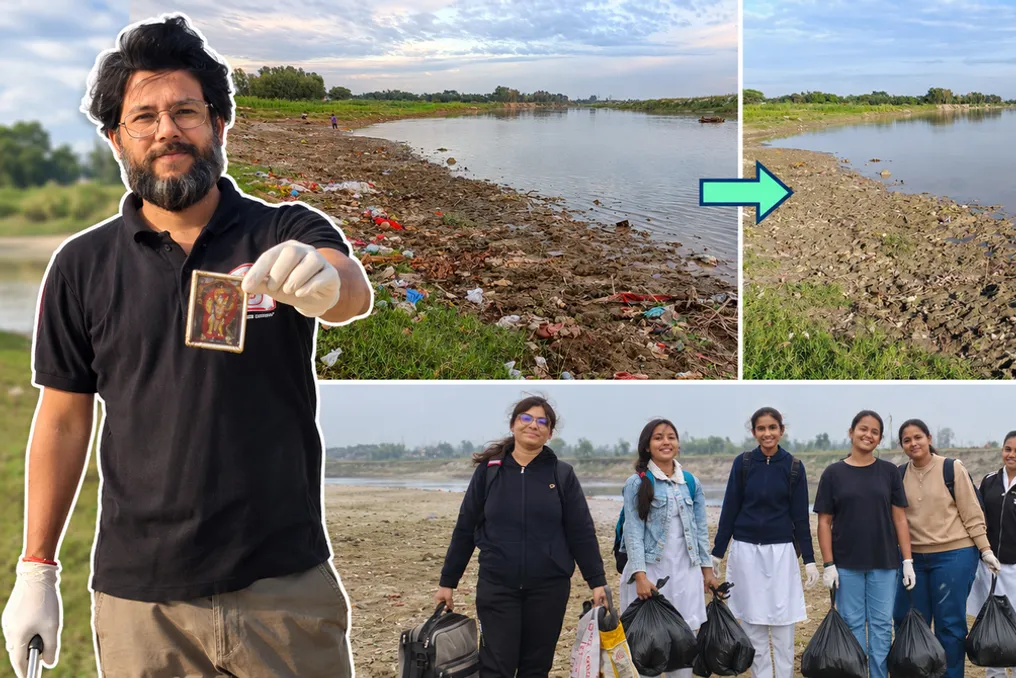
For Kapil Kumar, 35, who leads the 'Clean Up Ram Ganga' campaign, this willingness to take responsibility is immensely significant. His team from the organization 'Parivartan' reports conducting over 218 cleanup drives, removing more than 120 thousand kilograms of waste with the participation of over 5000 volunteers in recent years.
These figures conceal numerous interactions: conversations with visitors, assistance from residents in clearing space for equipment, and guiding volunteers back to the bank they have begun to value. Achieving these results required several attempts.
The Teacher's Question Took Him Beyond Textbooks
Kapil received a bachelor's degree in mechanical engineering in 2013 and spent a year in the automotive sector. From 2014 to 2016, he pursued a PGDM while preparing for civil service exams, including the UPSC examination. Preparation for UPSC continued until 2017.
He told The Better India that studying sociology during his UPSC preparation helped him look broader, move beyond individual problems, and understand society, communities, and factors influencing social change, giving him a wider perspective on the difficulties people face.
In 2016, blogs he wrote for essay and answer practice attracted the attention of junior colleagues and former classmates. They asked him, 'Why don't we do something locally?'—and that is how it all began. Initially, they conducted a few events, and then gradually scaled up their activities.
Visiting a government school in Moradabad gave this idea practical meaning. Kapil discovered leaking roofs, inadequate sanitary facilities, and children lacking proper chairs and desks. When he raised the issue of these conditions, a teacher challenged him. She asked, 'People usually come here for surveys and other work, criticize the government and administration, and then leave. But what can you do besides criticizing?'
She pointed out a child with vision problems. 'She asked me: 'Can you take her to the hospital and help get the necessary treatment?'—I agreed,' he recalls. Kapil contacted the chief medical officer and helped the child receive treatment and glasses. He notes that 'when you do something with sincere intention, expecting nothing in return, it brings a completely different satisfaction.'
Kapil and his friends founded 'Parivartan' in October 2016 and registered the organization in July 2017. Their early projects included raising awareness about the riverbank, air pollution, and women's empowerment through street plays and role-playing. He emphasizes that initially there was no fixed project or specific goal; they felt a desire to engage with social issues, so they gathered, discussed possibilities, planned, and implemented.
He admits that it was largely a process of trial and error. Some members left after completing engineering or MBA courses, choosing other professions. Kapil continued working with a smaller team, gradually realizing his calling to work in the social sector.
Why Did the Trash Keep Returning?
In November 2016, Kapil sat by the Ramganga river during a festival on the bank, watching plastic bags, flowers, clothes, and household waste being thrown into the water. He started talking to visitors about what they were discarding. He reminded them that in their city, the river was once a source of life for the riverside dwellers, but today industrial waste, sewage, and all types of solid waste are dumped into it.
These conversations showed him that people needed practical solutions. The team explained how flowers and other organic offerings could be composted in a designated pit, and how plastic and other non-biodegradable waste should be handed over to municipal collection. Visitors responded positively.
On Earth Day, April 22, 2018, the team officially launched the 'Clean Up Ram Ganga' campaign. Three months of weekly cleanups on the ghat were accompanied by the creation of a mural and a petition campaign that collected 11,000 signatures. They undertook a cycle of bicycle journeys (yatra) from Moradabad to Varanasi, passing through Rampur, Bareilly, Shahjahanpur, Sitapur, Lucknow, Rae Bareli, and Prayagraj. However, the work on the bank revealed a problem: 'What we did before was unsustainable. We cleaned the ghat for three months, but as soon as we stopped, it inevitably returned to its previous state.'
From 2018 to 2020, the team maintained activity with monthly events, cleanups during festivals, and awareness campaigns, without a strict weekly schedule. Then, the COVID-19 pandemic suspended public events. 'Parivartan' collaborated with the district administration and volunteers, providing essential supplies to marginalized communities. Kapil also recalls seeing distant hills from the rooftops of Moradabad during quarantine when the air was cleaner. This experience strengthened his interest in sustainable environmental work. He concludes that 'it made us understand that environmental work cannot be a one-time effort. Real difference appears when you keep showing up and keep working.'
This Time There Will Be No End Date
On Environment Day, June 5, 2021, the team began a new phase at Lalbagh Ghat. The bank was littered with household waste and discarded offerings, with little information or discussion about pollution. Kapil wanted the cleanups to become a regular commitment. He informed the team members and volunteers that this was not a temporary event but a long-term commitment to the Ramganga river.
He added that they track statistics, document their progress, and evaluate the campaign's impact to understand how it benefits. Weekly activity continues since then, and in case of floods or heavy rains making the bank unsafe, physical cleanups are replaced by awareness campaigns.
In the summer, volunteers usually work from about 6:30 AM to 9:00 AM, and in winter, closer to 7:30 AM. Kapil or one of his comrades conducts an briefing before starting. He explains that all volunteers gather with gloves and other equipment; he instructs them on tasks and the types of trash to collect. If he is absent, his comrades take charge and direct everyone in the work.
The main focus is on plastic and other non-biodegradable waste. Depending on the weather, season, and attendance, the weekly cleanup can collect about 300–700 kg. The team sorts waste wherever possible. Flowers and organic offerings are sent to the compost pit, and retrieved idols remain outside the river. Other inorganic waste is handed over to the municipal corporation for processing and disposal, and recyclable materials are sent for recycling where possible. In addition to collecting, volunteers converse with visitors about available disposal sites and ways to reduce waste. These conversations have become central to maintaining the cleanliness of the bank.
Changing Habits Requires Patience
Kapil believes that 'changing behavior is a very difficult thing.' During the Navratri fair, he estimates that 15,000–20,000 people visit near the temple daily, increasing the load on the riverbank.
Some visitors told volunteers that they follow traditions passed down through generations. The team explained to them how they could continue observing their customs while using designated waste disposal areas. Kapil notes that most visitors now use the designated pit or other disposal sites, and temple announcements also encourage people to keep waste and offerings away from the bank, reinforcing the volunteers' message.
Mansi Mehrotra, 25, has been associated with 'Parivartan' since December 2017. She joined after seeing the trash around the river and recalling how much patience one conversation required. She says that awareness was only the first step, and they realized that real change would only happen when they started acting themselves.
During a cleanup, she met a man planning to immerse plaster idols. Initially, he resisted her explanation of the environmental impact. The team continued the conversation, and eventually, he took the idols back. Mansi notes that sometimes creating change requires patience, meaningful conversations, and helping people understand the importance of it.
Vikrant, 38, a garbage truck driver from Nagar Nigam Moradabad, regularly visits the ghat and has witnessed the volunteers' work. He claims that 'we see changes almost every week. The difference is clearly visible to the naked eye.' He also says that 'I watched these young people working every Sunday for years, and their consistency influenced me.'
Giving People a Reason to Return
Campaign participants include students, professionals, residents, National Cadet Corps (NCC) and National Service Scheme (NSS) volunteers, as well as people from social organizations and community groups. 'Parivartan' has over 3000 registered volunteers, and six full-time staff members work specifically on the Ramganga campaign. Kapil also notes that staff participate in weekly cleanups as volunteers.
The team also wants people to enjoy their time by the river. After a week in the office or college, volunteers can spend time outdoors, socialize with vendors, and observe local agriculture and gardening. Pets play, picnics, river festivals, and stand-up performances take place after the cleanup. Kapil believes that when people are given the opportunity to come to the riverbank, participate in activities, and observe the surrounding community, they truly enjoy the experience.
Cleanups also mark events such as Independence Day, Republic Day, and Gandhi Jayanti. Over the years, participants have planted hundreds of trees, improved public spaces, and created informational murals. The campaign has received recognition in the Guinness Book of Records for 'Longest Riverbank Cleanup Organized by an NGO.' Kapil sees the impact of this campaign extending to the choice of volunteers in other fields. He believes that none of these volunteers will litter on the riverbank, whether it is Ramganga or any other river. Some of their volunteers also participate in beach cleanups in Mumbai, and others in cleanup efforts in Dehradun.
Old Newspapers Help Fund the Next Cleanup
Maintaining operations requires not only time but also funding. Through the SEHYOG initiative, 'Parivartan' collects old newspapers, books, plastic, and other recyclable materials from households and donors through door-to-door visits. This material is sold to authorized scrap dealers, and the proceeds help fund the organization's social and environmental initiatives, including the Ramganga campaign. Individual donors and well-wishers contribute to purchasing cleaning materials, conducting awareness events, and covering other expenses. Local support also helps volunteers organize cleanups when the core team cannot be present. Kapil advises: 'Even if none of our team can come, you can still collect tools and conduct a cleanup yourselves.'
Attracting Government Attention to River Issues
Kapil understands that removing solid waste only solves part of the river pollution problem. Action beyond weekly cleanups is needed regarding untreated sewage. The team presented a 10-point action plan and a booklet for its 200-week National Mission for Ganga Cleanup and State Mission for Ganga Cleanup. Kapil insists that wastewater treatment plants must function effectively so that urban drainage water is treated before entering the river. He emphasizes: 'Ramganga is a tributary of the Ganga, and Ganga cleanup is impossible without Ramganga cleanup.' His goal is to create a model ghat where people can come, observe their customs, and...
3.