Working conditions and salary of GDS in the postal department: working hours and rules
Read more
Aaj Tak
www.aajtak.in

Working conditions and salary of GDS in the postal department: working hours and rules

The position of Graminny Postal Servant (GDS) is popular among young people who want to work in the postal department. The attractiveness of this position lies in the fact that the candidate list is formed based on a rating from 10th-grade marks, not a written exam. Nevertheless, after selection, it is important to understand the duties and service conditions associated with this job. This review examines the working hours of GDS, the size of the TRCA compensation for BPM and ABPM, as well as the list of duties performed.

According to the official recruitment notice of the postal department, rural postal servants must work daily for no less than 4 hours and no more than 5 hours. These norms are established in accordance with the Rules of Conduct and Planning for Rural Postal Servants 2020. Thus, the GDS work schedule differs from the schedule of employees in ordinary state institutions.

GDS employees are paid not a fixed salary, like permanent civil servants, but a time-dependent compensation known as Time Related Continuity Allowance (TRCA). Official information from the postal department sets the initial level of TRCA depending on the position:

  • Branch Postmaster (BPM): from 12,000 to 29,380 rupees.
  • Assistant Branch Postmaster (ABPM) and Postal Servant: from 10,000 to 24,470 rupees.

This range represents the TRCA scale. Additionally, the respective GDS employees receive an inflation allowance (DA), which according to the rules provides for an annual increase of 3 percent.

Depending on the position held within GDS, employees perform various functions. The Branch Postmaster (BPM) is responsible for managing all activities of the rural post office. This includes providing postal services, working with the India Post Payments Bank (IPPB), serving customers, and promoting postal department programs. The BPM is also obliged to independently organize the premises for the functioning of the post office.

The task of the Assistant Branch Postmaster (ABPM) is to sell stamps and stationery, deliver letters and mail, and assist with transactions related to IPPB. In addition, the ABPM supports the work of the BPM.

A Postal Servant may be assigned to a post office, sorting office, postal office, or delivery center. Their duties include sorting letters and parcels, delivering mail, and processing mail packages. If necessary, they may also be assigned other departmental tasks.

According to the postal department's notice, rural postal servants are not permanent employees of the central government. Their working conditions are determined by the Rules of Conduct and Planning for Rural Postal Servants 2020. Consequently, they do not have the same salaries and benefits as regular central government employees. According to postal department rules, GDS must also have another source of income to sustain themselves.
Similar stories

Vacancies Announced in Government Departments: 2 Thousand Positions with Salaries Up to 100 Thousand Rupees
Read more
www.aajtak.in

Vacancies Announced in Government Departments: 2 Thousand Positions with Salaries Up to 100 Thousand Rupees

For youth seeking government employment, opportunities have opened up this week for recruitment in several departments. Vacancies have been announced in the Border Security Force (BSF) for various positions, including constable. Additionally, Western Coalfields has open positions for Junior Clerk III category, stores clerk, and data entry operator. Recruitment drives have also been launched in three other departments. A total of 2702 vacancies are planned to be filled.

If you are interested in securing government employment, you should review the candidate requirements, selection stages, and the projected monthly salary.

The Border Security Force has 1167 available positions, including Senior Inspector and others. Applications began on November 12, 2026, and the deadline for submission is December 31, 2026. The required education is a bachelor's degree, and the maximum age for candidates is 32 years. The selection process includes a Computerized Test (CBT), physical standard test, physical endurance test, document verification, and medical examination. The monthly salary ranges from 35,400 to 112,400.

Western Coalfields offers 514 vacancies, such as Clerk III category. Application intake is scheduled to start on November 17, 2026, with the last day for submission being December 1, 2026. Participation requires a secondary school certificate with mandatory typing skills, and the maximum age is 42 years. Selection is conducted through a written exam and skills testing. Salary is determined according to Coalfields rules.

Indian Oil Corporation has opened 409 positions, including technician and other specialist roles. Applications start on November 13, 2026, and the deadline is December 12, 2026. Qualification requirements vary by specific position and may include a secondary school certificate, an engineering diploma, an ITI certificate, or a bachelor's degree. The maximum age for candidates is 24 years. The selection process is based on meritocracy, document verification, or medical examination. Salary is determined according to trainee rules.

In the railway sector, there are 258 vacancies, including the position of Freight Train Manager. Applications will begin on November 9, 2026, and the deadline is December 8, 2026. An engineering degree or a diploma in the relevant field is required. The maximum age for candidates is 42 years. Selection is conducted via CBT, document verification, or medical examination. Compensation is regulated by railway trainee rules.

Employment opportunity at GDS post office with 90% score from 10th grade results
Read more
www.aajtak.in

Employment opportunity at GDS post office with 90% score from 10th grade results

After successfully passing the 10th-grade exams, many young people begin preparing for public service. For such candidates, recruitment as rural postal servants (GDS) in the postal department is an attractive option because no additional written exam is required for selection.

The list of candidates is formed based on grades in the 10th-grade certificate, but having 90 percent marks does not guarantee a GDS position. Various conditions determine the ranking process and candidate selection.

According to the official notification for recruitment into the postal department, candidates undergo preliminary selection through a computer-generated ranking list based on 10th-grade scores. The overall 10th-grade score is converted into percentages and calculated to four decimal places. Although a candidate with 90 percent may appear on this list, it does not automatically mean selection. If candidates with higher scores apply for a specific position, a candidate with 90 percent may not make the list.

As per the India Post notification, grades from the 10th grade obtained in an accredited school are used to compile the ranking list. If the certificate lists grades for each subject, the ranking is formed based on them. If the certificate lists scores or scale points, they are converted into scores according to the formula established by the department. If a Cumulative Grade Point Average (CGPA) is available, it is multiplied by 9.5 to obtain the score. If both subject grades and CGPA are listed, the higher scores calculated by both methods are taken. Score calculation in the ranking is done to four decimal places.

There are several reasons why a candidate might not be selected for GDS despite having 90 percent marks. Firstly, there is high competition for the relevant position: if many candidates have scores above 90 percent, a candidate with lower scores may fall behind in the ranking. Secondly, the number of vacancies is important: the number of available positions in each office and district varies, and fewer positions increase competition. Thirdly, reservation rules apply for various categories such as UR, OBC, SC, ST, EWS, and PwBD; the ranking is compiled separately for the respective vacancies depending on the candidate's category. Finally, in case of a tie in scores between two or more candidates, the decision is made by the department according to the priority order specified in the notification, which includes criteria such as age and category.

To participate in the GDS recruitment in the postal department, one must have a 10th-grade completion certificate from an accredited school. Furthermore, passing exams in mathematics and English is mandatory. The candidate must also possess the local language of their state or territory at a level no lower than 10th grade. Additional requirements include computer literacy, the ability to ride a bicycle, and sufficient means of subsistence.

No, a separate written exam or interview is not provided for GDS selection. Candidates are initially selected based on the generated ranking list derived from 10th-grade scores. Subsequently, the documents of the selected candidates are verified. Therefore, even if you have 90 percent in 10th grade, you are eligible to apply for GDS, but there is no guarantee of employment. To determine your chances, you need to study the vacancies for the relevant position, the scores of applicants, and the ranking list itself.

Yogi's Government Changes Recruitment System in Uttar Pradesh, Emphasizing Meritocracy
Read more
www.aajtak.in

Yogi's Government Changes Recruitment System in Uttar Pradesh, Emphasizing Meritocracy

The Uttar Pradesh government presents the distribution of government vacancies and employment contracts as part of its large-scale concept of 'New Uttar Pradesh.' The government asserts that the recruitment process prioritizes qualification and diligence, with no room for nepotism, recommendations, or corruption.

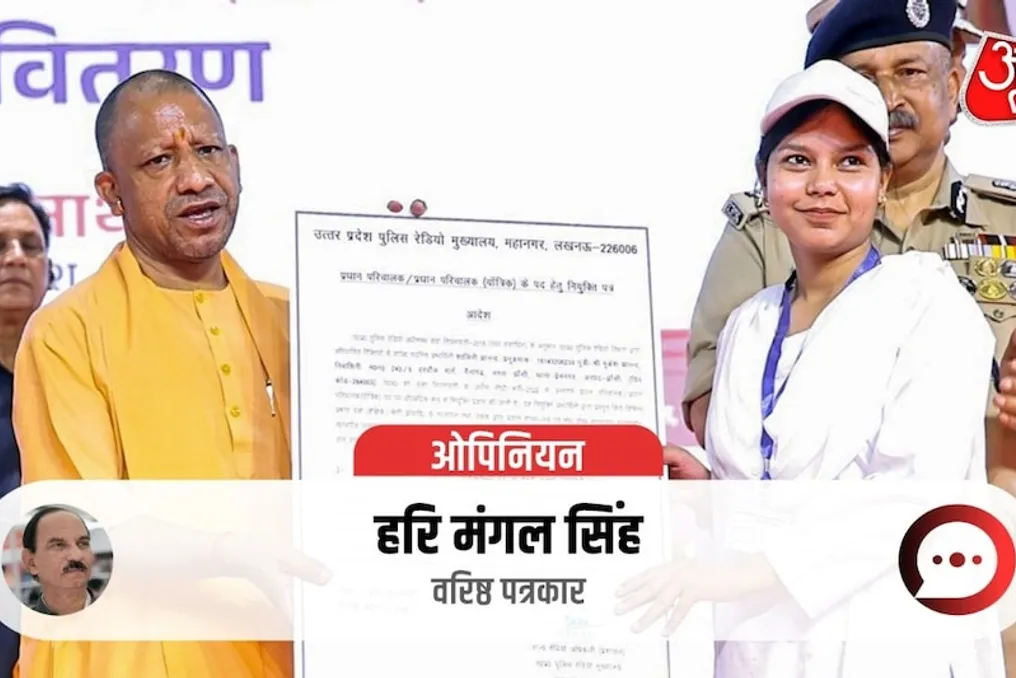
Senior journalist Hari Mangal Singh examines these changes as an attempt to transform the state's recruitment system and administrative culture. He emphasizes that the vitality of any region lies in the consciousness of its youth, which is nourished by the belief that the democratic system ensures equal opportunities and prevents favoritism towards talented individuals.

When a young person marks their answers on the OMR sheet in the examination hall, they place a seal of their deep trust in the Constitution, the system, and the justice of the state. Conversely, when this same young person leaves home in despair, believing that the selection list was predetermined in a closed room and the exam itself was merely a cruel administrative performance, this trust collapses.

In a vast, dense state like Uttar Pradesh, brimming with boundless youthful energy, public service has never been merely a means of subsistence; it is also a symbol of respect and a guarantee of the future. Therefore, when Chief Minister Yogi Adityanath develops a plan for a large-scale employment campaign in the state, it represents a profoundly serious step toward reviving fading trust.

This employment campaign became particularly noticeable after 1,146 junior assistants were recently issued employment contracts, and Chief Minister Yogi Adityanath announced that young people would receive employment contracts on average every five days before Republic Day. This ideological narrative challenges the dark period of the past, which brought only disappointment and frustration to the youth.

Recalling the period before 2017, it tells a horrifying story of systemic decline. It was a time when all major recruitment commissions and selection committees of the state became hostages to political will. Obtaining a job without large 'transactions' and influential recommendations was an impossible dream. There existed an unofficial but pervasive control by a certain 'syndicate,' where one conducted the exam, and the employment contract went to another.

The consequences of this model of corruption were extremely destructive. The legitimacy of the entire administrative generation born this way becomes questionable, as an official who reached a position through favor or financial influence, rather than ability, will never be loyal to the Constitution of India or the people. They will always owe allegiance to the political patron who placed them in that position.

Examples concerning the old periods of the Uttar Pradesh Public Service Commission, public petitions, and the Supreme Court's nullification of the then chairman's appointment in 2015 as an unjust political favor serve as proof of how real the eclipse of electoral integrity was.

Yogi's government linked good governance and employment to the criteria of law and order and civil security in the state to lift the youth out of this darkness of despair. One must consider: only a society free from fear can truly foster development and employment. Looking back, it becomes clear that at one time, about one and a half lakh vacant positions in the police department lay untouched. 54 PAC companies were unjustly liquidated, and months of curfews and unrest left scars on the soul of the state.

In contrast, today, over 2.30 lakh transparent appointments in the police department, along with the recruitment of Home Guards and forensic experts, prove that employment and security are now two sides of the same coin in Uttar Pradesh.

The social impact of this employment campaign is evident. To date, more than nine hundred and fifty thousand young people have received employment contracts. An example of this is the appointment of thousands of Lekhpal and Naib Tehsildars in sensitive departments such as the Revenue Department. For a rural resident, the first battle for their land and rights begins with the Lekhpal's salary. If a young person holding this position achieved it through their abilities and complete integrity, they establish a new standard of fairness in the village.

However, alongside good governance, humanity is also necessary. The decision to waive a bail amount of over 84 crore rupees for newly appointed inspectors is a striking example of administrative sensitivity. This step shows that the system understands the economic difficulties faced by the youth.

This employment contract distribution campaign in Uttar Pradesh is a crucial part of Yogi's government's broader 'New Uttar Pradesh' concept, where talent and hard work are the sole keys to success. The government has clearly conveyed a message: in this system, there is no place for appeasement, nepotism, or corruption. The 'zero tolerance' policy, which was used as a reliable weapon against mafias and criminals, is now being applied to the purity of recruitment processes and the youth.

Popular