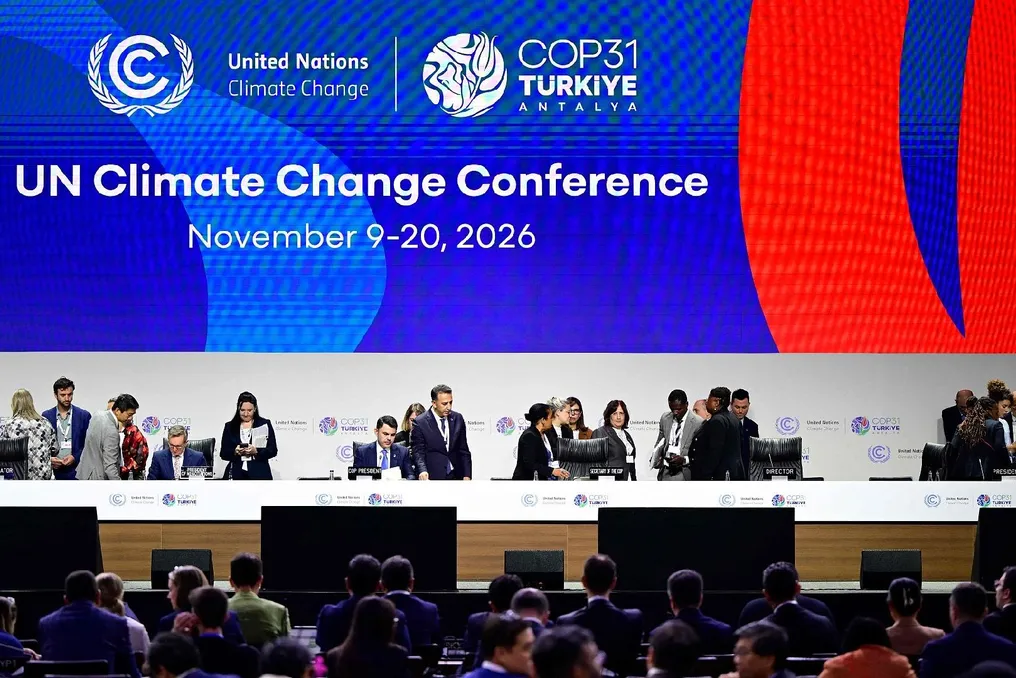
The recent 31st Conference of the Parties (COP31) to the UNFCCC failed to reach consensus on key policy decisions. This uncertain outcome sparked public debate and revealed that global climate governance has entered a complex phase of redistributing interests and responsibilities.
Analysis of the intense negotiations demonstrated that disagreements extended beyond purely environmental issues. The European Union insisted on including a clause about 'phased withdrawal from fossil fuels,' while energy-producing countries such as Saudi Arabia and Russia strongly resisted this. Simultaneously, many African nations strongly demanded that developed countries fulfill their commitments regarding financing climate change adaptation. This struggle for interests shows that the global energy transition is not just a political slogan but a task requiring the resolution of deep structural contradictions between climate goals and development needs.
An authoritative poll conducted by CGTN among 10,032 respondents from 40 countries reflects public opinion on this contradiction. The data indicates that 77.3% of respondents agree that the energy system should transition to a clean, diversified, and efficient model, with approval rates reaching 82.1% in Global South countries. However, when it comes to priority issues of the transition, 42.7% of respondents chose 'control over energy prices' (28.8%) or 'ensuring energy security' (13.9%), surpassing 'reducing environmental impact' (36.2%). These figures clearly indicate that the public supports a 'green' transition but is unwilling to achieve it at the cost of price and energy supply stability.
The deadlock at COP31 warns the world that a universal transition detached from national realities is doomed to fail. While reducing fossil fuel emissions is necessary to combat climate change, countries vary greatly in energy reserves and stages of development, creating a huge gap in the cost and accessibility of the transition. For developing countries undergoing industrialization, aggressively replacing energy sources may not only increase production costs but also trigger serious energy poverty. In the poll, 77.5% of respondents supported 'gradual development of new energy based on ensuring stable traditional energy supplies,' which is strong support for this pragmatic approach. Improving new energy infrastructure and increasing energy efficiency are key to balancing energy security goals and reducing the carbon footprint.
To advance the global energy transition, it is crucial to consider and respond to the legitimate demands of developing countries. Many Global South nations possess rich clean energy resources but have long faced shortages of funding and technological barriers. In line with the principle of 'common but differentiated responsibilities,' developed countries must not remain mere promise-makers who formally fulfill their obligations; they must deliver on their promises for financial support and technology transfer. Expanding the supply of clean energy technologies and lowering their application costs is a fundamental way to improve the conditions of the transition for developing countries.
In this process, the growth of China's new energy industry has made a significant contribution to the global 'green' transition. According to the CGTN poll, 74.2% of respondents believe that technological innovations and large-scale production by China in areas such as wind energy, photovoltaics, and batteries have effectively reduced the cost of corresponding products, making clean energy accessible to more countries. China has not only contributed to technological progress but has also increased the global supply of clean energy products. This 'affordable green transition' has significantly enhanced the economic viability of the global energy transition and created favorable conditions for developing countries to overcome the 'green divide.'
The poll data deeply reveals a truth: public support for clean energy and the emphasis on energy security and economic affordability have never been mutually exclusive concepts. Whether international climate cooperation can emerge from the mire of 'implementation deficit' in the future depends on the ability of countries to translate financial and technological support into practical solutions for the transition. The only sure path to ensuring sustainable long-term progress in the global energy transition is the full alignment of climate goals with the right of all countries to develop, while maintaining multilateralism and pragmatic cooperation.