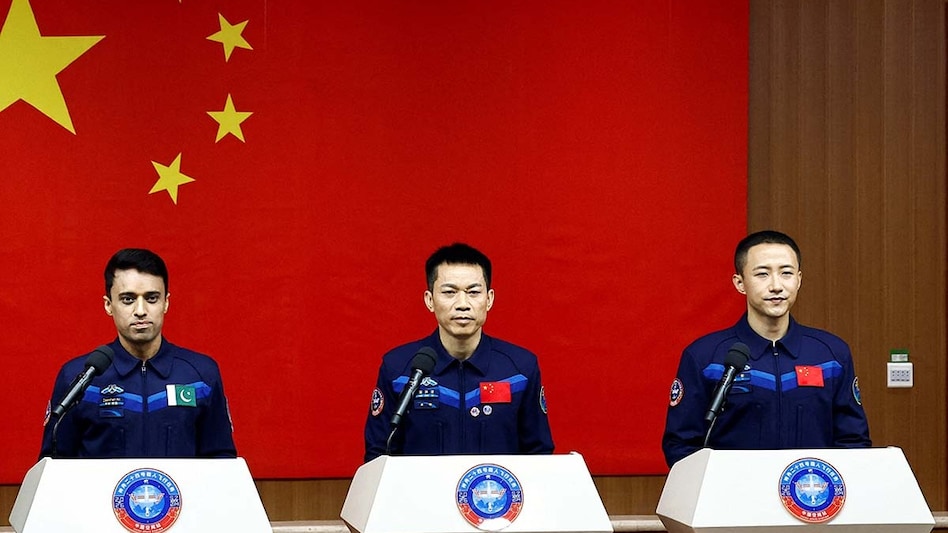
China is preparing to launch the Shenzhou-24 spacecraft on Wednesday morning at 8:18 local time. The launch will take place from Jiuquan Cosmodrome using the Long March-2F rocket. The China Manned Space Agency (CMSA) reported on Tuesday that the three-person crew is in good condition and all preparations for the launch are complete.
The crew includes commander Tan Hongbo, flight engineer Wu Yi, and Pakistani payload specialist Jishan Ali. Jishan Ali will be the first foreign astronaut to visit the Tiangong space station. His trip is part of bilateral cooperation between China and Pakistan, which is being implemented under Beijing's 'Belt and Road' initiative.
Since 2021, China has regularly sent three-person crews of Chinese astronauts to its Tiangong station on Shenzhou missions for up to six months. However, Ali's visit will be brief; he will return with two members of the Shenzhou-23 crew. Meanwhile, Zhou Yanzhu from the Shenzhou-23 crew will remain on the station for a year, allowing for the completion of the orbital crew rotation.
The Shenzhou-24 mission is the 41st flight within China's human space program. After reaching orbit, the crew will continue scientific experiments and research already underway on the station. This mission is not only technically significant but also important from a political and diplomatic perspective, as it is the first time a foreign national has been granted a spot on the Chinese space station. Cooperation under the 'Belt and Road' strengthens China's international partnership.
This launch occurs against the backdrop of escalating competition between the US and China for the Moon. The US accuses Beijing of plans to seize the Moon and exploit its resources, accusations which China consistently rejects. In this environment, the Shenzhou-24 mission demonstrates both China's space capabilities and its willingness for international cooperation. The regular dispatch of crews to the Tiangong station and the inclusion of a foreign astronaut show that China's space program is becoming more mature and open.
If the launch is successful, the crew will reach the Tiangong station, conduct experiments, and complete the rotation. Jishan Ali's short trip may pave the way for further international cooperation. This mission not only enhances relations between China and Pakistan but also strengthens China's position in global space competition.