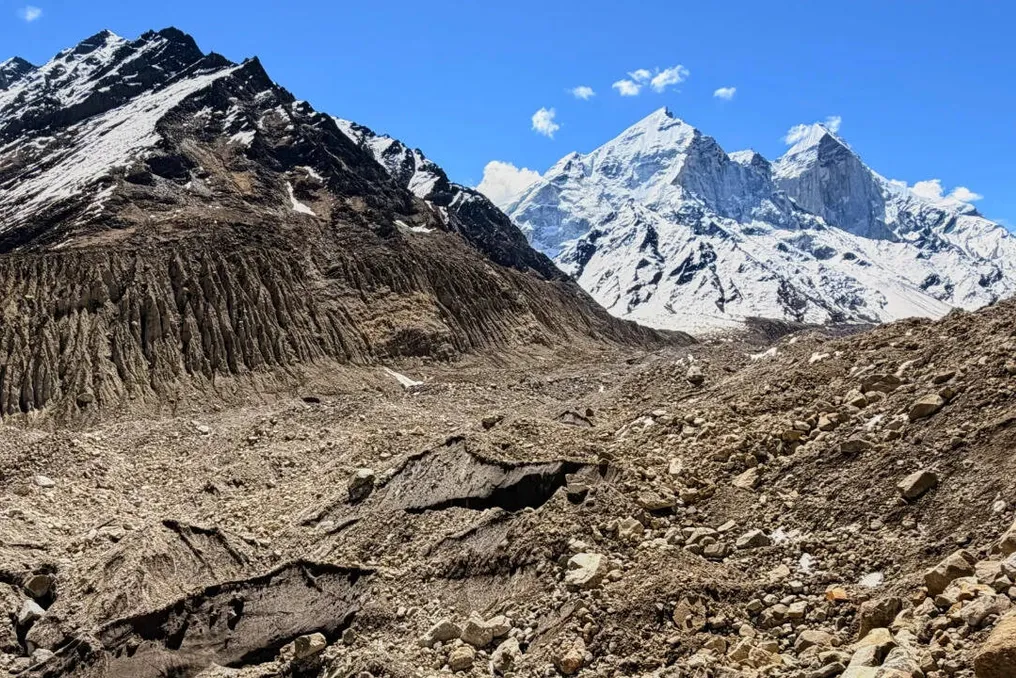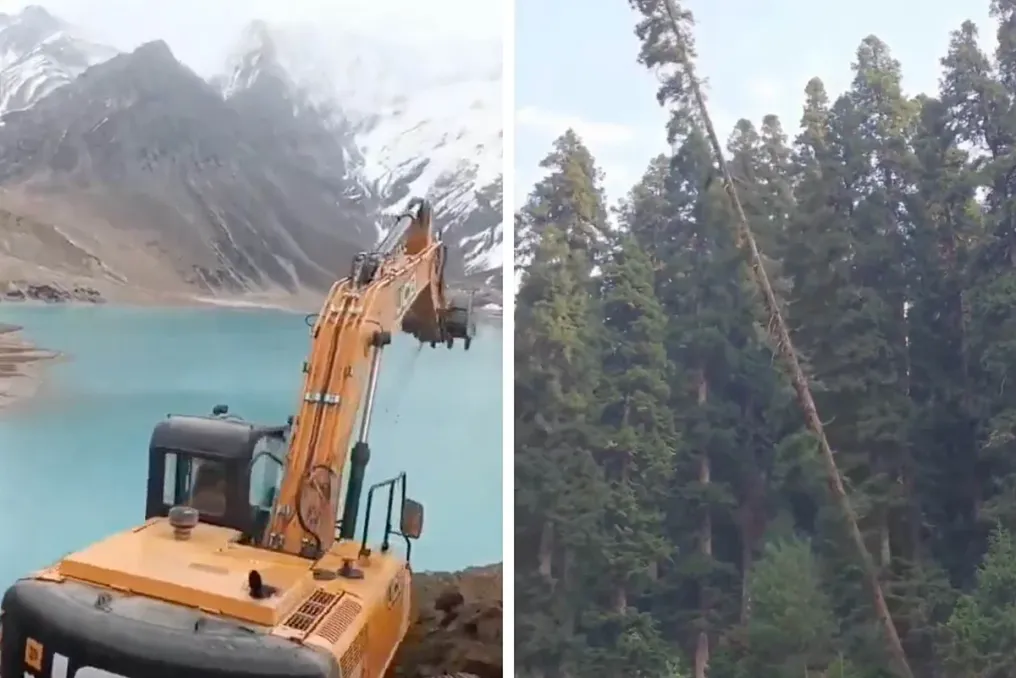
A video capturing the operation of an excavator near a glacial lake in India-administered Kashmir has triggered a wave of indignation. Local residents, political figures, religious leaders, and environmental activists view this activity as a threat to the ecologically vulnerable Himalayan region.
The video, showing the excavator's work near Sheshnag Lake—a pristine glacial lake located at approximately 3590 meters above sea level in the Anantnag district of Kashmir—went viral on social media this week. It drew widespread criticism, with many describing the activity as the 'destruction' of the region's fragile ecosystem.
The Kashmir Valley, with an average altitude of about 1600 meters, is ecologically sensitive due to its delicate Himalayan mountain system, which includes glaciers, alpine meadows, forests, wetlands, and interconnected river systems. This region is particularly susceptible to climate change impacts: rising temperatures accelerate glacier melt, alter snowfall patterns, and increase the risk of flash floods and landslides.
Sheshnag Lake, which is covered in snow for most of the year, is among 14 high-risk glacial lakes identified in Jammu and Kashmir and monitored for potential environmental threats. The video's creator, Mr. Bisht, stated: 'Development at the expense of nature and the disruption of ecosystems is destruction. Kashmir is on a ticking ecological time bomb that could explode at any moment, and we may pay a huge price for it in the near future.'
Mohit Bhan, leader of the People's Democratic Party of Kashmir (PDP), called the activity a 'crime against Hinduism and faith in nature.' Bhan wrote on X: 'What is presented as development should not come at the expense of the fragile alpine ecosystem and landscape deeply rooted in Hindu religious beliefs.'
The chief cleric of Kashmir, Mirwaiz Umar Farooq, described what he saw as 'alarming' and expressed concern over the impact of construction on the fragile Himalayan region. He noted on X: 'Since our glaciers are already receding, and recent devastating glacial floods in neighboring Nepal remind us of the growing vulnerability of the Himalayas, such actions are worrying.'
Former regional Prime Minister Mehbooba Mufti announced on Tuesday that she was prohibited from traveling towards Sheshnag. She emphasized: 'Issues related to construction in this fragile glacial ecosystem are becoming louder. What is hidden today could become a man-made disaster tomorrow.'
The discontent and concern are not unfounded. Kashmir, a disputed region predominantly inhabited by Muslims, divided between India and Pakistan and claimed fully by both, is situated in the Himalayas—the world's highest and geologically youngest mountain range, known for its fragile ecosystem. Like other Himalayan regions suffering from climate change, Kashmir is also experiencing increasingly unpredictable and extreme weather conditions. In recent years, changes in precipitation and snowfall patterns, accelerated glacier melt due to rising temperatures, as well as periods of flooding and drought have been observed.
In 2014, catastrophic floods in Kashmir, caused by unprecedented rainfall, killed over 280 people, and nearly two million were affected. This disaster was exacerbated by encroachment into wetlands and floodplains, rapid urbanization, deforestation, and inadequate drainage infrastructure. Concerns intensified due to devastating disasters in neighboring Himachal Pradesh and Uttarakhand, as well as in the Himalayan countries of Nepal and Bhutan.
In August, massive rock-ice landslides near the China border in Nepal led to catastrophic flash floods, claiming over 1500 lives and leaving thousands missing, resulting in the destruction of villages, roads, bridges, and hydropower infrastructure. In October, a glacial lake in Sintaphu, Gasa district, Bhutan collapsed, causing downstream flooding and damaging infrastructure. These events have once again raised questions about the vulnerability of the Himalayan region to glacial instability and extreme weather phenomena.
Sheshnag Lake is a high-altitude, glacier-fed alpine lake. It also holds religious significance as it is located on the traditional Pahalgam route to the Amarnath cave shrine, one of Hinduism's most revered pilgrimage sites. The cave contains a naturally formed ice stalagmite of a deity in South Kashmir. The lake serves as an important stopover for pilgrims undertaking the arduous trek to this shrine.
While infrastructure development and road maintenance are important, especially given the large seasonal influx of pilgrims, environmentalists warn that construction along the lake could increase risks associated with glacial lake outburst floods (GLOFs). A study titled 'Vulnerability to Glacial Lake Outburst Floods and Potential Downstream Consequences in the Himalayas of Kashmir,' published in the 'Journal of Glaciology' in January, showed that roads, bridges, hydropower projects, and settlements located downstream from unstable glacial lakes can be vulnerable to catastrophic floods and debris flows.
Following public outcry, the Border Roads Organisation (BRO), responsible for developing and maintaining road infrastructure in complex and border areas, stated that the work was carried out on existing routes and did not constitute new construction. It added that measures are being taken to ensure safe disposal of excavated material, protection of natural drainage, and minimization of surrounding landscape disturbance. In its statement, BRO reported: 'Based on the experience of previous yatra (pilgrimages) and requirements noted for road expansion during the Shri Amarnath Ji pilgrimage, BRO has begun widening the routes, focusing on stabilizing vulnerable sections and expanding them according to directives to ease congestion and ensure safer passage.'
Environmentalist and founder of the Himalayan Study and Conservation Organization, Anil Prakash Joshi, stated that any infrastructure along the lake would have long-term consequences. Construction involving blasting, earth excavation, or slope cutting near the lake could destabilize fragile mountain slopes and surrounding moraines, increasing the risk of landslides and potentially causing Glacial Lake Outburst Floods (GLOFs), endangering downstream roads, infrastructure, and settlements. Joshi told Khaleej Times: 'Any intervention in the mountains in the name of so-called beautification, infrastructure, and excessive resource use, whether it is the lake, water, or river, will have long-term consequences. Unfortunately, this is never considered when we think about developing a place.'
He continued: 'This is also a case where you disrupt it without understanding that the lake is a natural structure. Its full function depends on nature, and disrupting one factor will affect another and have far-reaching consequences in the future.'
Since the Bharatiya Janata Party government took power in 2014 under Prime Minister Narendra Modi, it has placed great emphasis on infrastructure development, investing billions of dollars in highways, roads, tunnels, and other communication projects, including those connecting remote pilgrimage sites in the Himalayas. Last June, Modi inaugurated the Chenab Bridge in Jammu and Kashmir—the world's highest railway arch bridge, standing 359 meters above the Chenab River. His government in neighboring Uttarakhand is promoting major infrastructure projects, including road construction under the Char Dham highway project, aimed at improving transport access to four major Hindu pilgrimage sites in the state, as well as strategic roads leading to the Chinese border, and hydropower projects. The mountainous state has witnessed deadly landslides, floods, and other natural disasters. In 2013, devastating floods and landslides around Kedarnath, one of the holiest Hindu shrines, claimed hundreds of lives and left thousands missing.
This catastrophe has raised serious questions about infrastructure development, environmental degradation, and disaster preparedness in the Himalayan region. Joshi noted: 'We cannot deny basic services, such as roads for residents of remote and inaccessible areas where facilities like hospitals and schools are often absent.' However, he added: 'But if we look at the timelines for project implementation, road construction in the mountains is often done in the same way as on the plains.'
Joshi stressed the importance of slow work in the mountains to avoid disturbing the surrounding landscape. 'The idea is that building one kilometer of road in the mountains should take at least two to six months. These pilgrimage roads are built in many places, but the method of their construction raises questions.' He concluded: 'We must be extremely careful when building roads. Science and technology must be used properly so that we can provide connectivity for residents of remote areas without damaging the environment.'
_